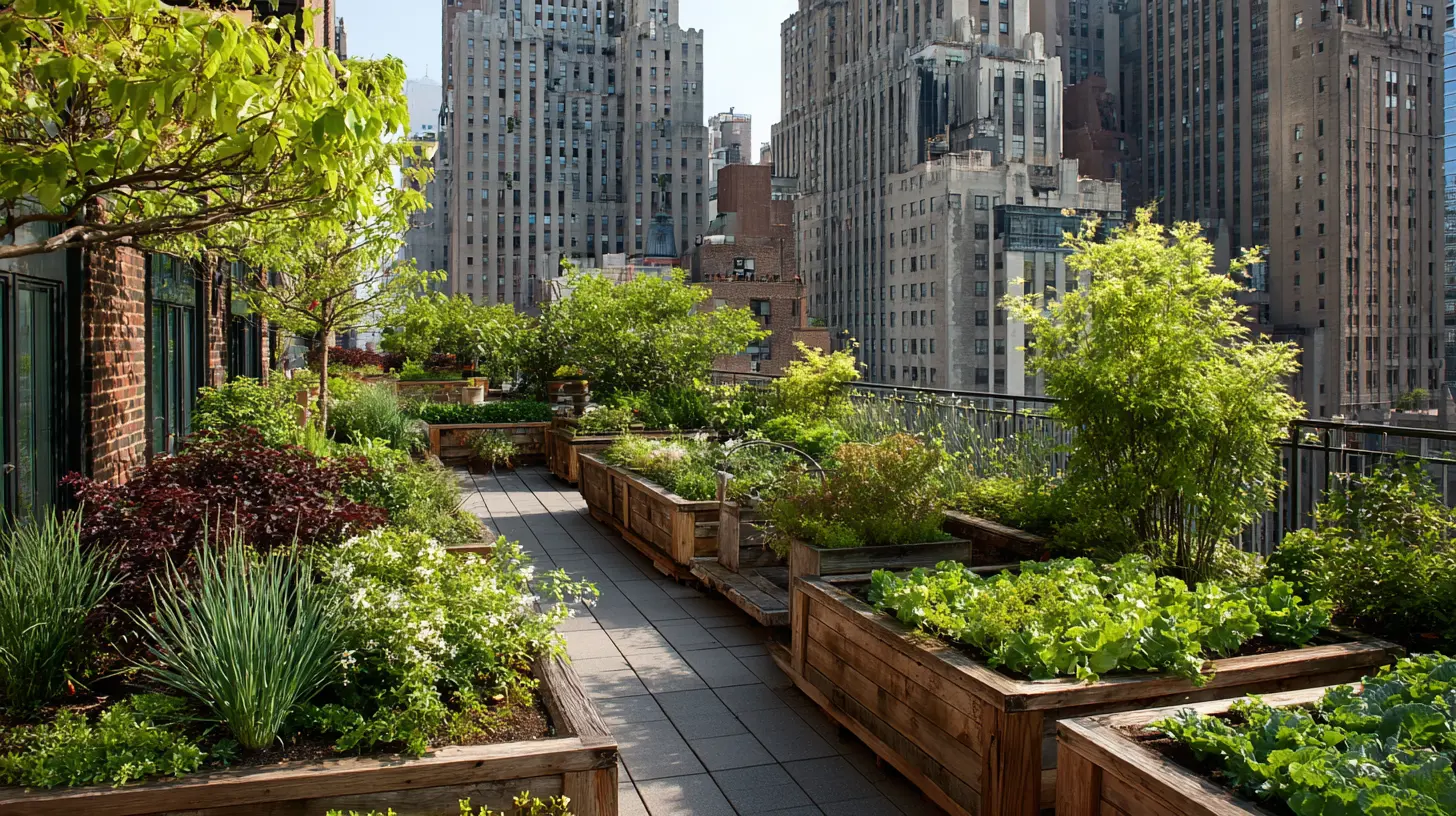
Thirty stories above street level, tomatoes ripen in the afternoon sun. Herbs perfume the air. Bees navigate between flowering plants. It's an unlikely Eden—a two-thousand-square-foot rooftop garden in the heart of downtown, where concrete and steel typically reign supreme.
"This was just tar paper and HVAC equipment three years ago," says garden coordinator Elena Martinez, gesturing across rows of raised beds bursting with vegetables. "Now it's producing food, cooling the building, creating habitat for pollinators, and giving residents a reason to know their neighbors."
Urban rooftop gardens represent more than aesthetic improvement. They're practical solutions to real urban challenges: food deserts, heat islands, stormwater management, and social isolation.
Cities can be up to 20 degrees Fahrenheit warmer than surrounding rural areas—a phenomenon called the urban heat island effect. Dark roofs absorb solar radiation, heating buildings and radiating warmth into the air.
Green roofs counter this dramatically. Vegetation and soil provide insulation, reducing building cooling costs by up to 30 percent. Evapotranspiration from plants further cools surrounding air. A study in Chicago found that widespread green roof adoption could reduce citywide temperatures by several degrees.
"It's not just about individual buildings," explains environmental engineer Dr. Raj Patel. "Green roofs create cumulative cooling effects. The more we install, the more significant the impact on urban temperatures and air quality."
Many rooftop gardens focus on food production, addressing urban food access issues while reducing transportation emissions associated with bringing produce into cities.
The Brooklyn Grange operates 2.5 acres of rooftop farms in New York City, producing over 100,000 pounds of vegetables annually. Their model demonstrates commercial viability—rooftop farms can generate significant revenue while providing fresh produce to urban neighborhoods.
"We're not going to replace industrial agriculture," says Brooklyn Grange founder Ben Flanner. "But we can supplement urban food systems, provide educational opportunities, and demonstrate that cities can be productive landscapes, not just consumptive ones."
Smaller gardens achieve similar goals on more modest scales. Residents grow food for personal consumption, donate surplus to food banks, and rediscover skills that urbanization had nearly eradicated.
Urban flooding costs billions annually. Conventional roofs shed water rapidly, overwhelming storm sewer systems and causing overflow that pollutes waterways.
Green roofs absorb substantial rainfall, releasing it gradually through evapotranspiration. A typical green roof retains 50-90 percent of precipitation, significantly reducing stormwater runoff.
"From a municipal infrastructure perspective, green roofs are incredibly valuable," notes city planner Sandra Chen. "They reduce strain on aging sewer systems, decrease flooding, and filter pollutants before water reaches rivers and streams. The return on investment, particularly in flood-prone areas, is substantial."
Cities aren't ecological wastelands, but habitat is scarce and fragmented. Rooftop gardens create stepping stones for urban wildlife, particularly pollinators whose populations have declined precipitously.
Research from the University of Toronto found that green roofs support significant insect diversity, including rare species. Birds use rooftop gardens as rest stops during migration. Even plants themselves show surprising adaptation to rooftop conditions.
"We're creating habitat where none existed," says urban ecologist Dr. Marie Nguyen. "Yes, it's artificial. But it's functional habitat supporting real biodiversity in otherwise hostile environments."
Some gardens specifically design for wildlife, incorporating native plants, brush piles, and water features. Others focus on food production but still support pollinators through diverse flowering plants.
Perhaps the most unexpected benefit is social. Rooftop gardens become community gathering spaces, fostering connections in buildings where residents might otherwise never interact.
"I lived here three years before we started the garden and knew maybe two neighbors," says resident Thomas Wright. "Now I know everyone in the building. We garden together, share meals, help each other out. The garden created community that didn't exist before."
Garden plots provide shared purpose. Residents work collaboratively, share knowledge, celebrate harvests together. Regular workdays and social events maintain momentum and connection.
For families with children, rooftop gardens offer rare urban opportunities for kids to grow food, learn about ecology, and play outdoors safely.
Despite benefits, barriers exist. Rooftop gardens require structural assessment—not all roofs can support additional weight. Installation costs can be significant, though long-term savings on cooling and stormwater management often justify initial investment.
Many cities now offer incentives. Toronto mandates green roofs on new buildings above a certain size. San Francisco provides rebates for green roof installation. Washington DC's RiverSmart program funds residential green roof projects.
"Policy matters enormously," says Sandra Chen. "When cities require or incentivize green roofs, adoption increases dramatically. When it's optional and expensive, it remains niche."
Some municipalities are retrofitting public buildings with green roofs, demonstrating commitment and gathering data on performance and benefits.
Successful rooftop gardens require thoughtful design. Structural capacity determines weight limits, influencing soil depth and plant selection. Irrigation systems must account for faster drainage and higher evaporation rates. Wind exposure at height requires windbreaks and careful plant selection.
Many rooftop gardens use modular systems—lightweight trays filled with growing medium that can be easily installed and maintained. These systems simplify retrofits while providing flexibility to redesign layouts as needs change.
"There's no one-size-fits-all solution," notes landscape architect David Kim. "Every rooftop has unique conditions—sun exposure, wind, weight capacity, access. Design must respond to those specifics while meeting users' goals."
Like any garden, rooftop gardens require maintenance. Unlike ground-level gardens, access can be challenging. Elevators may restrict moving supplies. Rooftop conditions—intense sun, wind, temperature extremes—create demanding growing environments.
Successful projects establish clear maintenance responsibilities. Some use paid coordinators. Others operate on volunteer models. Many combine approaches—core volunteers handle regular tasks while paid staff manage technical maintenance and coordinate activities.
" isn't just environmental—it's organizational," Elena Martinez emphasizes. "Gardens fail when maintenance responsibilities aren't clear or when enthusiasm fades. Successful gardens have systems ensuring continuity regardless of individual involvement."
Rooftop gardens are part of a broader urban agriculture movement including community gardens, urban farms, vertical farms, and edible landscaping. Together, these approaches reimagine cities as productive landscapes rather than purely consumptive ones.
is evolving. Hydroponic and aquaponic systems increase yields in limited space. Smart sensors optimize irrigation. Selective breeding develops cultivars suited to rooftop conditions.
"We're still learning what's possible," says Ben Flanner. "Every year we push boundaries—growing in harsher conditions, increasing yields, extending seasons. The potential for urban agriculture is much greater than we initially imagined."
For those inspired to start rooftop gardens, begin with assessment. Consult structural engineers to determine weight capacity. Check building codes and obtain necessary permissions. Connect with experienced rooftop gardeners for advice.
Start small. A few containers can demonstrate feasibility before committing to larger installations. Native plants adapted to local conditions require less maintenance than exotic species.
"Don't let perfect be the enemy of good," advises Elena Martinez. "Start with something manageable. Learn as you go. Expand gradually. The best rooftop garden is one that actually gets built and maintained, not the most ambitious one that never happens."
As climate change intensifies urban heat, as cities struggle with stormwater management, as communities seek connection in increasingly isolating environments, rooftop gardens offer elegant solutions. They're not panaceas, but they're meaningful responses to real problems.
Standing on Elena Martinez's rooftop as evening settles over the city, the contrast is striking. Below, traffic rushes, sirens wail, lights glare. Here, crickets chirp, plants rustle in the breeze, the air smells of herbs and earth. It's not wilderness, not suburb, but something distinct—a hybrid space where nature and city coexist.
"People ask if it's worth the effort," Elena says, harvesting basil for dinner. "I think that's the wrong question. The question is: how do we want to live? Do we accept cities as concrete deserts, or do we create spaces that support life—human life, plant life, insect life? For me, the answer is obvious."
As she speaks, a hummingbird visits nearby flowers, brilliant in the fading light. Thirty stories up, life finds a way.