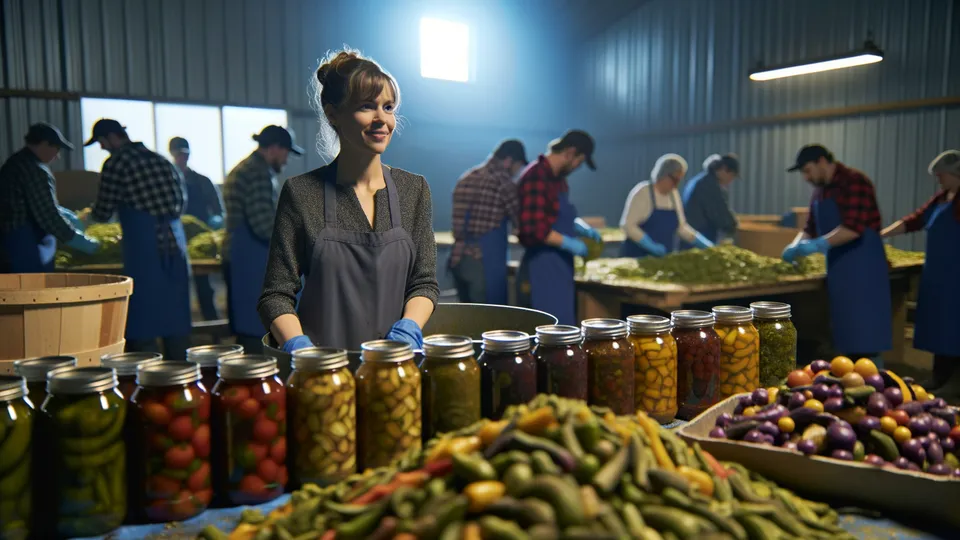
On an early September morning the Assiniboine River runs low and glassy, and the renovated brick building on 10th Street hums with the kind of ordered industry more often found in larger cities. Inside, crates of misshapen carrots and apples—too small or too bruise-marked for the grocery shelf—are being sorted, washed, and coaxed into a second life: soups, preserves, and vacuum-packed vegetables that will feed seniors, school kids, and newcomers across Westman.
At the center of this activity is Maya Leclerc, a thirty-seven-year-old entrepreneur whose hands still bear the faint staining of beet and berry seasons. She grew up visiting her grandmother’s root cellar in a small farm town west of Brandon, learning the rituals of canning and preserving. Those domestic skills became a kind of cultural capital when, after a decade in food distribution in larger provinces, she returned home to reckon with the visible paradox: abundant harvests and empty plates in the same county.
"I remember standing at a fall market, seeing the season’s best on one table and food boxes outside centres on the other," Leclerc says. "It felt like a design problem—one we could solve with humility and hard work, not slogans."
PrairieLoop, the nonprofit social enterprise she founded in 2019, is that answer. Operating from a modest processing kitchen downtown, the organization buys imperfect or surplus fruits and vegetables from dozens of family farms across Westman—Carberry, Rivers, Oak Lake—and through a network of gleaners. That produce is transformed on-site into shelf-stable or frozen products that fill community fridges, school meal programs, and farmer’s market stalls. The real isn't proprietary ; it's a local supply chain and labor model reframed to reflect human needs.
Leclerc’s approach is quietly practical. Instead of trying to outcompete the grocery sector, PrairieLoop positions itself as the connective tissue between harvest and household. They invested in low-cost vacuum-packing machines, a small blast chiller, and training programs. Local high school culinary classes rotate through the kitchen for hands-on modules. More consequentially, PrairieLoop employs people who often fall through conventional hiring nets—newcomers navigating English as a second language, young people who left school, and survivors of addiction seeking structured work.
"This place gave me a job where someone believed I could learn things I’d never tried before," says Miguel Perez, a refugee from Central America who arrived two years ago. He now leads the packing line. "We talk about recipes, about our kids’ lunches—work becomes our place to land."
The statistics matter because they anchor the project’s claims. In its third year PrairieLoop rescues roughly 10 to 12 tonnes of produce per season—enough, by the group's estimate, to produce upwards of 20,000 meals distributed through partner agencies and sale tables. Thirty percent of the labor roster is newcomers, and a similar proportion are youth under 25. These are not vanity metrics; they are measures of neighborhood stability. Seniors who live alone report eating more nutritiously when regular deliveries arrive. Parents whose shifts make evening cooking difficult have reliable, healthy options for their children.
Brandon's small downtown benefits too. PrairieLoop occupies a formerly vacant storefront, paying municipal taxes and bringing foot traffic to a stretch that had been losing renters. But Leclerc is careful to reject profit-centric narratives: financial is pursued so the social mission can persist. Funding arrives through a mixture of product sales, municipal contracts for school meal supplements, and small grants. The enterprise has had to learn tight stewardship—navigating food safety regulations, refrigeration costs, and seasonal variability—lessons that have shaped a pragmatic growth plan.
That plan is quietly ambitious. Leclerc envisions a distributed model across Westman: multiple micro-kitchens close to clusters of farms, connected by a modest cold chain and shared logistics. Each site would be small, locally managed, and incubate local leaders. She's also experimenting with solar-assisted drying and passive-cooling solutions to lower energy costs, consulting informally with researchers at the regional university on low-tech preservation techniques suited to prairie climates.
The social contours of the project are as integral as the kitchen equipment. PrairieLoop’s training program offers credentialed food-handling certificates, English-language coaching, and subsidized childcare for staff. "We try to remove as many non-essential barriers as possible," Leclerc explains. "Work is dignity—and it should be accessible."
There are tensions. Scaling runs up against perishable supply, regulatory complexity, and the fickle economics of food. The market for affordable, processed local food is uneven; consumer education remains a constant task. But what keeps Leclerc and her small team moving forward is not certitude about scaling but a series of modest, observable impacts: a woman delivering meals to her elderly father; a teenager discovering confidence on the packing line; a small farm that now sells fruit that previously went unharvested.
In the end PrairieLoop's story reframes innovation as patient craft rather than flashy disruption. Its work suggests that resilience in Westman will grow not from a single technological breakthrough, but from networks—of farms, kitchens, schools, and people—tied together by practical care. "We’re learning how to be useful," Leclerc says. "If we do that, the rest follows."
Outside, the river ripples and the downtown bus unloads students bound for campus. Inside the kitchen, the next crate is unsealed, and another season’s harvest is slowly becoming the connective tissue of a community learning how to feed itself better.