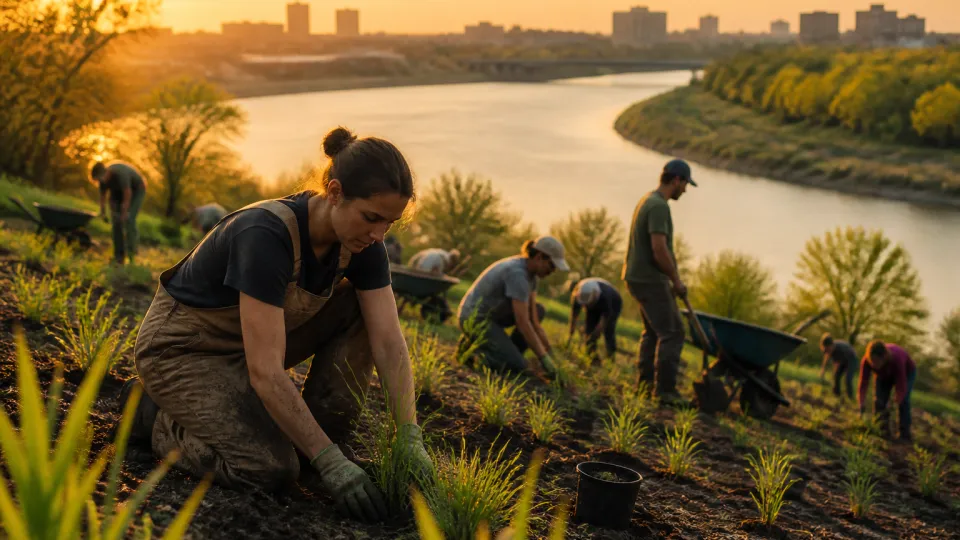
The morning the festival opened, the Assiniboine moved like a patient animal, both familiar and newly inscrutable. Volunteers in muddy boots pushed wheelbarrows of native-plug grasses toward a sloped bank while a group from Brandon University unrolled maps and soil cores under a pop-up tent. It was the kind of scene that could have been the subject of a dry policy brief — technical, procedural, necessary. Instead, River Resilience Week, the city’s first sustained cultural event focused on , folded those facts into stories: of a floodplain that remembers, of farmers learning new rhythms, of teenagers discovering the joy of seedlings.
The festival was born of a blunt local truth. In recent years Westman communities have felt the twin pressures of changing weather and intensified agriculture: longer dry spells punctuated by sudden, heavy spring melt and storms. These shifts have altered how water moves across the prairie and how people — inevitably — respond. Organizers described the week as equal parts repair and rehearsal: restoring wetlands and riverbanks to slow water, while rehearsing community-level responses that stitch conservation expertise back into everyday life.
"We wanted to get beyond slide decks," said an organizer from a civic environmental collective. "People need to see, touch and argue about what's possible. They need to know it can be done here." That mix of technical competence and civic conversation defined the event. One afternoon a workshop on riparian buffers ran side-by-side with a storytelling circle where older residents recounted spring trips to the river, recollections that often contained practical memory: where the willow always took root, which low meadow held water longest. Those stories mattered; they became local data.
Concrete interventions provided tangible examples. On a low-lying field reclaimed from seasonal flooding, a group of farmers demonstrated a three-pronged approach: contour swales to slow runoff, cover-crop mixes to hold soil and increase organic matter, and a small constructed wetland to act as a temporary reservoir and filtration system. A fourth-generation grain farmer who has shifted gradually to reduced tillage told a packed tent, "We used to think ditches were wasted land. Now they're part of the farm's water system. It costs time to change, but it saves soil and opens new habitat for birds."
Brandon University students and faculty contributed research that was quietly practical. A team from an environmental science lab shared soil-carbon sampling results from paired plots: adjacent conventional and regenerative systems on local fields. The regenerative plots, which included continuous cover and diversified rotations, showed incremental increases in organic matter and moisture retention — small numbers with outsized meaning in a region where every inch of water can determine yield. "You don't need miracles," said a graduate student during a Q&A. "You need incremental practices stacked over time." The audience — a mix of farmers, municipal staff and young people — took notes.
Nature and culture met in the community garden projects. Schoolchildren planted native wildflowers along an interpretive path built by local carpenters and elders. Each plant was labeled with its role: pollinator magnet, bank stabilizer, or drought-hardy survivor. The labels read like a curriculum for stewardship and, in afternoon sunlight, a group of teenagers debated the merits of prairie grasses versus berries with the intensity of seasoned planners.
Beyond practices, the festival underscored governance and equity. Panels explored how municipal codes and provincial funding can either entrench vulnerability or enable adaptation. A memorable session featured a municipal planner and a homeowner from a flood-impacted neighbourhood speaking in tandem: the planner detailed zoning changes designed to discourage risky rebuilds, while the homeowner talked about the emotional labor of deciding whether to leave a long-held property. "Policy without people isn't policy," she said. "You have to meet neighbours where they are."
The impact of the week was less about dramatic headlines than about the slow accretion of capacity. A local cooperative announced plans to pilot a shared equipment pool for cover-crop seeding; a school board committed to integrating watershed science into its grades 6–12 curriculum; a small grants program was set aside to support wetland restoration on private lands. These moves are modest in isolation but suggest the festival achieved its most important aim: moving conversations from abstraction to specific commitments.
As dusk settled over the river on the final night, a small group lingered by a newly planted bank. Someone recited a memory of a flood that was both frightening and formative, and another person, a teacher, spoke about how students now asked less about 'saving the planet' and more about 'how we keep our town safe.' The shift is telling: sustainability here is less a moral abstraction than a civic practice anchored in work, memory and the shared landscape.
River Resilience Week did not promise simple fixes. It did, however, model a kind of localism that is both ambitious and humble: applying science to prairie realities, listening to lived experience, and building institutions that allow neighbors to act together. If the Assiniboine is a teacher, Brandon's community is learning to take notes — not to romanticize the past, but to translate prairie logic into the long work of making a place that can withstand its own weather.
The question now is scaling what worked: from a week of workshops and plantings to year-round policy, shared infrastructure and an education pipeline that ensures the next generation can steward both soil and community. If this festival proved anything, it is that adaptation in Westman will be less about lone innovations and more about the social scaffolding that sustains them.
In the end, the river keeps on teaching. The community's task is to keep listening — and to act in ways that future Brandon residents will call ordinary, because they learned to be resilient together.