The morning light over Brandon cut through glass at the Keystone Centre like a question. Farmers arriving from quarter-sections of brown earth carried the same, familiar load of optimism and worry—boots still streaked with the winter’s last melt, eyes quick to size up a new gadget or a neighbor’s idea. Westman Ag Days, convened over two days last week, felt less like a trade show than a town meeting: a place to hold forward-facing tools up against lived experience and ask what works here and now.
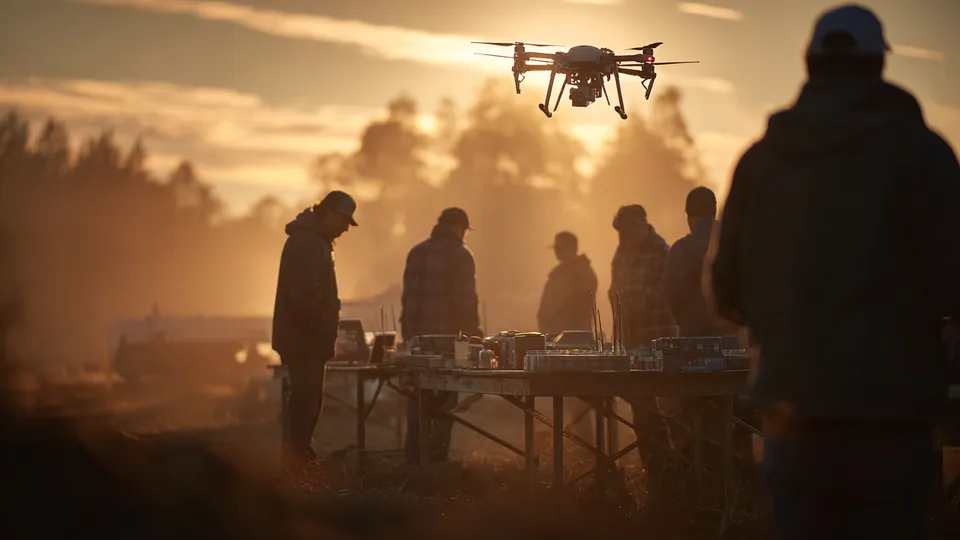
What made the event feel alive was how tangible the conversation was. In one corner, a farmer named Evelyn Peters—third-generation, operating mixed grain near Rivers—unpacked a drone she’d borrowed from a local co-op. “It’s not about having the fanciest kit,” she said, hands steady on the carbon-fiber arms, “it’s about getting after pest pressure earlier, and not throwing fertilizer at fields just because we did last year.” Peters described how a single aerial pass last season identified a localized nitrogen deficiency; the targeted fix, she estimated, saved both input cost and yield decline.
Elsewhere, a group from Assiniboine College guided high-school students through a soil health demonstration. They passed around cores of earth—dark, granular loam that smelled faintly of roots—and explained how microbial life and carbon content are now part of routine conversation in farm shops. New portable sensors that estimate organic matter and electrical conductivity drew a steady crowd. For many attendees, the attraction was not novelty but agency: tools that translate the invisible work of soil into numbers farmers can use.
The showground’s rows of exhibitors reflected a pragmatic, hybrid approach. Precision seeding controllers and RTK-GPS guidance systems sat next to booths offering training in cover-crop mixes, nutrient recovery from manure and community-based equipment sharing models. Startups pitched subscription software that turns satellite imagery into field-level prescriptions, while older co-ops demonstrated how they amortize the cost of expensive harvesters and sprayers across members. The theme was less about replacing tradition than about making stewardship more resilient, more measurable, and less risky.
Conversations often circled back to the economics of adoption. Capital costs remain the hurdle for many family farms. “There’s a gap between knowing something will work on paper and being able to afford it,” said Jason Miller, 27, who returned recently to his family’s mixed grain operation near Carberry. He and several peers described using phased adoption—renting drone time for a season, then moving to co-op ownership of guidance systems—to bridge that gap. Local lenders and a handful of provincial programs were cited as helpful, but attendees also made clear that peer networks and hands-on demonstrations were the real accelerants.
Beyond efficiency, attendees articulated a different metric of success: community resilience. A recurring thread was the role of shared knowledge. Older farmers who had weathered droughts and market shifts offered counterpoints to technocratic optimism, insisting that software must be built with a farmer’s season in mind. Youth participants brought urgency about climate risks and interest in regenerative practices. A roundtable on policy and practice produced a blunt exchange: researchers seek field-scale data; farmers need incentives that reward long-term soil care, not just short-term yield.
The presence of researchers and extension specialists made the event both granular and hopeful. One session showcased a pilot that couples yield-mapping with soil-carbon baselines, aiming to quantify the payback from no-till and diverse rotations. Another demonstration featured on-farm nutrient recovery technologies that aim to capture phosphorus from lagoon systems—small-scale solutions that could have outsized effects on water quality downstream.
There were limits. Broadband gaps peppered conversations like potholes. Digital tools assume constant connectivity; many westman townships still struggle to upload a single large imagery file. And there were candid admissions that not every innovation sits neatly within a seventy-year-old farm business plan.
If the event’s most lasting image was a drone’s shadow moving over a field, its truest impression was more human: neighbors swapping soil cores at a folding table, an elderly farmer laughing as a teenager explained a new app, a student taking notes with the seriousness of someone making future plans. The incremental, often messy work of adoption—testing, failing, and adapting—felt less like a race and more like a communal project.
Looking ahead, the stakes are local and systemic. Innovations showcased in Brandon promise to shave risk, lower inputs and open pathways for younger farmers; they also demand policy that aligns incentives with long-term land health and investment in rural infrastructure. For Westman, the transition will be uneven, shaped by credit access, community networks and a willingness to trade some short-term certainty for resilience.
On the last afternoon, as attendees folded tents and traded business cards, Peters paused with a small notebook where she’d sketched planting patterns and treatment zones. “We used to think progress came from bigger machines,” she said. “Now it’s about seeing the field differently—and doing it together.” The lesson at the heart of Westman Ag Innovation Days wasn’t that technology alone will save prairie livelihoods. It was that when soil, sensors and community converge, they create a practical optimism rooted in place, practice and people.