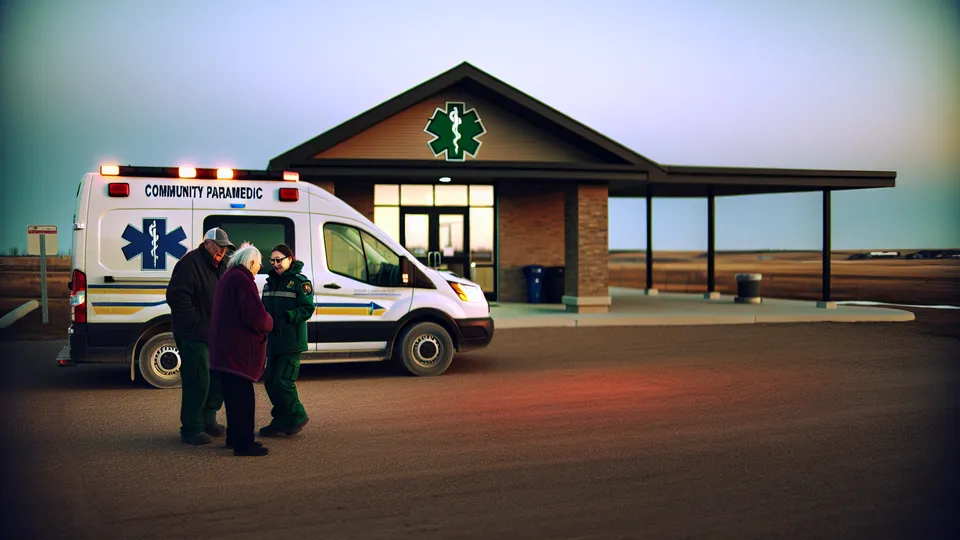
Evelyn still remembers the night the ambulance couldn't make it down her gravel lane. It was late, a wind that seems to come from everywhere in Westman, and the pain in her hip had become impossible to ignore. Instead of a siren and the rattle of gurneys, a yellow pickup rolled up with a community paramedic and a nurse from the nearest clinic. They carried a folding stretcher, a warming blanket, and a calm that turned the night into something manageable.
'They sat with me, gave me a shot for the pain, and called the hospital to arrange a bed the next morning,' Evelyn said. 'If they hadn't come, I don't know what would have happened.'
This scene is becoming less exceptional and more emblematic across the Westman region. In Brandon and its satellite towns—Carberry, Virden, Neepawa—healthcare is being reoriented around place and people. It is a practical redesign, not driven by lofty policy statements, but by nurses, paramedics, physicians, Indigenous organizations, and volunteers who are assembling services where people actually live.
At the center of that work in Brandon is a pragmatic network: the Brandon Regional Health Centre, Prairie Mountain Health's community outreach teams, the local Friendship Centre, and the training programs at Assiniboine Community College. Each brings different expertise: acute care, chronic disease management, Indigenous cultural supports, and a steady pipeline of students learning the art of rural practice.
One of the most visible developments is community paramedicine. Where ambulances used to be a one-way vehicle to the emergency department, paramedics now make scheduled home visits, check medication compliance, monitor chronic conditions, and act as a bridge to primary care. 'Paramedics see the whole person—the home, the supports, the challenges,' said Samir, a community paramedic who covers a wide swathe of Westman. 'Sometimes a hot meal and a medication review keep someone out of the ER for months.'
Telehealth has also come into its own. During the pandemic, video consults were an emergency fix; now they are an everyday tool. A specialist in Winnipeg will connect with a patient in Brandon while a nurse at the local clinic facilitates the visit, translating medical language and local context. For families balancing work, children, and travel across long prairie distances, the convenience is transformative.
Still, is not the whole story. Cultural and social supports matter just as much. The Brandon Friendship Centre has expanded culturally based programming for Indigenous patients, integrating elders and community health representatives into care planning. 'Trust is built slowly,' said an elder who works with the centre. 'When you see your own stories reflected in care, you are more likely to follow through.'
Volunteers and community groups are quietly filling gaps. A community-run transport program now operates out of Neepawa, ferrying seniors to appointments. Local churches and service clubs have set up accompaniment programs for new mothers navigating postpartum care. These are low-cost, high-impact interventions that often dodge the glare of official metrics but change daily life.
Education and workforce development are where the future is being shaped. Assiniboine Community College's applied programs place nursing and paramedicine students in rural rotations, exposing them to the complexity and rewards of Westman practice. Program coordinators say students who train in rural settings are far more likely to stay. 'We're training people to care in context,' said Claire, a nurse educator. 'That means teaching them how to build relationships, coordinate resources, and improvise when the system hasn't caught up yet.'
Challenges remain. Recruitment and retention of physicians, persistent underfunding, and the realities of long winters that complicate travel are not solved by goodwill alone. Nor can technology replace the need for hands-on care or culturally safe services. But the patchwork of initiatives has begun to align around a simple ethic: care should meet people where they are.
What makes Westman's approach noteworthy is its improvisational layer—small programs learning from one another and scaling what works. Clinics share protocols for home visits; paramedics coordinate with social workers; the Friendship Centre coaches hospital staff on cultural safety. These are incremental changes, but they compound when they become expectations instead of exceptions.
For Evelyn, the changes mean more than convenience. 'I feel like someone is keeping an eye on me now,' she said. 'It's not just medicine—it's someone who knows my name.'
If the next phase is to be sustainable, local leaders say funding models must catch up to the on-the-ground reality: integrated teams, flexible reimbursement for home-based care, and investments in rural training. The moral case is clear; the practical case is beginning to be documented by fewer ER visits, shorter hospital stays, and, most importantly, stories like Evelyn's.
In Westman, care is becoming less about a distant institution and more about the neighborhood, the clinic, and the paramedic who arrives in a pickup. That shift is quietly reshaping what health systems do—one home visit at a time—offering a small but durable lesson for other rural regions: when the system bends toward people, it changes how people live.