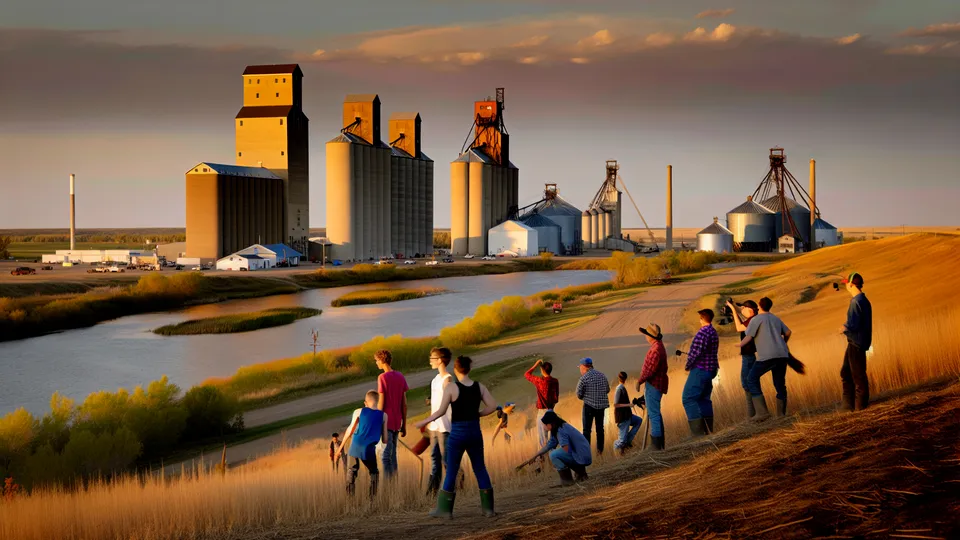
The broad prairie that frames Brandon and the greater Westman region carries traces of arrival and reinvention. Wooden grain elevators once punctuated the skyline like a ledger of seasons; the Canadian Pacific Railway’s arrival in the 1880s transposed Indigenous trade routes and oral geographies into a new map of commerce and settlement. Those early choices—where tracks were laid, where mills and markets clustered—did more than create towns. They set patterns of work, care, and belonging that communities are still negotiating today.
To tell Westman’s story is to attend to the ordinary infrastructure of everyday life: hospital wings expanded in quiet increments, a community college adding a nursing program in response to a regional need, a university that drew young people who then stayed to teach, to farm, to build businesses. Brandon’s identity as the “Wheat City” is not mere nostalgia. For decades, grain elevators and a relentless focus on commodity agriculture dominated both local economies and civic imagination. But that narrative understates the region’s capacity for adaptation—an attribute that has become essential in an era defined by climate variability, shifting markets, and demographic change.
There is a human scale to that adaptation. On a late-summer morning outside Rivers, a third-generation farmer, who asked to be identified only as Tom, described how his family moved from monoculture wheat fields to a diversified operation that now includes pulses, canola, and a small processing line for artisanal oatmeal. "You don’t plant the same crop every year and expect the same return," he said. "The land asks for rotation; the markets demand agility." Tom’s story echoes through small towns where co-operatives, contract processors, and value-added initiatives have emerged precisely because the old economics of bulk grain can’t, alone, sustain communities.
Education and healthcare have played a parallel role in anchoring Westman. Brandon University—born from earlier denominational colleges and reconstituted in the 1960s—became more than an academic institution; it’s a civic engine. Students bring new ideas, and local programs in Indigenous studies, environmental science, and rural health reflect a region rethinking its responsibilities to place. Assiniboine Community College and other training centres expanded practical programs tied to contemporary needs—ag-tech, elder care, and logistics—giving local employers talent without forcing young people to move to Winnipeg or Regina.
Health services have been a particular crucible for the region’s future. Rural hospitals and clinics weather workforce shortages, but they also incubate innovations: telehealth initiatives, cross-community staffing models, and nurse-led clinics. A nurse manager at a Brandon clinic noted that while recruitment remains a challenge, the pandemic accelerated collaboration between city and rural providers in ways that promise longer-term gains in access and continuity of care.
Indigenous presence and partnership are central to any honest history of Westman. The prairie is on the traditional territories and treaties involving Anishinaabe, Dakota, and Métis peoples. Recent years have seen more formal collaborations around land stewardship, education, and cultural revitalization. In towns where treaty histories are taught alongside settler histories, civic conversations change—policy and practice become more attentive to stewardship, reconciliation, and shared economic development.
Yet vulnerability remains part of the landscape. Small towns have lost grocery stores and banks; population decline in some rural municipalities is an ongoing reality. Extreme weather—and the anxiety it brings—changes how farmers, municipal leaders, and families plan for the next season. Still, where decline has threatened, community actors have often turned to novel solutions: municipal broadband projects to retain remote workers; heritage tourism focused on agricultural history; local food hubs connecting producers directly to restaurants in Brandon and beyond.
The region’s future will be neither a return to a single old model nor a wholesale break with the past. It will be an accretion of small, pragmatic experiments that bind history to possibility. That work requires institutions that can translate local knowledge into scale—universities incubating startups in agri-, health centres collaborating with home-care networks, Indigenous-led enterprises that reframe land use around ecological priorities.
In the end, Westman’s story is not about one dramatic turning point but about an ethic of stewardship embedded in farms, classrooms, and hospital corridors. There is a particular courage in choosing to stay and remake, to take the inherited rhythms of rail and harvest and bend them toward a more resilient region. "We don’t romanticize the past here," a longtime teacher in Brandon observed. "But we do remember it—and we use what we remember to argue about what comes next." Those arguments, measured and often pragmatic, will determine whether Westman’s next chapter is one of quiet decline or creative renewal—one community at a time.
Whatever the outcome, the stakes are human: the livelihoods of families who have tilled the soil for generations, the cultural continuity of Indigenous nations, the opportunities young people seek without leaving, and the care networks that keep an aging population safe. In a changing prairie, that human scale is the true measure of success.