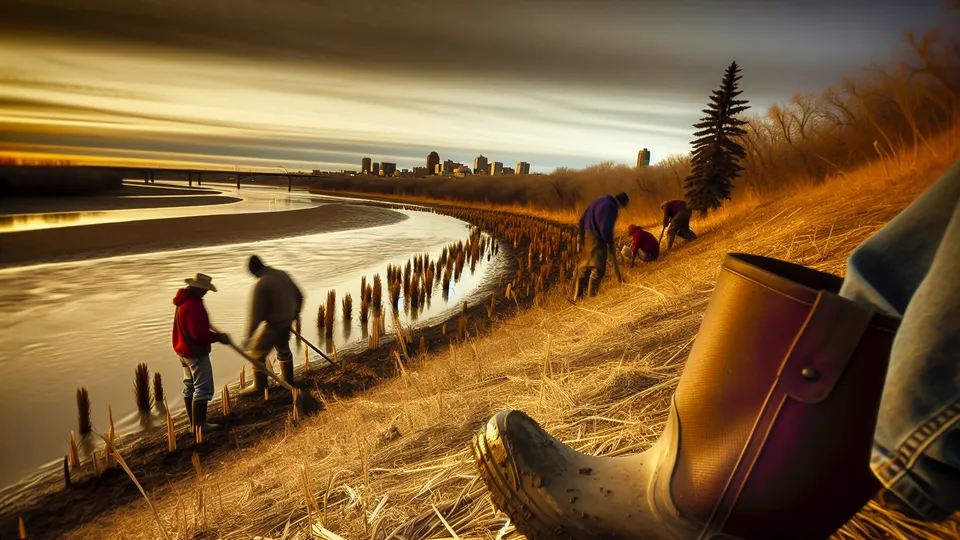
At first light the Assiniboine looks indifferent to the work unfolding on its banks: a broad, slow current carrying last night's rain, a few gulls quarrelling over a discarded pop bottle. But the people kneeling in the mud think otherwise. They are threading willow stakes into the eroded lip of the river, pressing them into place with practiced hands, and talking about winter floods as if discussing an old neighbor's habits—something to be understood, negotiated with, and sometimes persuaded to change.
"This place saved my father's farm once," says Maya Singh, a schoolteacher who helped organize the volunteer crew. "If we lose the riverbank, we lose the memory of how this valley works. And then you lose the people who can make a life here." Her voice is steady but worn; she has spent several springs waking before dawn to map gullies and record the migration of geese. "It started with a few of us meeting in a coffee shop. Now farmers are calling to ask where to plant buffers. Students are showing up with waders. It has become contagious."
What is contagious in Brandon is a practical form of stewardship that eschews slogan and ceremony. Over the last five years, a loose coalition of neighbours, university researchers and farmers has moved from conversation into coordinated action: stabilizing eroded river banks with live fascines and native grasses, restoring wetlands that once absorbed floodwaters, and experimenting with cover crops and reduced tillage on working fields to hold soil where it belongs. Each initiative responds to a specific local problem—erosion after an unusually wet spring, sediment-choked backwaters, declining waterfowl habitat—but together they form a mosaic of resilience.
Tom Levesque, whose family has farmed near Brandon for three generations, remembers the spring of 2014 when his low-lying hayfields sat under a sea of water for months. "We lost seed, we lost ground," he says. "You can't just keep doing what you always did and hope the river cooperates." Tom began planting rye and clover after harvest to keep the soil anchored. He converted a narrow strip between his crop land and a drainage ditch into a buffer of native sedges and willows—at first a personal hedge against loss, but now a demonstration plot. Neighbours come by to ask about costs and yields. "The yield dip was small," he notes, "and we've seen fewer weed problems and better moisture retention." More importantly, he says, the buffer has cut the visible runoff after heavy rains.
Researchers at Brandon University and Assiniboine Community College have partnered with farmers like Tom to put data behind the anecdotes. Dr. Emily Carter, an ecologist at the university, has been sampling water and soil along stretches of river where volunteers and landowners have intervened. "We're seeing measurable reductions in turbidity and nutrient spikes downstream of restored wetlands," she explains. "It suggests that these relatively low-cost, locally led efforts make a cumulative difference to water quality—particularly during spring melt events when the system is most stressed."
Equally notable is how the work reframes who belongs in environmental decision-making. Retirees who once tested grain, teenage volunteers, Métis elders who teach traditional planting, and municipal staff have all found shared tasks and language. At a community meeting last winter the conversation turned to food waste: if the town could divert kitchen scraps, could compost support municipal parks and community gardens, reducing landfill emissions and improving soil in public spaces? A pilot program now collects food waste from a cluster of neighbourhoods and inoculates failing patches of green space with rich, dark compost. "We were skeptical at first," admits municipal parks manager Lucas Fontaine. "But after one season, the lawn along 6th Street is greener and kids are actually harvesting beans from the community plot."
There are limits and trade-offs. Some landowners are reluctant to change practices that have been economically reliable for decades. Grant programs are competitive and unpredictable. And while local initiatives have blunted certain impacts—sediment pulses, habitat loss—they cannot alone rewrite broader climatic trends that bring erratic precipitation and extreme warmth in seasons that used to be stable.
Still, the character of the response matters. In place of top-down mandates or fatalistic resignation, Brandon's environmental work has embodied a patient, iterative approach: small experiments, careful observation, and the slow spread of techniques that respect both livelihoods and ecology. "We don't pretend to have solved the river," Maya says, watching volunteers pack up for the day. "But we are learning to listen, and to build with what we have."
Looking ahead, the coalition is planning a formal network to share data and best practices across Westman, paired with educational programs to encourage the next generation to stay and steward the land. Funding remains an obstacle, but the social capital—the trust and mutual respect accrued by neighbors muddying their boots together—may be the most durable currency of all.
In a region often described by its distance from urban centers, these modest labors on the riverbank feel radical. They reclaim the idea that environmental policy can be local, human-scale, and rooted in the rhythms of a particular place. If Brandon's quieter renaissance offers any lesson beyond its floodplain, it is this: resilience grows not from grand declarations but from the steady, ordinary decisions people make when they choose to care for what holds their lives together.