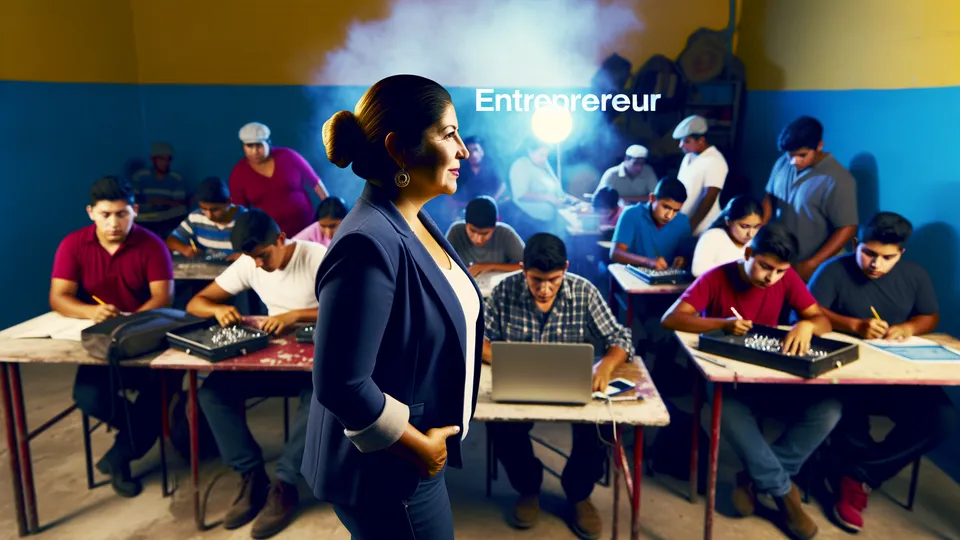
On a cool March evening, the lights of a former sewing factory on Princess Avenue throw long rectangles across a floor scuffed by decades of work. Near a bank of soldering irons and a row of laptops, Amara Redsky straightens a stack of laminated lesson plans and chats with a student about wiring diagrams. Her voice is quiet but exacting; her presence is the kind that makes a nervous person believe they can do more than they thought possible.
When Redsky founded Prairie Roots Learning Co-op in 2017, she did not set out to start a charity or a tech incubator. She wanted a place where learning could be practical, respectful of local cultures and rhythms, and directly connected to the businesses that sustain Westman. More than five years later, the co-op runs after-school coding classes for children, micro-credentials in solar installation and carpentry, adult literacy sessions, and a mentorship program that pairs elders with youth to teach traditional land-based knowledge alongside modern trades skills.
"Education in this region has often been a one-size-fits-all package that asks people to fit into distant systems," Redsky told me, folding her hands over a ceramic mug. "What we try to do is start from where people are—with their stories, their strengths—and build from there. That gives learning traction."
The traction shows in granular ways. Prairie Roots has worked with more than 600 unique learners since its founding and provided over 3,000 learning encounters, from single workshops to full certification programs. Its ‘‘Circle of Skills’’ bridging program, developed in partnership with Assiniboine College, has placed 86 adults into formal apprenticeship streams and an additional 120 into entry-level roles with local employers such as Prairie Electric and Riverbend Construction.
One participant, 28-year-old Marcus Lavoie, describes the co-op as a hinge. A single father who had been laid off from seasonal work, Marcus enrolled in a six-week solar technician course, paired with mentorship and job-search assistance. He now installs panels across the region and helps run Prairie Roots’ weekend workshops.
"I used to think I’d have to move away to find anything steady," Marcus said, folding his jacket into itself. "This program gave me skills and a place to try them out. I get to stay here, and my kid gets to grow up in the community I love. That matters."
The co-op’s approach is notable not only for outcomes but for method. Many sessions begin with a community circle—an intentional pause to share where people are at—before shifting to hands-on tasks. Elders are compensated and scheduled as instructors, not token participants. Local employers are invited to co-design curriculum so that what students learn mirrors the demands they will meet on the job. This is education practiced like civic infrastructure.
That model has required Redsky to navigate tight budgets and institutional inertia. Prairie Roots blends public grants, philanthropic donations, course fees on a sliding scale, and social-enterprise revenue from a maker’s market it runs downtown on Saturdays. "We’re constantly improvising funding so the programs remain affordable," she said, "but we’re also adamant that this work be compensated fairly—educators and elders shouldn’t be unpaid labor in the name of good will."
The co-op has also pushed at the edges of recognized credentialing. In collaboration with Brandon University, Prairie Roots is piloting a suite of micro-credentials—short, stackable certificates aimed at rural learners who cannot commit to full-degree pathways. The aim is to make those credentials portable, provincially recognized, and linked to apprenticeship hours. "Recognition matters," Redsky says. "People need credits that employers and institutions actually accept."
Beyond certificates, the co-op’s most tangible impact is relational. Local employers report reduced onboarding time and higher retention when they hire people who trained at Prairie Roots, in part because trainees arrive with contextual experience and an understanding of Westman’s work culture. Teachers and social workers speak of a new, visible optimism among learners who had long been written off by traditional systems.
Looking ahead, Redsky wants to take the co-op’s model beyond Brandon. Plans are underway for a mobile learning bus—modular workshops on wheels that can serve smaller towns and First Nations communities across Westman. She is also advocating for policy changes that would fund micro-credentials and community-based pedagogy rather than only traditional postsecondary seats.
Her ambition is not boundless expansion for its own sake; it is a careful scaling that refuses to lose the intimacy of place-based learning. "The work is small-bore and relational," she says. "We measure impact in people who stay, in jobs that sustain families, in traditions that are honored in the classroom. If we can multiply that, slowly and with care, the region changes."
In a province where out-migration and skill mismatches are perennial concerns, Prairie Roots is a quiet counterproposal: education as a practice rooted in history and responsive to contemporary need. Standing amid the hum of students soldering LEDs into place, Redsky watches as a young woman explains a wiring plan to an elder who nods and smiles. It is the kind of ordinary scene that, in the aggregate, reshapes a community.
"It’s about constellations, not pillars," she says, with a laugh that softens what could be a programmatic slogan into a lived conviction. "We are building connections—between people, skills, and place—that hold when other things shift. That’s the real work of education here."
If Prairie Roots’ next years are any indication, Brandon’s learning landscape will keep remapping itself—quietly, deliberately—around the people who stay and build on the ground.