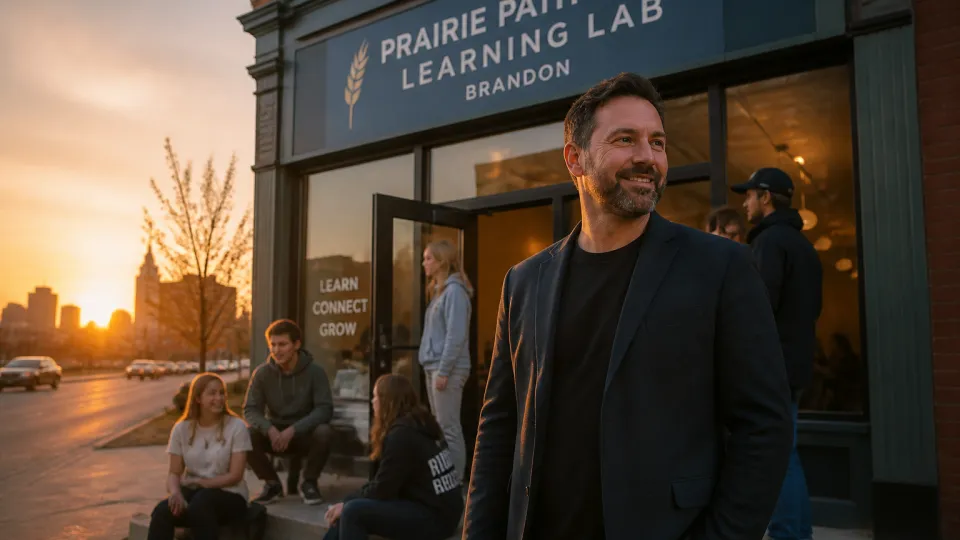
On a rain-bright Tuesday in late October, a dozen people sit elbow to elbow under strings of bare bulbs in a storefront that used to be a bakery. The room smells of coffee and ink. A woman in a wool coat leans forward to ask a question about resumes while a retired schoolteacher makes notes in the margin of a workbook. At the front, Leah Balan — cropped hair, quick smile, the sort of voice that wavers between coach and confidante — sketches a flowchart on a whiteboard and then walks the room back through it.
"Learning has to be useful first," she says, "and human second. If it's not both, people won't come." The room laughs because everyone here has been both teacher and student, employer and employee, neighbour and neighbour's helper. Prairie Pathways, the learning lab she opened four years ago, lives in that connective tissue.
Balan moved to Brandon a decade ago after stints in Winnipeg and Calgary. She had worked in adult education and workforce development, and—frustrated by how training programs often skirted the realities of small-town life—she rented the bakery and reimagined it. What started as evening classes for newcomers and high-schoolers grew into a hybrid model of evening workshops, short accredited modules, and mobile learning pop-ups that park at farmers' markets or outside the Assiniboine Community College campus.
The lab's curriculum is practical and local. One recent series paired digital-shop skills with Indigenous beadwork and design, taught in collaboration with an elder from the Sioux Valley Dakota Nation. Students learned basic e-commerce, product photography, and pricing while also spending an afternoon with the elder talking about protocols and meaning. "People arrive with skills they've always had," Balan says. "We just make space for those skills to be seen as economic and cultural capital."
That blending has real consequences. Miguel, a newcomer from Honduras, arrived in Westman with experience fixing tractors but no Canadian credentials. After a six-week hybrid course that coupled hands-on diagnostics with workplace-readiness coaching, he was hired by a local ag-tech firm testing grain-handling equipment. "Before we had him, we thought someone from away wouldn't understand our routines," the shop foreman told me. "But Miguel had the patience and the skill. Leah helped us see it differently."
Prairie Pathways does more than place people in jobs. It is a testing ground for how learning in rural regions can be reciprocal, responsive and low-barrier. The lab's micro-credential courses — often four to eight weeks long — are stackable. A participant can start with a fundamental digital literacy badge, add a customer-service module, then complete an employer-verified practicum. The certificates are intentionally modest; Balan insists they be legible to local employers. "We don't want people collecting paper," she says. "We want them collecting opportunities."
Partnerships have been essential. Brandon University and Assiniboine Community College have shared resources and guest lecturers; local businesses host practicums; municipal officials have let a mobile learning bus use civic lots for pop-up classes. Funding has been a blend of municipal grants, philanthropic gifts and small-sum contracts with employers seeking upskilled workers. The model is lean, built less on big endowments than on a web of modest, sustained commitments.
The human element often trumps any grant line. A woman named Margaret, who grew up on a nearby mixed farm, enrolled in a digital storytelling workshop because her grandson was moving west. She left with better video-editing skills and a renewed confidence to tell her family's migration story. "I thought I was too old to learn," she told me, pulling a printout of the short film she'd made. "But the class made me see my past as something other people might want to know about."
Challenges remain. Broadband access outside Brandon is inconsistent, and funding cycles can frustrate long-term planning. Balan worries about scaling without losing intimacy. "Growth often means abstraction," she said. "Our work is rooted in kitchen-table conversations. How do you do that at scale?"
Her answer is pragmatic and gradual: a networked model that trains local facilitators across Westman to run modules adapted to their towns; a digital platform with low-bandwidth features; and a continuing emphasis on cultural partnership so programs reflect local histories. She is exploring a regional apprenticeship consortium to link micro-credentials with certified trades pathways, a bridge between informal learning and formal certification.
What marks Prairie Pathways is not heroism but attentiveness. In a region often depicted as education-poor or opportunity-scarce, Balan's work insists on a different story: that rural learning can be nimble, culturally resonant, and deeply practical. The lab's measures of success, she says, are modest—"Did someone get a better job? Did they feel respected? Did a community tell its story?"—but the ripple effects are visible. Small businesses retain staff; seniors find new ways to connect; young people see local career pathways they hadn't known existed.
On a Friday afternoon the storefront fills with teenagers making flyers for a youth-led fair. Outside, the prairie light is flat and fierce. Inside, Balan moves through the room, offering a quick edit here, a phone number there. She is thinking about the next iteration: more partnerships with Indigenous-led organizations, deeper employer commitments, a regional credential recognized by Manitoba's trades boards. The ambitions are specific because the starting point has always been specific: the people who walk in the door with ordinary needs and extraordinary knowledge. In Brandon's shifting economy, that kind of focused, human-scale education might be the most consequential work of all.