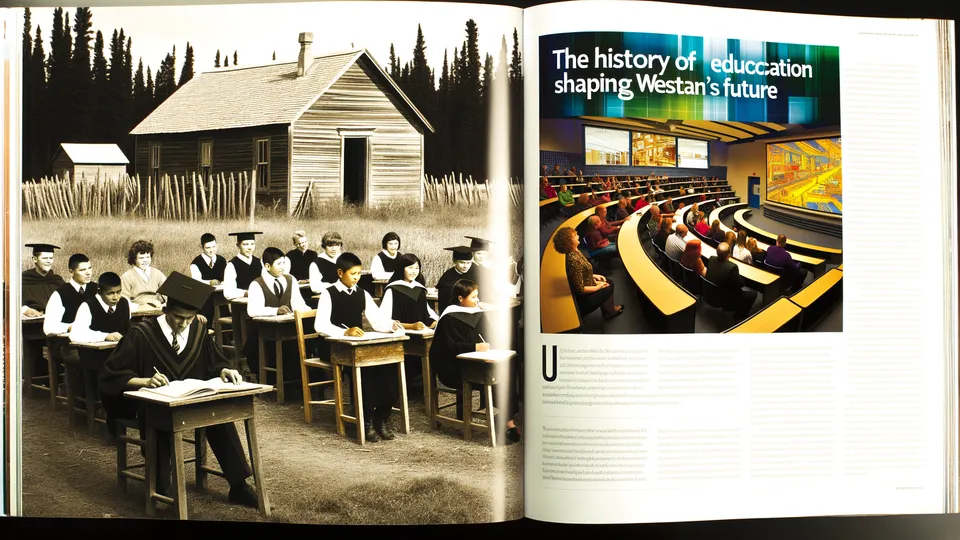
On an early September morning in Brandon, the light falls across the brick facade of a school that has taught three generations. Inside, a bulletin board holds photos of harvest-month science projects, an ESL poster in three languages, and a faded class picture from decades ago. In Westman, schools have always been repositories of memory — places where farming calendars and immigrant languages, Indigenous traditions and vocational instruction intersect. To understand the region today is to read its classrooms.
The story of education in the Westman region is at once practical and intimate. When settlers arrived on this portion of the prairie, building a schoolhouse was often a 's first act of permanence. One-room schoolhouses — simple, wind-battered structures with pot-belly stoves and slates — dotted the landscape. They taught reading, arithmetic and civic lessons, yes, but they were also meeting halls, polling places and spaces for funerals and hockey-team dinners. The curriculum was shaped by seasons and sovereign necessity: planting and harvest dictated attendance, and local teachers were expected to be generalists, neighbors and moral guides.
As towns like Brandon grew, so did institutions. Religious colleges, private academies and later public institutions organized pathways to professional life. A local college evolved into a university that would anchor higher education in the region; community colleges and vocational training centers expanded opportunities for trades, health care and . Those institutional layers changed the economic grammar of Westman. Students who once left for training in Winnipeg or beyond could now pursue nursing, agri-business or education close to home — and, often, return.
But the changes were not linear or uniformly beneficial. Mid-century consolidation shuttered many rural schools as populations shifted and transportation improved; the loss of a school often signaled a loss of identity for a town. At the same time, residential schools and colonial policies inflicted deep harm on Indigenous communities across Manitoba, severing language and intergenerational teaching in ways that reverberate still. In Westman, as across the country, reconciliation is reshaping conversations about what education is for and who gets to lead it.
Human stories reveal the contours of these institutional shifts. Teachers in rural classrooms took on roles far beyond instruction: they were nurses on call, organizers of winter grain drives, and the adults who kept libraries alive. Graduates who trained locally, especially in trades and health care, became lifelines for smaller towns facing clinic closures and labour shortages. Adult-education nights, literacy programs and newcomer language classes are quietly transformative: they reconnect older farmers to changing regulations, help refugees find work, and give high-school dropouts a second chance at credentials.
Today, the challenges and opportunities of Westman education have a twenty-first-century shape. Broadband access — or the lack of it — has become an educational equity issue. During pandemic school closures, students with reliable internet continued coursework, while others fell months behind. Teacher recruitment and retention remain thorny in smaller communities. Economic change, particularly in agriculture and the energy sector, demands new kinds of skills; apprenticeships and micro-credentialing are growing responses. Perhaps most consequential is the growing insistence that Indigenous knowledge and language become integral to curricula — not an add-on, but a foundation.
Brandon and surrounding towns are experimenting with place-based solutions. Partnerships between school divisions, the regional university, community colleges and local employers are producing training modules tied to local labour needs: health-care practicum placements in rural clinics, ag- courses developed with farmers, blended online and in-person classes that let students work and study without relocating. Community hubs — often sited in former school buildings — host after-school programs, elder-led language circles and trade nights, reweaving civic life around learning.
Those efforts point to an ethic that has long been present on the prairie: education as communal infrastructure rather than mere credentialing. The question for Westman now is how to convert this ethic into durable systems. That means funding that acknowledges geographic disadvantage, sustained investment in broadband, incentives for teachers who commit to rural schools, and a renewed partnership with Indigenous leaders to co-design curricula and train educators in culturally sustaining pedagogy.
If there is a single lesson from Westman's educational past, it is that schools survive when a community considers them essential to local life. The old one-room schoolhouses remind us that the most important learning happens where people see themselves reflected — in language, in schedules, in the content of what is taught. The future will require both the humility to learn from those forms of communal pedagogy and the imagination to scale them — through technology, policy and persistent relationships — so that the next generation of Westman students can thrive here without having to leave.
"Education in the Westman is a conversation between past and present," a teacher might say, tracing a finger over a class photo. That conversation now must be widened, made more inclusive and better resourced. The stakes are not abstract: they are the viability of towns, the preservation of language, and the dignity of aspiration in a region that has always learned how to endure and to remake itself.