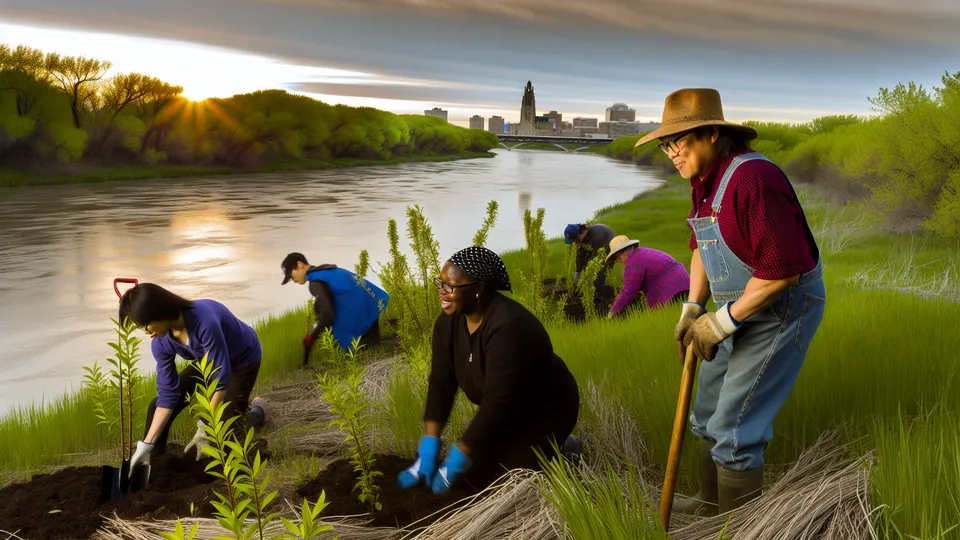
At first light along the Assiniboine River, a handful of people move as if following an old, shared choreography. Waders crunch gravel. Rubber gloves pull at willow saplings. A truck idles at the edge, its bed full of native grasses bound in burlap. Steam rises from thermoses and conversations begin in the pragmatic language of tasks: where to plant the buffer strip, how deep to set a root ball, which stretches of bank have eroded most.
This is not a dramatic rally or a municipal spectacle. It is an ordinary morning in Brandon that feels quietly consequential. The volunteers — farmers, students from the local university, municipal staff, and neighbours who showed up because a friend called — are repairing a patch of riverbank where winters have chewed away soil and spring floods have sometimes licked at backyards. They are, in small, cumulative acts, redefining what stewardship looks like in Westman.
For farmer Hannah Sinclair, whose fourth-generation grain farm sits fifteen minutes west of Brandon, stewardship began in a heartbreak moment. "We lost a strip of land to the river one year after a big spring thaw," she said, hands folded around a paper cup. "It made me realize I didn't want to be fighting the river. I wanted to work with it." Hannah moved from conventional tillage to a mix of no-till, cover crops and restored riparian buffers. "It's messy work, it's slower the first few years, and the equipment is an investment," she added, "but the soil returned. The creek doesn't cut through like it used to."
Hannah's shift is emblematic of a loose but growing constellation of changes across Westman. Farmers who once measured success only by yield are now assessing soil organic matter, presence of pollinators, and the quality of the creek that bisects their land. Several nearby operations trialed cover crops this spring to reduce run-off; another adopted rotational grazing to rebuild pastures. These are not prescriptive mandates but experiments born of necessity: volatile weather, rising input costs, and an acceptance that long-term productivity depends on ecological health.
The movement is not confined to fields. At the heart of Brandon's downtown, a community composting initiative launched out of a local church basement and a conversation between neighbours. What began as a weekend pilot has matured into a municipal pick-up service for households and small restaurants, diverting hundreds of kilos of organic waste from landfill each month. "It's been transformative in ways we didn't predict," said Marisol Perez, a program coordinator. "People come to drop off compost and end up staying to swap tips on saving seeds or keeping bees. The project has become a hub for environmental literacy."
Equally striking is the crossover of knowledge. Indigenous land stewards from nearby communities have been integral, sharing decades of place-based observations: where water lingers in spring, which grasses held firm during the last drought, how to read animal tracks for clues about habitat shifts. At a riverside meeting last autumn, an elder stood before a circle of farmers and students and described the river as a relative to be listened to. "That language changed the tone of the meeting," said a university student who attended. "It anchored the science in responsibility."
These exchanges also lay bare the barriers to scaling local solutions. Funding cycles that favour short-term outcomes, gaps in provincial policy that complicate riparian restoration on private land, and the cost of some regenerative equipment are recurring concerns. "We need policy that recognizes farmers as ecosystem managers," says a municipal planner who has spent months facilitating multi-stakeholder workshops. "Otherwise, the burden falls unevenly on those already stretched thin."
Yet, the story here is not one of despair but of pragmatic adaptation. Neighbourhoods have developed tool libraries for repair and upcycling; a student-led research group at Brandon University is mapping flood-prone corridors to inform planting priorities; and a cooperative of local artisans turns reclaimed wood into community benches that sit, intentionally, near restored banks.
What binds these efforts is not a single manifesto but a shared ethos: an acceptance that resilience is built through daily practices and relationships. You see it in the way a farmer explains cover crop choices to a volunteer, or how a municipal worker makes room in a budget to store saplings for a community planting, or in the quiet gratitude when the river holds its new bank through a late thaw.
The future of Westman’s environment will hinge on networks rather than silos. If municipalities, farmers, Indigenous knowledge keepers, and universities can sustain reciprocal partnerships and advocate for policies that reward long-term stewardship, the region stands a better chance at weathering the changes ahead. The work will be incremental, often unglamorous, but deeply human: bargaining with weather, recalibrating tools, sharing meals after a day of planting.
On the riverbank, as the sun climbs, a young volunteer brushes soil into place around a willow sapling. "It felt good to be useful," she says simply. There is a steadiness in the sentence that captures the larger truth unfolding across Westman — that a community rebuilding its relationship to land is, in the end, rebuilding itself.