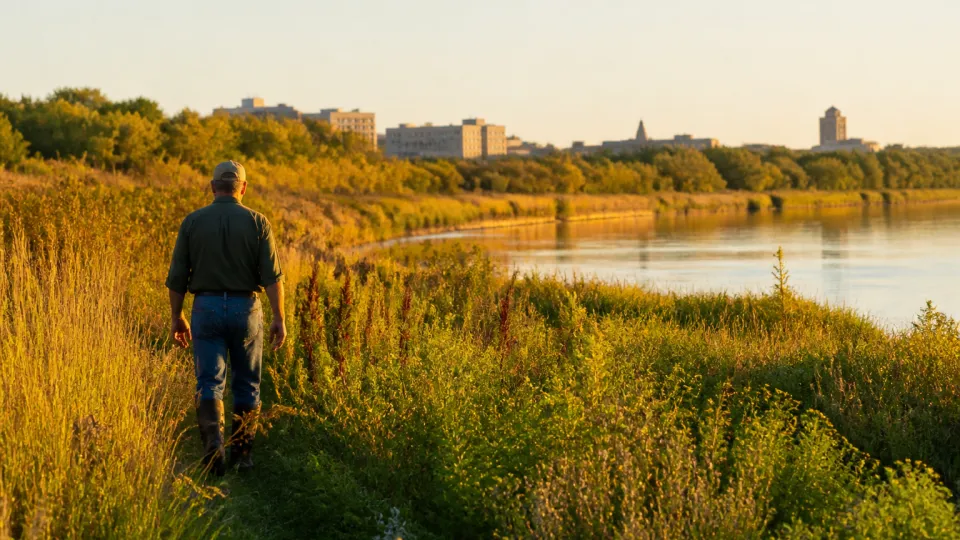
On a late autumn afternoon, where the Assiniboine slows beneath a low bridge, you can still see the old prairie line as a pale ribbon in the distance. A century ago, that pale ribbon would have been home to grasses taller than a man and a tapestry of wetlands that soaked up spring floods and nourished migrating birds. The landscape of Westman — Brandon and the surrounding patchwork of fields and small towns — was remade quickly, deliberately, and with consequences that took generations to understand.
The first wave of alteration came with rail, settlement, and a promise that the prairie could feed the world. Timber was scarce here; the solution was soil. Farmers and municipal planners drained wetlands, straightened creeks, and pushed the Assiniboine into ever cleaner channels. Those choices produced an economy and a resilient in its own way, but they also created a hydrology that now moves water faster and farther. The memory of those choices is lived in dikes, drainage tile lines and, increasingly, in the conversations at kitchen tables about how to live with a river that no longer behaves like it once did.
Understanding that history is essential to the region's recent environmental turn. In the latter half of the 20th century, a different set of voices began to be heard: conservationists, local teachers, Indigenous elders, and young farmers concerned not only with yield but with long-term viability. A practical ethic took hold in Westman — restoration not as nostalgia but as risk management. Wetlands are now framed less as lost wilderness than as infrastructure: sponges for floodwater, filters for runoff, and insurance for aquifers.
“I grew up hearing that wetlands were wasted land,” one longtime resident recalled. “Now we see them as something our grandchildren will thank us for.”
The human stories here are revealing. Take the farmer whose fields flank a braided side channel of the Assiniboine. He installed tile drainage decades ago to speed planting; last spring he helped re-excavate a shallow marsh on a marginal slope, fencing it as a wildlife buffer. He did it not because he had discovered a doctrine but because the marginal land had become marginal for a reason: it held water. Restoring it reduced the time his fields stayed saturated after snowmelt and brought back shorebirds he hadn't seen in years. Economically, it made sense. Emotionally, it connected him to a landscape memory he could see again.
Municipal projects have followed that pragmatic spirit. In and around Brandon, small yet strategic investments in naturalized stormwater ponds, riparian buffers, and community tree planting have been prioritized alongside traditional grey infrastructure. These measures are not dramatic; they are iterative, the kind of slow institutional learning that accumulates into resilience. Where engineers once proposed higher walls, planners now design wider floodplains where water can spread safely.
Equally important has been collaboration. In recent years, partnerships between rural municipalities, Indigenous knowledge keepers, conservation groups and local schools have reframed the environment as a shared asset. Elders speak about travel routes and seasonal harvests; youth bring data literacy and enthusiasm for carbon accounting and soil health. Universities and extension services, when called in, play supporting roles — running trials on cover crops, grazing rotations, and prairie seed mixes that can compete with aggressive weeds while holding soil in place.
There is also a small but growing marketplace for the practices themselves. Regenerative methods — reduced tillage, cover crops, diversified rotations — are not panaceas, but in Westman they are being tested in the crucible of weather extremes. Farmers report soil that holds moisture better in drought years and drains more slowly in wet ones. Payment-for-ecosystem-services schemes and conservation easements remain nascent, but community-operated seed libraries, a municipal compost program, and urban gardens in Brandon show that can be granular and locally meaningful.
This history is not only about nature; it is about identity. Indigenous stewardship, often sidelined in earlier decades, is now central to conversations about land and water. Acknowledgement of Treaty relationships and Métis histories adds moral clarity to projects that would otherwise be technical exercises. When restoration is tied to memory and justice, it carries a different weight.
What lies ahead for Westman is a series of trade-offs that require political imagination as much as ecological insight. Rewilding corridors, investing in soil carbon, ambitious wetland reconnection and equitable water governance each demand dollars, legislation and sustained civic will. But the region's recent record argues for cautious optimism: change here has been incremental and pragmatic, built on the knowledge that ecological health is local, measurable and, crucially, repairable.
The story of Westman’s environmental turn is not cinematic heroism. It is a series of modest restitutions — fences moved, ditches filled, a school class planting willows along a creek — that aggregate into a different relationship with place. Those small acts, when stitched together across farms, towns and treaty lands, begin to return a working landscape closer to the balance that sustained people here for millennia.
And in that return there is a lesson for other regions: sustainability is not an abstract virtue but a conversation between the past and possibility. In the shadow of the Assiniboine, Westman is learning how to listen to both.