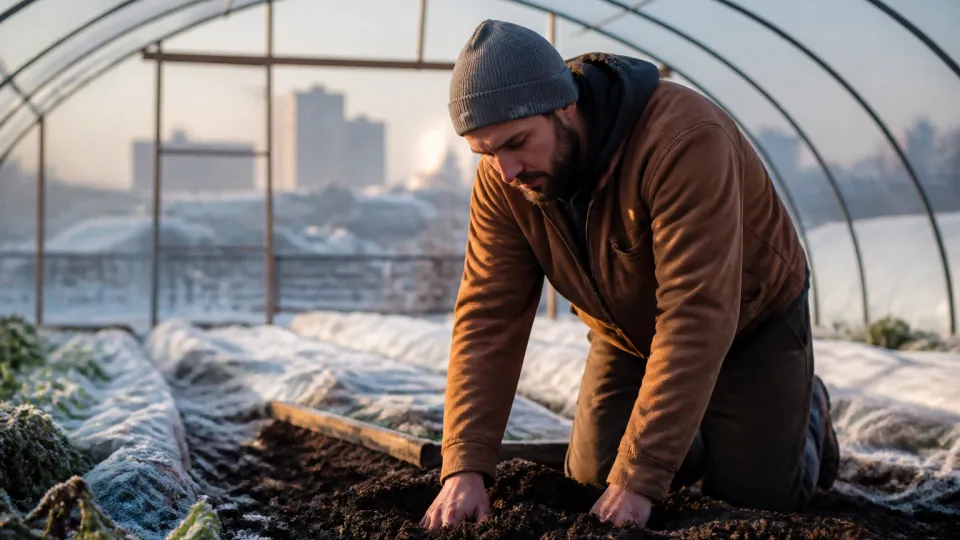
On a sharp March morning, when the prairie still held a memory of winter in its frost, Maya Thompson unzipped the plastic of a small hoop house and breathed in the humid, loamy air. Inside, baby lettuces had already split the soil; outside, a volunteer - a high-school student named Jonah - arranged seed trays with the kind of concentration that made Thompson smile. "There’s a hum to this place," she says. "Like something starting up again."
Thompson is the founder of Prairie Roots Collective, a grassroots enterprise that has, in five years, converted five vacant downtown lots and a dormant municipal park strip into a network of microfarms, gardens, and a modest processing shed. What began as a single garden plot intended to address food access has become an integrated model of urban agriculture designed to stretch Brandon’s short growing season, build local capacity, and return otherwise forgotten parcels to productive, biodiverse landscapes.
Counting in total around 1.5 acres, the Collective’s sites are a deliberate patchwork: intensive raised beds, a pair of insulated hoop houses for season extension, a polytunnel for seedlings, and a line of native prairie strips planted to support pollinators and reduce runoff. Thompson and her team have installed rainwater catchment barrels and drip irrigation, set up a community composting hub, and run workshops that teach seed-saving and pest management tailored to the Westman climate.
Those technical choices reflect a pragmatic understanding of place. Brandon’s growing season is unforgiving; the Collective compensates with a suite of low-tech, resilient strategies that squeeze an extra six to eight weeks of yield out of the land. "We’re not trying to recreate California here," Thompson says, "we’re learning how the prairie wants to be farmed and listening to it."
The impact on the community is tangible. Prairie Roots Collective produces roughly 10,000 pounds of vegetables a year — tomatoes, hardy greens, root vegetables, and herbs — sold at the downtown farmers’ market, supplied to a handful of local cafés, and directed to a sliding-scale community-supported agriculture (CSA) program. Crucially, about 40 percent of the harvest is distributed through partnerships with local food banks and seniors’ centres. "I don’t know how I’d have fed my family without Maya’s box last winter," says Claire MacDonald, a retiree who lives three blocks away. "It’s fresh, and I get to know the people who grow it."
Prairie Roots has also become an incubator for skills. Thompson runs an apprenticeship — a 12-week paid program that has trained 25 participants to date, many of them newcomers to Canada and young people seeking work outside oil and commodity sectors. One apprentice, Amina Hussein, arrived in Brandon two years ago and credits the Collective with teaching her not only vegetable production but how to navigate local food systems and start a small market business. "I learned to seed, to sell, to trust the seasons," she says.
The enterprise operates on a hybrid model: small sales, municipal grants, philanthropic donations, and a modest consulting arm that helps churches, schools, and housing cooperatives establish edible landscapes. Perhaps the most consequential of Thompson’s efforts is an informal partnership with the city. After a year of pilot projects and community consultations, the municipal council approved a multi-year license allowing the Collective to steward underused lots. That access has been decisive; it turns transitory stewardship into an investment in soil, infrastructure, and social capital.
Environmental outcomes are as real as the community ones. The compost hub diverts an estimated 20 tonnes of organic waste a year from landfill, while native strips have increased local pollinator activity on monitored plots. Thompson’s team is mapping soil health across sites, using cover crops and rotation to rebuild organic matter in soils compacted by past neglect. "We’re trying to sew back a functioning web," she says. "Not ornamental gardens, but systems that matter for water, soil, and insects."
Thompson’s work is not without tension. Funding cycles are short, volunteer labor ebbs and flows with the seasons, and the Land Bank model she envisions — a municipal policy to designate certain urban parcels for long-term food production — remains aspirational. She fields skeptical questions about scale: can microfarms really move the needle on food security in a region defined by large-scale grain agriculture? Her answer is both practical and reframed: resilience is not a single metric. It is an assemblage of relationships, localized supply chains, and the capacity to respond to shocks.
Looking forward, Thompson is exploring a franchise-like model to seed similar Collectives in neighboring towns, coupled with a digital platform for knowledge-sharing and seed exchange. She’s also advocating for municipal policy changes that would reduce barriers for urban growers and recognize small-scale agriculture as part of the city’s green infrastructure.
On that March morning, after Jonah left with a box of seedlings, Thompson stood for a moment and looked across the rows. The city hummed faintly at the edge of her view — a bus, a distant train — but the garden held its own pace. "This is slow work," she said. "It’s not flashy. But when you watch a bed come back to life, when you hand a volunteer their first jar of pickles made from our cucumbers, you see how durable this becomes. That durability is what the prairie needs."
In a region more often talked about in terms of commodities and weather, Prairie Roots Collective is a lesson in small-scale patience and civic imagination: a local answer to global anxieties, grown in raised beds and community agreements, patient enough to endure the next season’s frost and hopeful enough to plan for the one after.