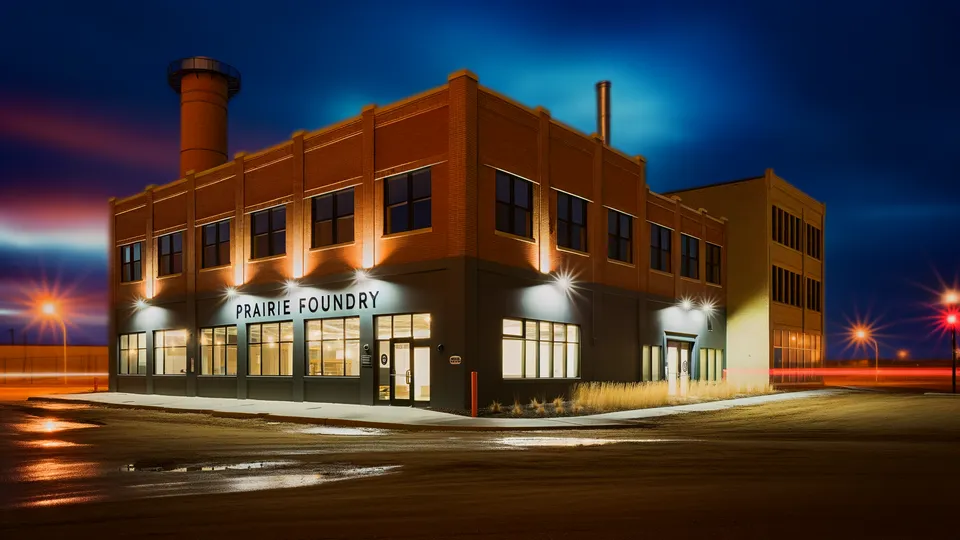
On a Thursday morning in late April, the light that slips between two brick buttresses of a converted warehouse paints the co‑working desks at Prairie Foundry the color of wheat. Asha Patel moves through the space with the unhurried gait of someone who knows both its plans and its missteps: a bank loan delayed by a pandemic, a zoning meeting that ran five hours, a scaffold that stalled reopening for two months. None of those things feel like a story when you enter the place—what matters are the machines humming in the back room, the soft patches of seedlings under grow lights, the whiteboards alive with soil‑sensor schematics.
Patel, 38, left a marketing job in Winnipeg to return to Brandon in 2017 with a single idea: use a place to make place. "I didn't want to build a shiny incubator that lived only on grant reports," she says. "We needed something that braided livelihoods, housing, and technical skills together—because people leave here when they can't see a path to stay." The path she imagined has been stubborn and small in its progress, and, measured in local terms, consequential.
Prairie Foundry occupies a narrow sweep of downtown that was once a warehousing quarter for farm supplies. Patel bought the building in 2018 and converted its ground floor into shared workshop and lab space for small manufacturers and ag‑tech pilots. The second floor became a mix of short‑term housing and studio apartments offered at moderate rents to young professionals and trainees. The philosophy was pragmatic: entrepreneurs need benches and benches need people who can afford to live near them.
The results are specific. Twelve startups have used the Foundry as their first address—among them FieldSense, a low‑cost soil‑moisture sensor whose pilot allowed a Neepawa farmer cooperative to reduce irrigation costs by 18 percent; and Root & Rise, a vertical‑farm microbusiness that supplies leafy greens to local shelters and a handful of grocery stores. FieldSense's founder, Samique Khan, recalls tinkering under a heat lamp in the Foundry’s back room. "We needed a space where a prototype could get tested on real soil outside the lab," Khan says. "Asha pushed for that partnership and then introduced us to farmers who were willing to try something risky." FieldSense now employs eight people, half of them recent graduates of Assiniboine College.
Patel has also placed an emphasis on apprenticeship. In partnership with Brandon University and Assiniboine, Prairie Foundry runs a 12‑week technician training program that combines hands‑on fabrication with business mentoring. The program has graduated 45 trainees to date, a mix of recent grads, newcomers, and veterans. "It changed how I think about work," says Jenna Martin, a 23‑year‑old millwright apprentice whose first job after graduating was at a solar‑panel installer started out of the Foundry. She speaks slowly, with the kind of clarity that comes from opening new openings. "Before, I felt like I had to leave Westman to do anything interesting. Now I can see starting and scaling right here."
The Foundry's finances are a detail of local politics as much as bookkeeping. Patel raised $1.35 million through a combination of provincial grants, a community bond that drew 200 local investors, and private philanthropy. Those figures matter to municipal councillors who once worried that a downtown revitalization would mean boutique cafés and gentrified storefronts. Patel deliberately kept rents moderate and prioritized tenants with ties to Westman. "We had to prove that economic renewal could be inclusive," she says. "That it wouldn't just price people out."
There have been setbacks. A fire code upgrade and an unexpected winter roof replacement ate into reserves. Some partnerships dissolved when companies outgrew the Foundry's footprint and moved to Winnipeg or Calgary. Yet the departures reveal the project's broader aim: to act as an enabling infrastructure rather than an end point. "The Foundry is meant to be catalytic," notes city planner Marlo Jensen. "If a business leaves because it's grown, that's a municipal victory."
Beyond the bricks and the balance sheet, the Foundry's real imprint is human. At a neighborhood table one evening, Patel convened a meeting of farmers, students, city officials, and recent immigrants to test the pilot curriculum for a farm‑to‑table logistics app. They argued for two hours over data permissions and delivery windows, then laughed over shared samosas. The conversation felt like small governance: messy, earnest, and rooted in place.
Looking forward, Patel is sketching a scaled plan. She wants to seed satellite hubs in Virden and Neepawa, pilot rooftop solar to power the Foundry’s fabrication equipment, and expand a co‑op housing model that lets apprentices buy into their units over time. "The next decade in Westman isn't about copying the city," she says. "It's about choosing what to keep from the city—skills, capital, networks—and fitting them to prairie scales and rhythms."
If the Foundry proves anything, it is that regional development can be less about single headline projects and more about the patient accumulation of small experiments that change daily life. Patel did not invent a miracle; she made a working hypothesis about how a town can keep its young people, strengthen its farmers, and test new technologies in the landscapes that will use them. In Brandon, the light through the Foundry's windows keeps falling on the same desks, and on more people than it did five years ago. That, for many, is the kind of slow change worth staying for.