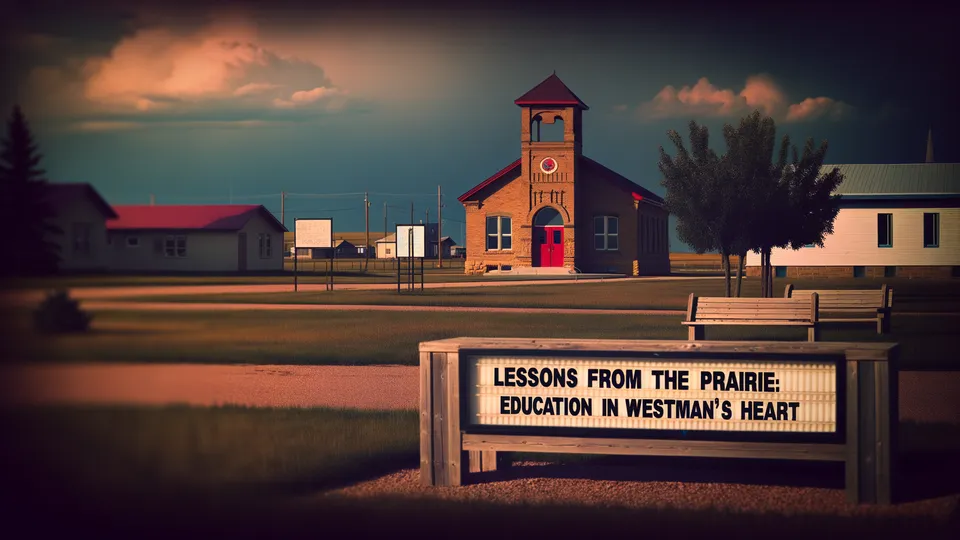
On a wind-swept afternoon just outside Brandon, the skeleton of a one-room schoolhouse still leans into the horizon — its clapboard siding sun-bleached, its windows reflecting a sky the colour of wheat. For decades these buildings were not simply places of instruction; they were communal theatres where farmers, seamstresses, and loggers took their turn as parent-teachers, trustees, and sometimes, the only recruiter for a school play. The scent of dust, the faint groove where a student once carved a name into a desk, speak to an era when education was stitched into the daily rhythm of rural life.
That intimacy is the anchor of Westman’s educational story. The region’s schools emerged from pragmatic needs: to teach children necessary skills, to socialize communities across wide distances, and to create pathways to work beyond the farm gate. Teachers arrived from a variety of backgrounds, often trained locally or through short summer institutes, and their impact was measured in generations rather than test scores. As one retired teacher remembered, 'We taught everything from reading to bookkeeping. We taught respect for neighbours and how to balance a checkbook. The schoolhouse was where we learned to live together.'
Mid-century consolidation redrew the map. One-room schools yielded to consolidated schools and bus routes, bringing subjects and specialists into reach but also rearranging social geographies. Towns like Brandon became educational hubs as secondary schools expanded and local colleges matured into degree-granting institutions. That shift widened opportunities: agricultural science and vocational training were added to the curriculum, and a growing cadre of locally trained teachers began to circulate between town and country. The trade-off was cultural. Where once the teacher doubled as a neighbour and anchor, the larger institutions sometimes felt distant and bureaucratic.
Yet those institutions have also been engines of resilience. Brandon’s colleges and university have provided teacher training, arts programs, and community partnerships that ripple into surrounding municipalities. Adult education programs, offered through community centres and continuing-education departments, reconnected returning farmers, seasonal workers, and new Canadians to learning that was practical and immediate. Local libraries and museum-led programs sustained a civic conversation about history, literacy, and belonging.
The human stories threading through these shifts are often quiet but profound. Consider the student who left a one-room school with basic literacy and later returned as a math teacher to mentor the next wave of learners. Consider the newcomer family that found stability through evening ESL classes offered in a church basement, or the Indigenous elders who negotiated to have local histories and languages recognized in school curricula. These are not footnotes; they are proof that education is less an institution than an ongoing set of relationships.
Today those relationships are being tested and remade. Broadband access, once a metaphorical luxury, is now central to whether a student can complete assignments or attend a virtual lab. Rural teacher recruitment remains stubbornly difficult — small communities lose teachers to urban centres as the cost of living and professional opportunities pull younger educators away. At the same time, calls for culturally responsive curricula and meaningful partnerships with Indigenous communities are reshaping what learning must look like to be equitable and honest.
There are hopeful experiments underway. Community learning hubs that combine childcare, adult education, and local health services are emerging as pragmatic models for rural areas. Schools are piloting blended learning that pairs in-person mentorship with remote access to specialized instruction. Local universities are deepening partnerships with communities to co-create programming that respects local knowledge, seasonal labour patterns, and Indigenous pedagogies. As one principal put it, 'We are not replacing the past; we are translating its strengths into tools for the present.'
If Westman’s educational history teaches us anything, it is that place matters. Curricula that ignore agricultural cycles, regional labour markets, and the lived histories of Indigenous and immigrant neighbours will fail to connect. Investment in rural broadband and teacher incentives matters as much as it does in cities. So do community voices in curriculum design and the structural supports that allow teachers to live in the towns they serve.
The future of learning in Westman will likely be hybrid and locally inflected: community-funded apprenticeships that pair high school students with local tradespeople, university extensions that deliver credentialing on evenings and weekends, and culturally sustaining programming that restores erased narratives. Real success will be measured not only by provincial metrics but by the quiet evidence that lingers in communities: increased adult literacy, more young people staying to build businesses at home, renewed partnerships with neighbouring First Nations, and schoolhouses — old and new — once again humming with shared purpose.
Preserving that hum requires both policy attention and civic will. The past century produced an educational ecosystem by improvisation, neighbourliness, and institutional growth. The next must do the same, but with deliberate investments in connectivity, reconciliation, and teacher pathways that honor the region’s distinctive rhythms. In Westman, education has always been a communal endeavor. Its continuing promise will depend on whether communities can reclaim that posture for a rapidly changing world.