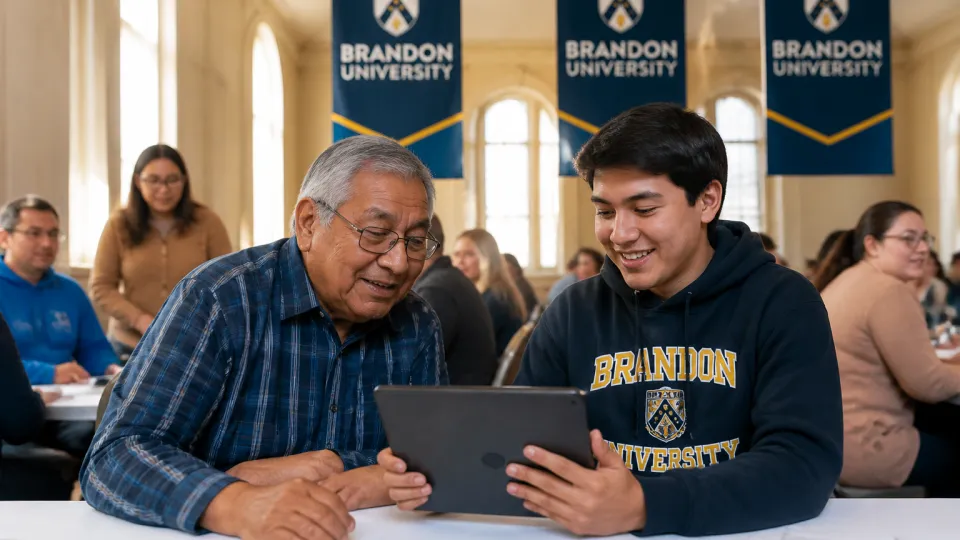
On a wind-bitten evening in late March, the auditorium at Brandon University hummed in a way that was equal parts instruction and sanctuary. Folding chairs were arranged in small clusters rather than rows, and at each table a different mode of learning was on display: a teenager showing a newcomer how to code a simple game, an elder sketching Dakota syllabics on a whiteboard as two nursing students transcribed, a retired electrician walking a group of high-schoolers through the wiring behind a washing machine.
The occasion was the inaugural Brandon Learning Festival, a deliberately loose assemblage of workshops, panels and pop-up classrooms organized by a coalition of university faculty, community college instructors and local non-profits. It was designed not as a conference for credential-holders, but as a marketplace of learning — practical, intergenerational and placed firmly within the rhythms of Westman life.
"We wanted to change the frame," said Dr. Helen Park, director of community engagement at the university, as she warmed her hands on a paper cup of coffee between sessions. "Education in our region isn’t just about degrees. It’s about how people learn to live together, pass down skills and adapt to changing economies."
What distinguished the festival from conventional public events was its attention to the seams of community life where learning actually happens. At an adjacent room, a workshop called "Trades After High School" paired instructors from Assiniboine Community College with young parents who had not finished their diplomas. One young father, Aaron, described how a single night at the workshop — an introductory welding demo and an information session about childcare supports — had shifted his sense of what was possible.
"I thought trades were something for other people," he said, wiping his palms on his jeans. "Seeing the tools close up and talking to someone who had my schedule made it real. I signed up for a night class on the way home."
Elsewhere, language programming drew a different crowd. An elder from Sioux Valley Dakota Nation led a small, attentive circle through the cadence of Dakota greetings and place names. Participants ranged from students studying Indigenous studies to parents seeking to reconnect children with an ancestral tongue. It was an intimate counterpoint to the more transactional sessions — a reminder that education is also a vehicle for cultural recovery.
"Language carries a way of seeing the world," the elder explained. "When we teach a child how to say the name of the prairie, they learn to notice its birds and seasons. That's learning, and it's survival."
These pockets of practice are not isolated curiosities. Over the last half decade, Brandon’s institutions have quietly aligned around a shared problem: how to keep rural communities economically viable while honoring cultural roots. That has meant practical strategies — co-developed certificates that allow credits to transfer between the community college and university, a mobile "learning bus" pilot that brings adult literacy and trade-prep to smaller towns, and a coordinated navigation service connecting newcomers with employment and childcare.
The results are modest but meaningful. In Virden and Neepawa, for example, evening trade-prep courses have nudged enrollment among adults who had previously believed their education options ended with high school. In Brandon, a community literacy cohort that began at a food bank has evolved into a peer-led reading circle that feeds into a formal GED program.
"People don’t just walk into a college feeling ready for it," observed Tanya Morales, program coordinator for a local immigrant settlement agency. "When we bring learning to people — into the library, into community centers, onto buses — barriers shrink."
There are limits, of course. Funding cycles remain short, rural transit is unreliable, and broadband gaps still make some online options impractical for farmers and families outside city limits. There is also a political dimension: debates over curricula and the rightful place of Indigenous knowledge in formal education still surface in school-board meetings.
Yet the tone at the festival was not defensive but iterative. Panels that might once have been siloed — elder-led language revitalization, applied trades pedagogy, immigrant workforce integration — were instead braided together. In one session, an instructor from the community college described a hybrid apprenticeship model that would pair Dakota language classes with heritage carpentry, envisioning a restoration economy rooted in language, place and skill.
"We don’t want to put these things in separate boxes," said Dr. Park. "If we value community resilience, our educational models must reflect the complexity of people’s lives."
As the festival wound down, volunteers stacked chairs and a small group lingered, reluctant to dissolve the evening’s mixed energies. A young newcomer and an elder were still seated together, laughing over an idiom that had no direct translation. Outside, the prairie gusted and the streetlights came on. Inside, there was a sense of accrued possibility: that learning could operate not only as a ladder to individual success but as the connective tissue of a region adapting to demographic shifts and economic change.
If the Brandon Learning Festival was an experiment, it was one with a clear moral outline — education as public good, stitched to culture and livelihood. The work ahead is logistical and political, but the human commitments are already there: teachers willing to bend their syllabi, elders sharing knowledge, newcomers eager to belong. That, in a place shaped by distance and seasons, may be the most enduring lesson of all.