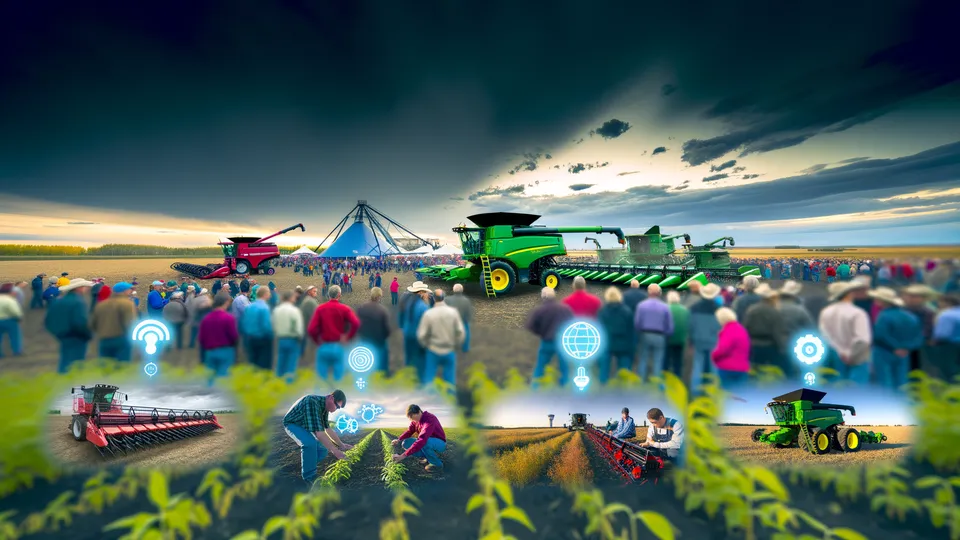
The hum of a drone threaded through the Keystone Centre's cavernous hall as if a distant bee had wandered indoors. Long tables that usually host curling trophies and trade shows glowed instead with soil moisture probes, salvaged tractors retrofitted with machine-vision cameras, and hand-drawn maps of watershed drains. It was a gathering that felt roughly like a farmers' market collided with a university lab: the Westman Agricultural Day, where and lived experience negotiated the next round of rural life.
On a Tuesday morning in late spring, the crowd ranged from young tech founders to furrowed-faced producers who measure success in bushels and beetles. In a corner, five students from Assiniboine Community College huddled over a 3D-printed nozzle designed to retrofit legacy sprayers so they spray only where the crops are, not the grass between the rows. Nearby, Dr. Amina Patel from the Brandon Research and Development Centre unrolled a poster on long-term soil carbon trials—data that she said pushes back against an easy narrative that tech alone will fix farming's environmental headaches.
"It's not about replacing wisdom," Patel told me. "It's about giving farmers tools that make informed choices faster. The real work is about decisions at the paddock level, season after season." Her work, supported by federal researchers, tracks how modest changes—rotating cover crops, altering tillage windows—compound into measurable differences in soil structure and water retention. Those findings are what farmers here call 'the long game.'
For many producers, the day was less a parade of gizmos than a marketplace for risk: stories of yield gains balanced against the practical constraints of cash flow and connectivity. Martha Sinclair, a fifth-generation farmer from Rivers who grows canola and pulses, walked slowly past an autonomous cultivator demonstration. She has tried precision-seeding services and says the results are promising, but cost and the learning curve keep her cautious.
"We can't buy every bright thing that comes along," Sinclair said. "But when something saves diesel or keeps our soil in place through a wet year, that matters. It's not about being fancy—it's about being here next year and the year after." Her face, weathered by decades of wind across the flatlands, lit when she talked about neighbors who volunteered a day to transplant a small pollinator strip—technology-free work powered by community labor.
Small start-ups were on hand to marry those impulses with product. PrairieSense, a Brandon-based sensor company founded by Elias Kwan, showed a low-cost probe that streams moisture and nitrate data to a phone app. Kwan's pitch was simple: farmers shouldn't need a PhD to understand their fields.
"We built this after driving around the region and hearing the same worry—'Am I wasting inputs or leaving money in the ground?,'" Kwan said. "If we can swing the needle even a little, it helps individual families and the broader regional economy." His device, he added, was designed to be repairable by local workshops, a small but intentional move to keep innovation anchored in place rather than shipped away.
That anchoring was exactly what drew students into the room. A lab demonstration by Assiniboine showed how agricultural education increasingly blends software and soil science. Instructor Kyle Martin emphasized that today's curricula teach a different language: combining farm mechanics with data interpretation and community engagement. "Kids want to come back to the places they grew up in, but with opportunities to build something there," he said.
Still, the show was candid about limits. Broadband dead zones remain a practical barrier for any system that depends on live data. Margins in crop farming are narrow; adoption requires not only investment but clear pathways to shared benefit. And there are social considerations: whose voices get prioritized when a cooperative database is built? Who owns the data that a sensor collects?
Those questions shaped a panel conversation about cooperative models. A local grain elevator manager argued for shared equipment pools and data trusts, while a county councillor described pilot programs that subsidize digital literacy workshops for older farmers. The mood was collaborative, not triumphalist: innovation here was presented as an iterative, collective effort.
By late afternoon, as rain began to haze the horizon beyond Brandon, a small group walked outside to watch an autonomous sprayer track a demo field. It moved with a hesitance that felt human, stopping to consult visual markers, then proceeding. For residents of Westman—who read weather patterns, seed catalogues, and school bus routes as part of the same landscape—the machine was a tool in a larger practice of care.
The day closed with a simple question passed around by organizers: what would success look like in five years? Answers ranged from more stable farm incomes and fewer soil-depleted fields to young people returning with ideas and craft. The thread connecting them was not novelty but continuity: innovation that plugs into local histories, economies and relationships.
In an era when technological solutions are often sold as magic bullets, Westman's experiment feels refreshingly non-dogmatic. The region is not rejecting high-tech; it is resituating it—so it serves community resilience rather than replacing the social fabric that makes resilience possible. If the next harvest reflects the discussions held that day, it will be because farmers, students, researchers and entrepreneurs kept showing up together, trading tools and stories until both fit the prairie they call home.