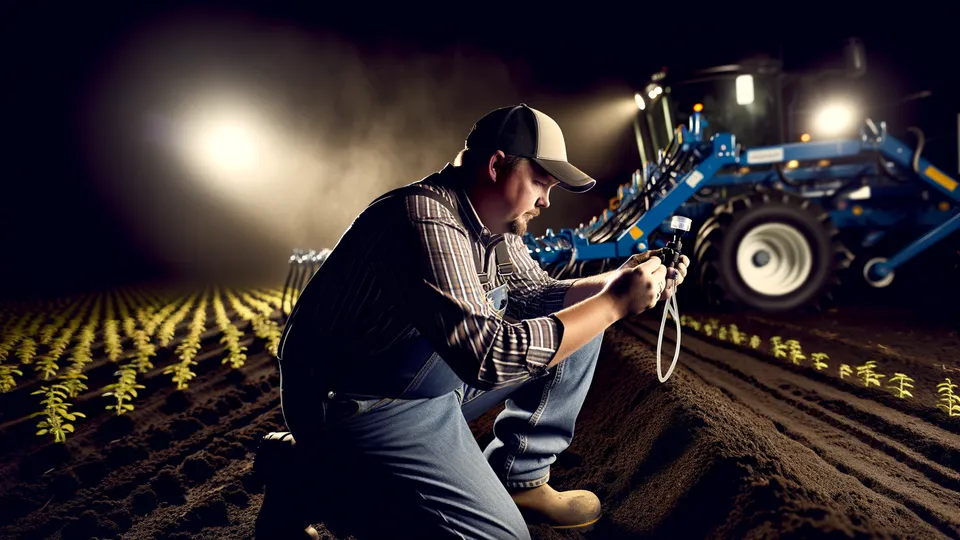
Spring arrives in the Westman region not with fanfare but with calculation: seeding windows, soil temperatures, and the slow, exacting choreography of machines guided by invisible lines. At dawn a third-generation grain farmer stands beside a tractor, not to wrestle with levers but to watch a tablet. The screen maps moisture pockets, marks areas for variable-rate fertilizer and streams data from a sensor buried in the field a month earlier. It is, in equal parts, old work—soil, seed, weather—and something quieter and stranger: an act of translation, turning impulses from the land into numbers and back into decisions.
This quiet translation is the story of agricultural in the Brandon hinterland. Over the past five years, farmers here have moved beyond the binary of tradition versus . Instead, they are weaving new tools—soil probes, satellite imagery, and precision application—into long-established practices of risk-sharing and neighbourly labour. The result is not a techno-utopia but an intimate, improvisational adaptation driven by real pressures: volatile markets, erratic precipitation patterns, and mounting input costs that make every kilogram of fertilizer matter.
Take a cooperative near Rivers where a group of eight producers pooled capital to buy a variable-rate fertilizer rig. Rather than each farm shouldering the full cost of a machine that sits idle much of the year, the co-op schedules the equipment around planting windows and hires a local technician trained at Assiniboine College to run the calibration and data logging. "We still talk over coffee about what the land needs," the co-op's manager told me, "but the machine lets us act on that conversation with a precision we've never had."
The technological tools themselves are increasingly affordable and modular. Soil moisture sensors that once cost prohibitive amounts are now sold in packs that can be deployed across fields for a season. Drones and satellite platforms, once the domain of large operations, are being used by custom applicators based in Brandon to offer scouting and imagery for smaller farms. Those images inform where to seed cover crops, reduce tillage or pull livestock to rotational pasture—tactics that sequester carbon and build resilience in drier years.
These tactical changes are shaped by local institutions. Assiniboine Community College, which runs agriculture and environmental programs in Brandon, has become an on-ramp for younger residents curious about ag tech and soil science. At the same time, the Brandon Research Centre's applied trials on crop varieties and agronomic practice provide empirical grounding for farmers making high-stakes choices. "You need to know the science isn't one-size-fits-all," a researcher there told me. "What grows in a controlled plot may behave differently at the top of a knoll where wind and soil depth change everything."
The human elements are complex. Older farmers wrestle with the learning curve of new interfaces; younger returnees, attracted by the possibility of marrying data work with the land, bring different expectations about labor and lifestyle. The regional labour market is also shifting: skilled technicians who can manage data feeds and calibrate equipment are as valuable as a good tractor driver was a generation ago. Local ag retailers and co-ops increasingly hire staff with both mechanical and digital skills, creating new career pathways in small towns where opportunities were once dwindling.
Yet the transition is uneven. Broadband connectivity lags in pockets across Westman, making real-time monitoring frustrating or impossible. Upfront capital remains a barrier for many small acreage operators, who watch neighbors adopt new systems and weigh the cost of joining in. And there are worries about data: who controls the granular information about yields and inputs, and how that data might be used in contract negotiations or by insurers?
Community responses have been practical and locally led. Equipment-sharing models, low-cost training clinics, and farmer-to-farmer mentoring have softened the cost and knowledge barriers. Schools and municipal partners have experimented with shared innovation hubs where farmers can test sensors and software before committing. In several towns, local entrepreneurs now offer contract services—soil mapping, drone scouting, precision application—translating complex technology into a service farmers can purchase by the acre.
Looking ahead, the most meaningful innovation emerging from Westman is not any particular sensor or drone but a reorientation toward resilience: making each decision and purchase with the aim of stabilizing family farms and the communities around them. That means marrying empirical agronomy with local knowledge about weather, markets and family rhythms; it means building cooperative structures that share not only machines but risk-benefit calculations. It means training a new generation that is comfortable both with muddy boots and debugging a data stream.
At a harvest celebration in a small hall outside Brandon, conversations turned quickly from yield numbers to grandchildren, to drought the year before, to plans for a new cover-crop pilot. The machines and sensors provide the means; the enduring work is social. 'We’re not being replaced by technology,' one farmer said, stirring his coffee. 'We’re just learning a new language to talk about the land.' In learning that language together, Westman may be crafting a model for rural places where innovation is less about novelty and more about renewing the ties that make agriculture possible.