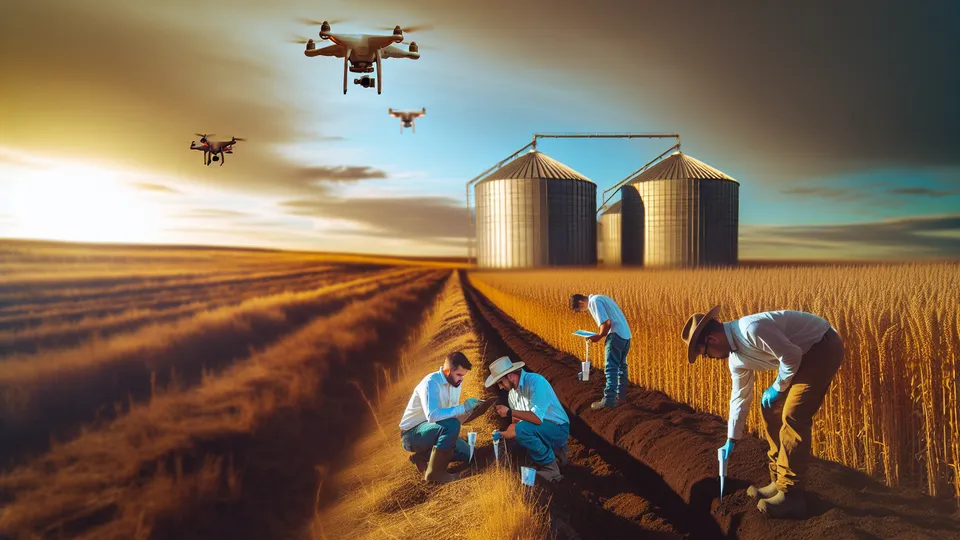
The day the mobile soil lab rolled into a field outside Brandon, a line of tractors and pickup trucks circled it like visitors at a small-town fair. The van's side flap became a classroom: a bank of jars with soil cores, a laptop showing moisture-readout graphs, and a chalkboard with the day's agenda—cover crops, water probes, and a new low-cost sensor being calibrated.
It was an ordinary prairie morning in appearance, but the work underway felt consequential. Over the last three years the Westman Commons (WIC), a community-led initiative, has stitched together local farmers, Brandon University researchers, students from Assiniboine Community College, and small- startups to tackle problems that feel simultaneously global and intimate: a changing climate, rising input costs, and the desire to steward family land for the next generation.
"We were tired of solutions delivered in reports we never read," said one farmer who helped launch the project. "We wanted to try things here—on our soil, with our people—so the answers could actually work for us."
The Commons was born from informal conversations in coffee shops, extension offices, and a few town halls. Funding arrived in modest tranches from a provincial resilience grant and local donations; what grew in its stead was an operating logic of shared risk and shared data. Farmers volunteered fields for demonstration plots. Students took on summers as field technicians. Researchers designed trials small and practical enough to be replicated by neighbouring farms.
The methods are familiar—cover cropping, reduced tillage, diversified rotations—but they are being applied with a communal rigour that is less common on the prairies. One example is a network of paired plots across five farms comparing conventional canola-wheat sequences with rotations that include oats and a winter rye cover. Sensors measure moisture use and soil temperature; the commons aggregates the readings and posts them on an open dashboard. If one farmer notices better emergence or lower herbicide need, that insight travels quickly across county lines.
Technology is treated pragmatically here. Drones and machine-vision are used not as flashy ends but as diagnostic tools: a drone pass reveals a patchy emergence that might be corrected by changing seeding depth rather than buying a new seed variety. A refurbished grain bin becomes a community hub where youth can learn to calibrate scales and read market signals. The mobile soil lab, in particular, has become a symbol of the Commons' ethos—low-cost, portable, and focused on making scientific data useful on a Monday morning when harvest decisions must be made.
Equally important has been the Commons' attention to the social architecture of change. The initiative pays youth apprentices to work with older farmers. It hosts evening sessions where producers talk about cash flow and risk management, not just carbon credits. Local Indigenous knowledge-keepers have been invited to speak about land stewardship practices that predate modern agronomy, prompting generational conversations about timing, fire, and plant relationships.
Outcomes so far are neither miraculous nor minimal. Participating farms have reported lower input bills in trial years where cover crops reduced weed pressure; a few have seen improved water infiltration in fields that previously pooled after heavy rains. Students emerge from summers with job-ready experience and many have stayed on as field techs or started small ag-tech businesses in Brandon. Perhaps most importantly, skepticism has given way to a new kind of pragmatic curiosity: if a practice saves time and money, and builds soil, it gets repeated.
There are challenges. Scaling beyond early adopters will require more sustained funding and an infrastructure for data governance—who owns the farm-level data, and how will it be used? The Commons is grappling with questions about intellectual property when local startups are involved, and the perpetual problem of translating short-term trial data into long-term soil metrics.
Yet the initiative's greatest achievement may be cultural. In a region where family farms carry histories and anxieties, the Commons has carved out a place where experimentation is normalized and failure is not punished but learned from. "You don't have to be perfect to try something new," a young agronomist remarked during a winter workshop. "You just have to be willing to measure it and tell your neighbours what happened."
Looking forward, participants envision a networked Westman that treats experimentation as public infrastructure—shared equipment pools, regional seed-saving cooperatives, and apprenticeship pathways that keep local youth employed and invested. Those visions are practical, rooted in budgets and barn audits. They are also aspirational: a community adapting in place, honoring the past while building tools for resilience.
If the commons model proves durable, it will be less about a single piece of technology or a particular practice and more about a social invention—that farmers, researchers, and students can sit at the same table, measure what matters, and build incremental change that resounds across the landscape. In a changing climate, those modest, attentive acts of collaboration may turn out to be the most consequential innovations of all.