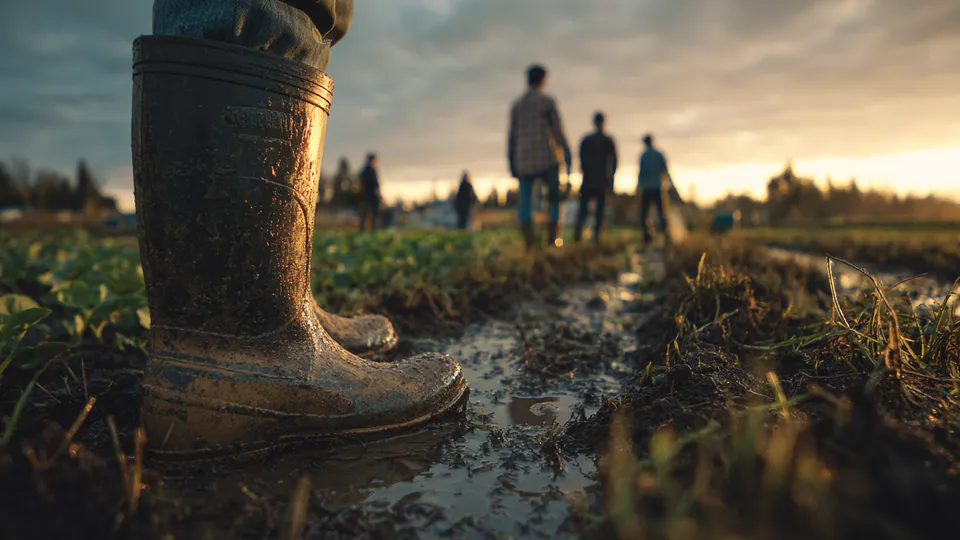
On a late April afternoon the Assiniboine River moved slow and wide through Brandon, its banks still telling the story of last summer’s high water: flattened grass, new reeds finding purchase in silted edges, and a cluster of volunteers in mud-streaked boots reconstructing a stretch of riparian planting. They were not actors in a ceremonial photo; they were a loose coalition of city planners, students from Brandon University, neighbours, and land keepers from surrounding rural properties. All had come to address a problem that feels simultaneously intimate and systemic—how to hold soil and water, livelihoods and culture, in a place where weather seems to be rewriting the rules every season.
This is not a story of a single silver-bullet project. It is a patchwork of small, stubborn experiments—cover crops on clay loam outside Rivers, a neighbourhood co-op negotiating rooftop solar leases in south Brandon, an elder-led initiative to restore native prairies near a reserve—each testing ways to reduce risk and rebuild ecological function while keeping families and local businesses solvent.
Take the farm a dozen kilometres west of town where Sarah McLeod has been reconciling two inheritances: the family’s dependence on commodity crops and a growing conviction that conventional practices are failing the land. Sarah began planting cover crops on fields most at risk for erosion and testing strip-tillage to protect soil moisture. "Four years ago, when the rains came in concentrated bursts, I watched topsoil go away in a day," she says, wiping her hands on a weathered jacket. "I couldn't keep telling my kids that this was just the way it was."
For Sarah, the moves are pragmatic. Cover crops reduce herbicide costs, help retain moisture in dry spells and cut fuel use—small margins that matter when global markets dictate farm gate prices. But they are also part of a wider network of support: a local ag co-op that offers a seed sharing program, a grant that helped pay for a cover-crop seeder, and online forums where producers trade tactics and warnings. These networks reveal an important trend: change at ground level is rarely purely ecological; it is social and financial too.
In Brandon, municipal policy and citizen initiatives are catching up, but not without friction. The city has hosted workshops on floodplain restoration, and a volunteer-run community garden behind a seniors’ residence now supplies produce to an outreach kitchen. Yet municipal budgets are tight, and choices about zoning, stormwater infrastructure, or incentives for retrofits still reflect a caution born of competing priorities.
"Policy lags because municipal decision-making is built around short budget cycles," explains a planner involved in an Assiniboine resilience study. "But the ecological timelines and the community's needs don't fit those cycles. People are making do in the meantime." The interim solutions—temporary berms, citizen-led plantings, informal tool- and knowledge-sharing—are effective but precarious.
There is also a shifting role for knowledge production. Researchers at Brandon University are documenting local soil health trends and modeling hydrological changes at a scale that resonates with farmers and municipal staff. That collaboration has real consequences: data from small watershed studies helped convince one group of ratepayers to support a wetland restoration that reduced seasonal flooding to neighbouring yards. Knowledge here is the glue between lived experience and municipal action.
Still, barriers persist. Access to capital for smallholders to convert equipment, the complexity of provincial and federal funding streams, and an agricultural economy that prizes yield forecasts over soil metrics all slow adoption. Likewise, Indigenous stewardship and voices are only slowly being incorporated into mainstream planning—though when welcomed, they transform outcomes by centering land histories and long-term care practices rather than short-term fixes.
What does the future look like for Westman? It is neither a simple victory lap nor a resignation. The most likely path is incremental and relational: more farms experimenting with regenerative practices because their neighbours did and a few have incomes stabilizing; more municipal projects that are co-designed with citizens and local researchers; targeted investments in community energy projects that reinvest returns locally; and an emergent cultural norm valuing soil and water as community assets rather than externalities.
There are models to scale—pooled equipment shares, community bonds to finance solar arrays, and technical assistance hubs that translate university research into actionable farm plans. But above all, the region’s resilience depends on the social infrastructure now under construction: trust between farmers and scientists, municipal officials and grassroots organizers, and between Indigenous and non-Indigenous stewards.
Back at the river, as the planting day wound down, the volunteers stood in a line and surveyed a narrow ribbon of newly stabilized bank. "It's small," an elder from a nearby community acknowledged, "but it's where we start." In a region where climate pressure and economic realities converge, such small starts—multiplied, connected, and supported—might be the most realistic route to a more sustainable, equitable Westman.