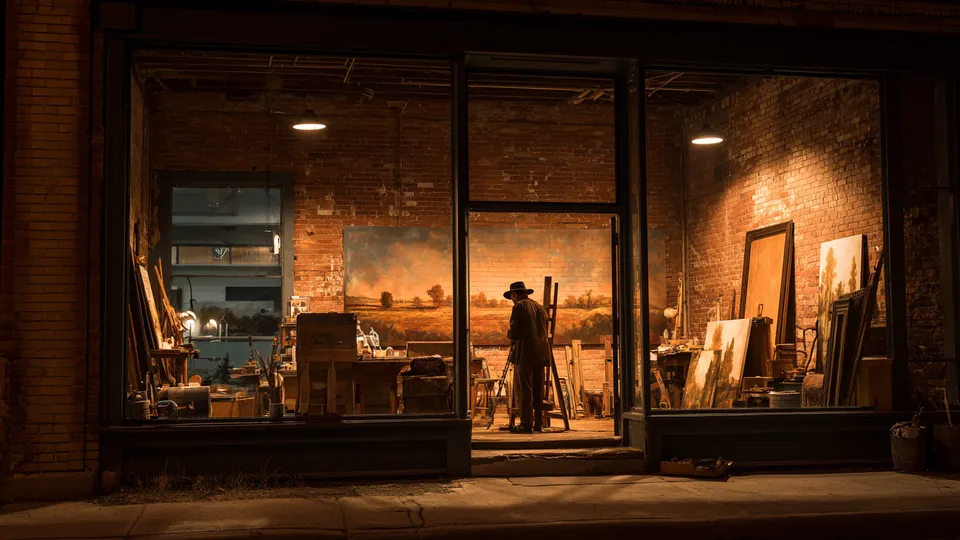
On a late October evening, the windows of a converted storefront on Brandon's 10th Street glowed with the kind of warm chaos that marks a city in the middle of remaking itself. Easels leaned against salvaged wooden beams, a group of students from Brandon University debated a score of contemporary compositions by lamplight, and across the room an elder paused between stories and stitches, preparing fabric for a community quilt.
It is an ordinary scene that would have been rarer a decade ago. Today, it feels like a hinge: the local arts ecosystem—museums, university programs, independent galleries and itinerant festivals—has become not merely a set of cultural offerings but a force reorganizing how people live and work in Westman.
Brandon's Art Gallery of Southwestern Manitoba and Brandon University have been central to that shift. Gallery curators and university faculty have expanded outreach beyond exhibition walls and lecture halls, deploying artist residencies, school partnerships and workspace collaborations in the downtown core. These initiatives have created new kinds of visibility for emerging artists while nudging the city toward more sustained cultural programming.
"We used to think of the gallery as a destination; now we think of it as a partner," a curator at the gallery told me, summarizing a new posture of collaboration. That partner-first approach has material consequences: downtown storefronts that once sat vacant are being taken up as studios and pop-up venues, attracting small weekend crowds and keeping more people in the city after dark.
The human stories threaded through these developments are instructive. Lena Hart, 34, is a painter who moved back to Brandon after stints in Winnipeg and Calgary. She converted a 1920s pharmacy into a light-filled studio where she also hosts youth workshops. "People bring their lives into class—it's not about showing up and painting a landscape anymore," she says. "It's the older woman who brings stories about the farm; it's the student trying to afford school. The studio became a place where we make decisions about the future together."
Indigenous artists and cultural leaders are reshaping the cultural agenda as well. Across Westman, there is a deliberate effort to center Indigenous voices—from collaborations that foreground Treaty 2 histories to exhibits that present contemporary Indigenous art on equal footing with other regional programming. Those collaborations are less about symbolic inclusion and more about rethinking who sets the cultural agenda. An organizer from Treaty 2 territory said, "People are finally listening. We want respectful partnerships, not token gestures."
At a larger scale, the region's festivals provide a pressure test for these trends. Dauphin's Countryfest, long an anchor of rural Manitoba's music calendar, continues to draw crowds, but community-run arts festivals in towns like Neepawa and Swan River are experimenting with mixed programming—pairing headline music acts with workshops, Indigenous storytelling sessions and artist markets—in order to stay relevant and financially sustainable.
The pros are visible: more nights downtown, new creative economies, stronger university-community ties and a renewed sense of place. But the strains are real and instructive. Municipal arts funding has been steady at best, while demand for programming and affordable workspace has increased. Volunteer boards that once ran festivals and galleries are ageing; younger professionals often lack the capital to convert spaces into studios. The post-pandemic economy, with its labor shortages and rising costs, has compounded the challenge.
offers one partial solution. Brandon University ensembles stream performances to new, geographically dispersed audiences; galleries host hybrid openings that allow diaspora communities to attend. Yet digital reach does not pay rent. The deeper question is one of civic priorities: will municipal and provincial decision-makers treat arts infrastructure as essential to urban planning and economic development, or as a discretionary amenity?
The most promising responses combine policy thinking with granular, human-scale work. Municipal incentives for adaptive reuse of heritage buildings, small grants for artist-led placemaking projects, and incubator programs co-designed by the university and community organizations have shown early success. When funding and policy follow those models—targeting affordable studio space, long-term rental stability and Indigenous-led projects—the cultural ecology becomes more resilient.
Looking forward, the stakes go beyond festivals and gallery openings. Westman's arts resurgence is testing a broader hypothesis: that cultural life can be a vector for demographic stability, civic engagement and economic diversification in mid-sized regions. If local leaders invest in the infrastructure that artists need—studios, rehearsal spaces, professionally staffed institutions—then the arts will be able to deliver more than ephemeral enchantment. They will provide jobs, attract new residents, and anchor a richer public life.
In the transformed storefront on 10th Street, the evening wound down with shared coffee and a tentative plan to mount a winter exhibition. The plan was modest and impractical in many ways, but it carried a confidence that has become common in Westman: that creative work, when organized with care, can remake the places where people live. That kind of confidence, sustained by smart policy and community patience, is the region's most consequential work in the years ahead.
For Brandon and its neighbours, the question is not whether art matters. It is how much the community is willing to build a city that treats cultural life as infrastructure worth funding and defending.