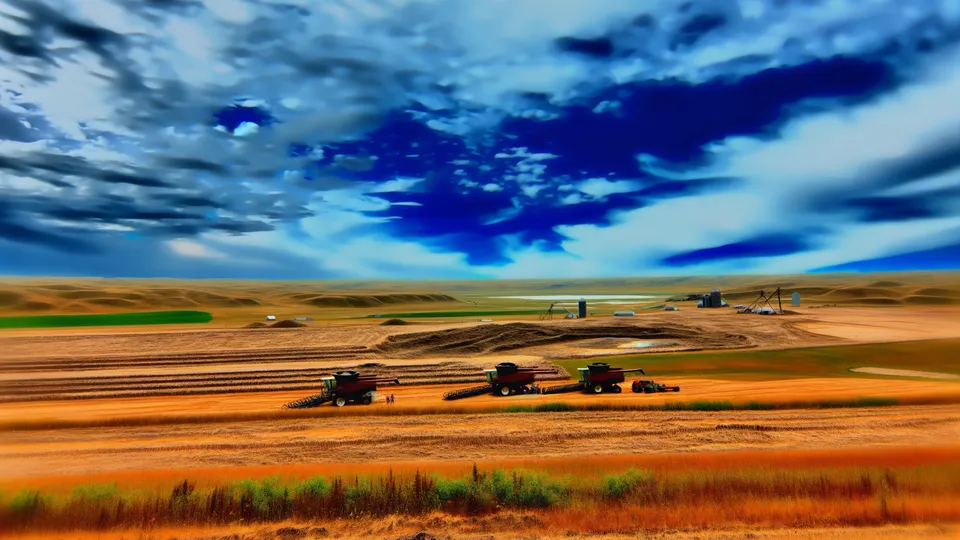
On an October morning outside Brandon, a silver combine hums across a field already stubbled with last season's wheat. The cab is quiet except for the soft ping of satellite-referenced guidance and the occasional radio call. A few rows away, a retired farmer stands with his granddaughter, watching the machine trace invisible lines across land his family has worked for four generations. That juxtaposition — the tactile memory of hands in soil alongside a machine navigating with minutes and metres of precision — is the story of Westman agriculture: a slow, often contested arc of invention that has remade the prairie and the people who live on it.
The Westman region’s turn toward has never been merely technological. It has been social, institutional and geographical. When settlers first arrived on these plains, incremental changes — better seed, a sturdier plough, a cooperative — were survival strategies. Over the 20th century, those small changes aggregated into systems. The Brandon Research Centre, part of Agriculture and Agri-Food Canada, and the extension work of provincial agronomists connected farmers to experiments in variety development, pest management and soil science. Those institutional threads tied individual fields to regional resilience.
Consider canola, the product of decades of plant-breeding work across the Canadian prairies. It is easy now to call the crop a revolution: its oil altered diets and its seed transformed rotations. For Westman, canola provided a new anchor for economies that had been dependent on a narrow set of crops. Local grain elevators, seed cleaning operations and trucking firms adapted; younger farmers found different margins to make a living. But beyond markets, canola’s success also shows how scientific curiosity met local practice: breeders offered varieties, but farmers learned which ones worked in the specific soils and microclimates west of Brandon.
Another quieter innovation was the rise of conservation tillage. By the late 20th century, many Westman farmers began leaving residues on their fields to protect soil from erosion and to conserve moisture. The practice was not the product of a single laboratory breakthrough but of farmer-to-farmer experimentation, municipal support, and research that documented long-term benefits for soil organic matter. For communities, reduced tillage meant lower fuel bills, less time in the field, and a different rhythm to planting and harvest — small changes that ripple through rural life.
The human dimension of these shifts is often overlooked. In Rivers, Souris and smaller hamlets, implement dealers became hubs of knowledge as much as commerce; seed reps, agronomists and retired farmers traded tips over grain-coffee at lunch counters. I spoke with a third-generation farmer near Rivers who described learning GPS guidance through a borrowed tractor and a willing neighbor. “We didn’t buy the idea, we borrowed it,” she said. “Then we learned it saved us time, cut overlap and let me be home more for supper.” Such accounts underline a truth: matters only when it sits within community networks that translate it into daily practice.
Institutional partnerships have also been vital. The Brandon Research Centre’s trials on disease-resistant varieties and soil amendments have been presented at local workshops, and farmers have pushed back, tweaking plots in ways that created new questions for researchers. This two-way flow — where farmers are not merely recipients of innovation but co-creators — has sustained a pragmatic culture of improvement. It’s an ethos visible at local co-operatives and commodity boards that balance market access with stewardship.
Today, the latest wave of innovation is digital: drones mapping crop health, satellite data informing variable-rate seeding, and software platforms aggregating yield information across seasons. These tools promise to refine resource use and strengthen resilience to a warming climate. Yet they bring new challenges — data ownership, subscription costs, and the need for tech literacy among older operators. Westman’s response so far has been characteristically communal: rural extension programs, local startups, and university outreach are working to make the benefits accessible beyond the largest farms.
The stakes are more than productivity. As climate variability increases, soil health and water management will determine which communities remain viable. Innovations that once simply raised yields must now be judged on their capacity to build long-term resilience: cover crops that sequester carbon, diversified rotations that blunt pest outbreaks, and market arrangements that keep small and medium farms in business. The future will reward those innovations that are scalable and equitable.
Looking forward, Westman’s best asset is not a particular piece of machinery or a single lab. It is a culture: a braided tradition of experimentation shared in kitchen tables and council halls, in research plots and coffee shops. If the region is to navigate the twin pressures of global markets and climate change, it will need to sustain that culture — investing in local research, training, and infrastructure that keeps knowledge circulating.
Ultimately, the story of agricultural innovation here is a human one. Technology has rearranged the contours of work and commerce in Westman, but the choices about what to adopt, what to adapt, and what to preserve remain local. Standing in that field outside Brandon, the older man and his granddaughter watch the combine move across the prairie, a living line of continuity between past labor and future possibility. The lesson is plain: progress on the land is not a solitary act of invention but a communal conversation about how to live well on this place for the next generation.