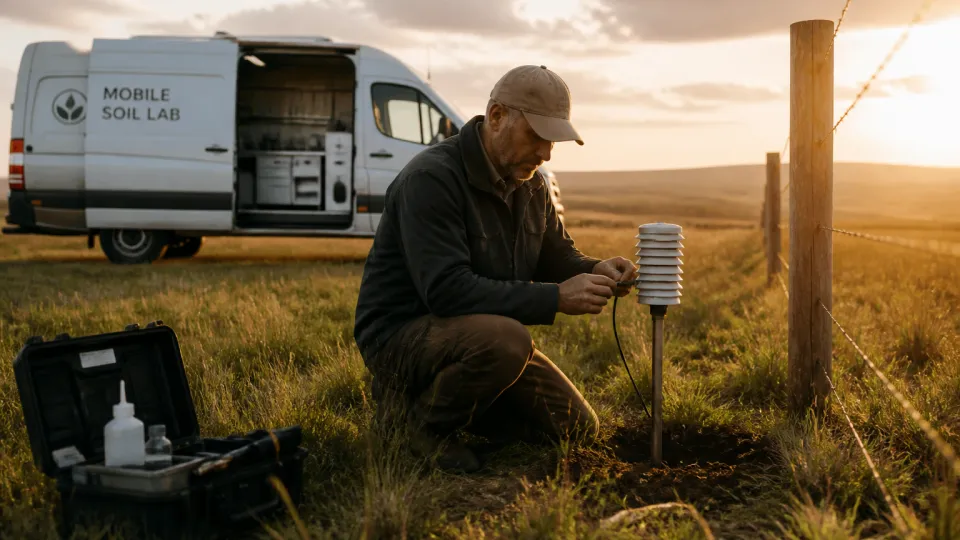
At first light, the prairie folds open like a ledger. A woman named Maggie steps out into the cold and squints at a small post near the fence line, where a cylindrical sensor blinked green. The device tells her what the soil cannot say aloud: moisture levels, electrical conductivity, a hint of when to hold the plow.
That sensor is one of hundreds born from a modest idea that took root in Brandon two years ago: what happens if farmers stop treating as a commodity sold through distant catalogues and instead build a shared system with local knowledge at its heart. The result is the Westman Ag Collective, a cooperative of farmers, students, technicians and restauranteurs experimenting with low-cost monitoring, regenerative cropping, and a data commons governed by members of the community.
The collective did not arrive fully formed. Its origin story is ordinary and urgent — a string of volatile seasons that left small and medium-sized producers scrambling for ways to hedge risk. The region that feeds Manitoba began to look for more than insurance policies; it needed information that could be turned into timely decisions. A handful of farmers, a lab technician from a community college, and a high-school teacher started meeting in the back of a bakery to sketch a plan.
They prioritized accessibility over novelty. Instead of proprietary rigs that cost thousands, they adapted open-source circuitry and off-the-shelf probes to measure soil moisture and temperature, paired those sensors with a basic cellular gateway, and made the data legible through a shared dashboard. A mobile soil-testing van, repurposed from a retired university research vehicle, tours farms from Souris to Neepawa to collect physical samples that calibrate the sensors.
The human architecture has been as important as the hardware. The collective runs a mentorship program that pairs veteran producers with apprentices. Twenty-year-old Noah, who grew up on a mixed grain operation, joined the apprenticeship after finishing high school. He learned to solder sensor boards in the community college lab, and now he helps deploy them across rented plots. "I was worried technology would replace jobs," he says. "Instead it taught me a skill that keeps me here, working with the land and getting paid for it."
Farmers say the adjustments are not about flashy yield claims but about decision-making. On one marshy quarter section, members used sensor readings to delay spring tillage until a stubborn finger of moisture drained — a choice that prevented compaction and reduced diesel and repair costs. On another farm, shared data highlighted an area with progressive salinity, prompting a switch to salt-tolerant forage and a later rotation plan that preserved soil structure.
Markets have bent to the collective as well. A cooperative marketing arm helps small growers bundle specialty vegetables and value-added grains for restaurants and weekly boxes in Brandon. By coordinating planting windows and sharing post-harvest facilities, producers with plots of 40 to 400 acres find steadier returns and new buyers who value provenance and stewardship.
Partnerships with local institutions give the work an educational spine. Students in applied agriculture programs assist with calibration and create open-source guides so a farmer in Virden or a community garden in Brandon can replicate the work. The collective has also been deliberate about governance — they established a data commons that restricts external commercial harvesting of datasets and sets priorities for anonymized research partnerships. It is an attempt to balance innovation with community control.
This local-first approach has limits and tensions. Not every farm can afford even the modest subscription for data hosting, and there is a learning curve that leaves some older producers skeptical. The collective meets those problems directly: equipment is lent on a rotating basis, and peer-to-peer workshops are scheduled at times those farmers can attend. When disagreements arise over what to plant or which metrics to prioritize, consensus-building — slow, noisy, often imperceptible — becomes itself the technology that holds the network together.
Looking ahead, members of the collective talk about scaling without dissolving the local ties that made it work. They envision regional hubs that share maintenance resources, extend apprenticeship placements, and formalize partnerships with processors in Brandon so that regenerative practices translate into price premiums. They also see a contribution to climate resilience: distributed monitors and adaptive rotations that allow farms to respond to the sudden rains and sudden droughts that have become routine.
Back at the fence line, Maggie scrolls through the dashboard on her phone. A week of rain is forecast but the sensor shows the quarter will barely cross the threshold that would require irrigation. She takes a breath that is part calculation and part relief. "It's not a magic bullet," she says, "but it's the kind of help you can trust because it comes from people who know what this land needs." In the end, what the Westman collective is cultivating may not be just smarter fields, but a renewed sense of agency — a practical, small-scale politics of stewardship that asks what a community can do together when the weather no longer reads like the way it always has.