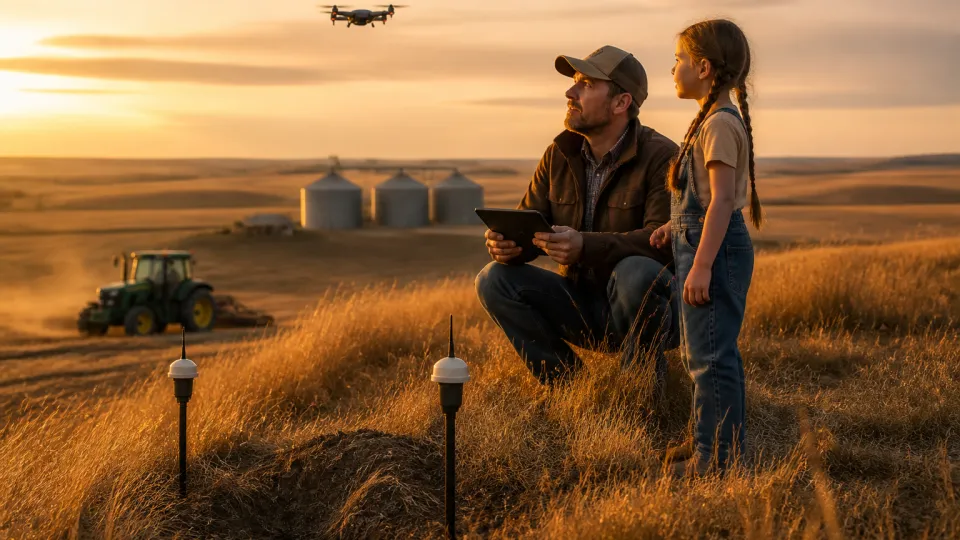
On an October morning just outside Brandon, a tractor idles beneath a low, flat sky while a young woman kneels in a furrow and taps a small device that looks like a remote control. The device displays a stream of data: soil moisture at six depths, the pH across the field, a graph of nitrogen availability. A drone hums overhead, finishing a grid pattern it has flown twice this season. They are not chasing novelty. They are trying to keep a century-old way of life alive.
"We used to go by feel," says Earl Hiebert, a third-generation farmer whose family has worked the land since his grandfather homesteaded in the 1930s. "Now we go by data. It doesn't replace experience — it focuses it." Earl gestures to a line of canola and barley whose vigor this year helped him weather a dry spell that would have cost his neighbours. "That strip first told us where to pump less fertilizer. We spent less, and the crop didn't miss it."
What is happening in Westman is not a single dramatic invention. It is a steady reweaving of practices — sensors tucked into the soil, variable-rate seeders, cover crops, community equipment co-ops, and small labs where agronomists and farmers translate numbers into decisions. Taken together, these adjustments are altering how farmers manage risk, invest in their land, and pass farms to the next generation.
Brandon's agricultural landscape has been especially fertile ground for this quietly pragmatic . Local co-operatives have pooled resources to buy expensive equipment such as high-resolution mapping drones and autonomous-controlled sprayers that individual farms could not afford. In one community initiative, a group of ten farms share a mobile soil-testing rig; results are uploaded to a common platform so neighbours can compare profiles and coordinate planting strategies.
For farmers like Marion Desjardins, who returned to the family farm after a stint in software development, that communal approach made adopting less daunting. "I didn't want to be the one trying to figure everything out on my own," she says. "Seeing the same questions and the same problems across our group meant the answers were more useful. We learn fast because we don't have to repeat the mistakes alone." Marion's farm has integrated cover crops and reduced tillage, and she now hosts workshops for other women in agriculture to share both technical skills and the emotional labor of running a farm.
Researchers and local entrepreneurs have found the region's mixture of mid-sized family farms and civic institutions conducive to practical experiments. A partnership between a community agricultural cooperative and a university-affiliated research team has piloted soil carbon measurement protocols that could feed into nascent carbon credit markets, and another project retrofitted an older combine with semi-autonomous guidance systems to prolong the machine's useful life while improving efficiency.
These projects are deliberate in how they anchor innovation to community needs. Rather than replacing labour, many technologies have reallocated it: older farmers report less back-breaking work and more time for oversight and mentoring; young people are finding roles that combine fieldwork with data analysis. Local technicians and small-scale manufacturers have found a market for repair services and custom retrofits, keeping dollars circulating in Westman rather than to distant suppliers.
But the transition is uneven and emotional. Adoption requires broadband, capital, and a learning curve, and not every family has the appetite or means to join the tech-forward cohort. There is also a deep cultural component — the pride in knowing land intimately, the skepticism toward promises of easy fixes. "We have to remember soil is not just chemistry; it's history," Earl says. "The data is a tool, but the land still expects respect."
The human payoff shows up in quieter statistics than press releases: fewer emergency loans in bad years, steadier cash flow across seasons, and a renewed willingness among young adults to stay or return. Local schools now include agri-tech modules and invite farmers to co-teach, integrating practical knowledge with computer science and environmental studies. Mental health workers note that farmers who can see a measurable plan to buffer climate volatility — whether through diversified crops, insurance linked to satellite monitoring, or community-shared grain storage — report lower chronic stress.
Looking ahead, practitioners in Westman are grappling with questions that move beyond efficiency. How will small farms access carbon markets without losing autonomy? How can data ownership remain local rather than ceded to large platforms? Can innovations scale in ways that preserve the social fabric of rural communities?
The answers are not purely technical. They are civic decisions about who controls equipment, who interprets the data, and who benefits when fields yield a little better than they did last year. The innovations in Westman suggest a different kind of agricultural future: one that uses tools to deepen connection, not replace it. As Earl watches his daughter review a soil map, he smiles with the kind of satisfaction that comes from both continuity and change.
"If you're going to pass land on to the next generation," he says, "you want them to have options. You want them to stand here and know they can make decisions that honor what came before and keep this working for the future."