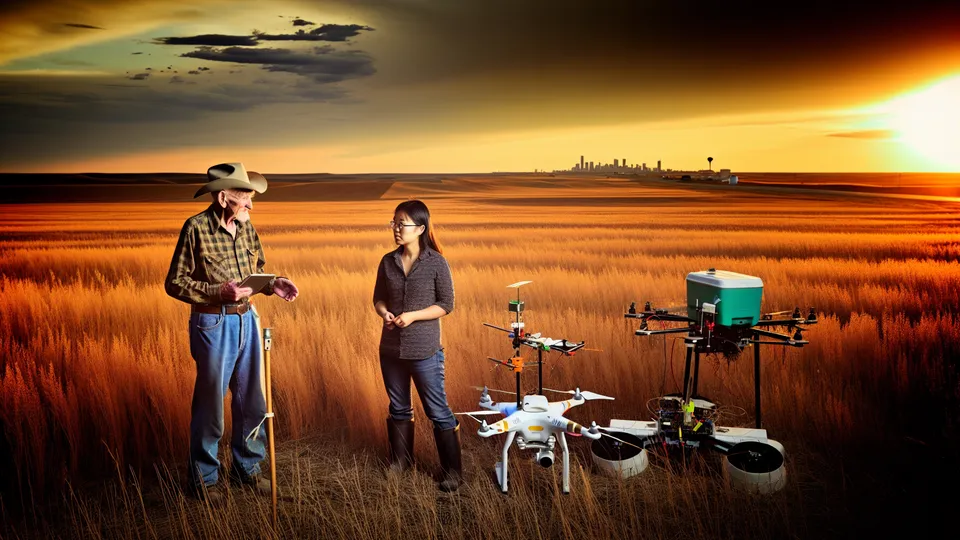
On a raw spring morning near Neepawa, Evelyn Martin walks the contour of a field that has been in her family for four generations. Her boots leave shallow impressions in dark, sweet-smelling loam. Along the wheel tracks a line of small gray cylinders—soil moisture sensors—glints like a newly planted army. Evelyn carries a tablet and a thermos, and when she crouches to read the numbers she murmurs as if to another person: “Forty-two at six inches. That’s better than last year.”
The scene is not simply about precision. It’s about a different relationship to the land: one where measurement replaces guesswork, community replaces isolation, and young people who once left for the city are finding roles that let them return. Over the last decade, farms around Brandon and the broader Westman region have become living laboratories for incremental, human-scale —less about headline-grabbing robots than about combining old practices and new tools to keep farms viable and soils alive.
Evelyn is one of a growing number of producers who have adopted cover cropping, reduced tillage and targeted irrigation guided by real-time data. “We used to go by the calendar,” she says. “Now we go by the plant.” Her family still plants wheat, canola and pulses, but small changes—mixing oats and peas as a cover in fall, using a variable-rate seeder in spring—have smoothed the year-to-year shock of erratic rains.
Nearby in Brandon, a small start-up led by Noah Singh runs field-mapping services for farms of all sizes. Singh’s company uses satellite imagery and drones to create what he calls “health maps”—lightweight, user-friendly overlays that point to compaction, nutrient gaps and early pest pressure. Farmers like Evelyn receive an email after a flight: “Yellow patch, west quarter—consider a chisel pass.”
“Most producers aren’t looking for a magic bullet,” Singh says. “They want a nudge. Tell them where to look and what to test, and they’ll do the rest.” This nudge model is quietly reshaping labor as well: local youth who once took construction jobs now manage fleets of small drones, service soil probes, or run tablet-based dashboards for neighboring farms.
Research partnerships anchor the technical work. The Brandon Research and Development Centre and Assiniboine Community College have run collaborative trials on multi-species cover crops, biochar amendments and low-disturbance seeding. Dr. Claire Dubois, an agronomist based in Brandon, describes the experiments as pragmatic. “We’re not chasing novelty,” she says. “We’re testing what keeps nutrients where they belong, how to cut inputs without losing yield, and how to measure progress in a way farmers trust.”
The trust piece matters. One of the largest innovations in Westman agriculture has been social rather than technological: the creation of data co-operatives. Farmers share anonymized yield and soil data in regional pools that allow benchmarking and collective bargaining for seed, fertilizer and carbon services. The co-ops defend data sovereignty—members control what gets sold to third parties—and they enable smaller farms to access analytics that would otherwise be cost-prohibitive.
There are real financial motivations: optimized input use trims costs and, increasingly, verified practices can access new revenue streams through early-stage carbon programs. But the most persuasive stories from Westman are about risk management and community. In the drought of 2021, farms that had diversified cover crop species and installed in-field sensors fared better. They didn’t always win awards; they kept cash flowing, crews employed, and families on the land.
Not every experiment works. Some farmers tried elaborate robotic weeding systems and found the maintenance appetite too high. Broadband remains inconsistent across the region, and the initial capital outlay for sensors or variable-rate equipment can intimidate older operators. There is also a cultural shift required: sharing data and adopting practices that look different from traditional rotations demands time and a willingness to be publicly imperfect.
But that friction is changing in concrete ways. Assiniboine’s agricultural programs now include apprenticeships with local farms; a mentorship network pairs retiree operators with young technicians. Local grain elevators have started offering incentives for loads accompanied by basic soil-health documentation. Municipal planners and rural co-operatives are beginning to map resilient corridors—routes where equipment and internet access are prioritized to support innovation.
The human cost and reward of that work comes into focus at Evelyn’s kitchen table. Her husband keeps a ledger—paper still—and a whiteboard where the crew records anomalies. Their youngest son, Carter, studied agriculture in Brandon and came back, not to take over immediately, but to launch a consulting gig helping neighbors adopt modest digital tools. “It’s not glamorous,” he says, “but there’s a dignity in fixing a problem that keeps people fed and employed.”
Looking forward, Westman’s agriculture will likely continue as an interleaving of low-tech stewardship and targeted digital tools. That hybrid approach makes the region resilient to the uncertainties of weather, markets and policy. It also preserves a social fabric: town hall meetings where a sensor company pitches a trial, evening workshops at a college, a co-op board deciding whether to test a new cover mix.
Innovation in Westman is not a spectacle; it’s a steady practice of combining curiosity with care. The result is not only better yields or reduced inputs but a quieter thing: communities that are renewing their relationship to the land, and to each other, one modest experiment at a time.