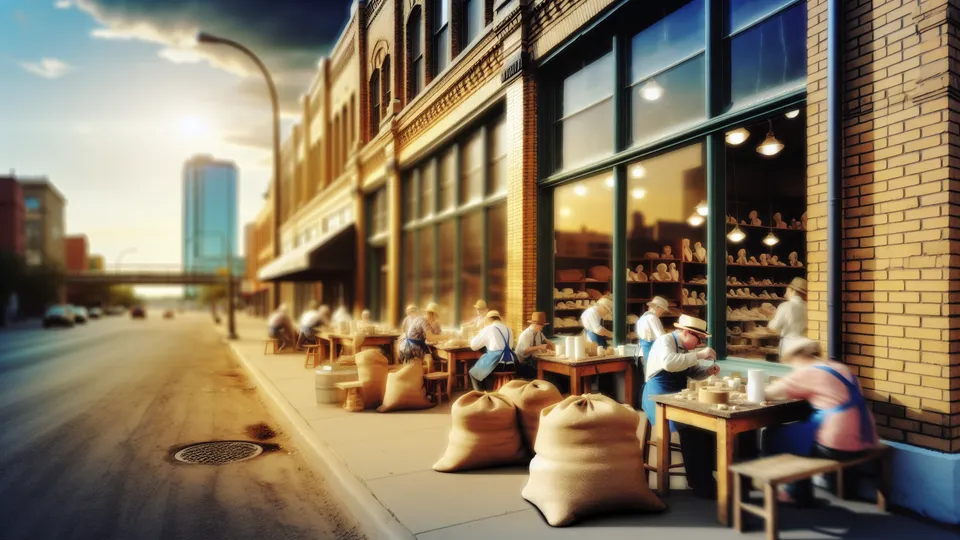
On a March morning along Rosser Avenue, a blue bicycle chained outside a low brick storefront is the quiet first sign of a different kind of economic life. Inside, the hum of a refurbished grain mill blends with chatter from a weathered counter; a young woman in a work apron adjusts a conveyor belt while an older man pins a label to a bag of prairie barley. The shop—part café, part micro-mill, part hub—sells loaves, local flour, and a subscription that delivers small-batch grains to families across Westman.
This scene is becoming familiar in Brandon and its satellite towns: businesses that refuse the simple duality of rural decline or urban mimicry and instead build hybrid enterprises that serve both local needs and distant markets. They are innovations that are as much cultural as technological—reconfigurations of who makes what, how it is sold, and what value looks like for a region long defined by commodity agriculture.
“People come in not just for the bread,” says Evelyn K., who founded the micro-mill two years ago. “They come because there’s someone who knows the farmer, who can explain the variety of grain, who understands the rhythm of harvest. That context changes what a commodity becomes.” Her operation sources grain within an hour’s drive, experiments with heirloom wheat, and hosts workshops that teach home bakers to appreciate variety and seasonality.
The practical innovations are modest but consequential: shared production spaces that reduce capital barriers; digital marketplaces that let a pottery maker in Virden reach buyers in Winnipeg; and supply agreements that link local producers to institutional buyers, such as hospital cafeterias and university dining halls. Marcus Liu, who coordinates experiential learning programs at Brandon University, notes that the most resilient startups here are those that integrate learning, apprenticeship, and production.
“Students bring design thinking and digital skills,” Liu says. “Local makers bring craft knowledge and networks. When they sit in the same workshop, the output is not a product that’s more fashionable—it’s a product that carries a story and a market.”
One compelling example is Harvest & Loom, a cooperative that began as a weekend craft market in a repurposed grain elevator. It now manages a small packaging line, an online storefront, and a workforce development program that provides paid internships to young people returning from studies and immigrants settling in Westman. The cooperative’s packaging uses recycled paper sourced from a Brandon recycler and includes QR codes linking buyers to the farmer and the maker—an effort to reintroduce provenance to everyday goods.
These businesses are not just seeking premium prices; they are repairing fractured value chains. During the pandemic, a number of Westman entrepreneurs pivoted from retail to filling gaps in local food security—turning a community kitchen into a steady supplier for food banks and establishing neighborhood delivery networks that now persist. Those short-term improvisations are becoming institutionalized—ways of ensuring locally produced goods reach vulnerable households without passing through fragile distant distributors.
The human impact is plain. For towns that have long struggled with youth outmigration, the new enterprises provide both meaningful income and a feeling of embeddedness. “I came back because I could imagine a life here that wasn’t waiting for a call from the city,” says Noah R., a craft brewer who returned to Rivers after training in Calgary. His brewery collaborates with a nearby hop grower, uses spent grain to feed livestock, and hosts weekly skill-share nights where coopers, bakers, and carpenters trade techniques.
Yet these innovations face structural headwinds. Access to capital remains uneven; most regional lenders favor conventional agricultural or real-estate projects over small-scale manufacturing. Broadband gaps and transportation costs complicate digital marketplaces. And scaling without losing the distinctiveness that makes Westman products appealing is a persistent tension.
Local leaders are responding in pragmatic ways. City halls, universities, and chambers of commerce are facilitating shared-use facilities, low-interest equipment loans, and procurement policies that prioritize local sourcing for public institutions. Rather than chasing Silicon Valley models, the region is building what might be called infrastructural patience: modest investments that lower start-up costs, expand networks, and accept slow growth as a design feature.
That approach—incremental, relational, place-based—has deeper cultural implications. It reframes from an extractive, growth-at-all-costs ideal to a practice of stewardship: stewarding resources, stories, and community skills. The result is a slower economy that nevertheless amplifies collective resilience.
In the weeks when a late frost threatened this year’s barley crop, members of the micro-mill organized transportation and temporary storage for a neighbor’s harvest, keeping the grain from being sold off cheaply. That kind of mutual aid may not appear in GDP statistics, but it represents a different metric of value: the ability to keep small enterprises viable through shared risk.
Looking forward, Westman’s experiment suggests a roadmap for other rural regions: invest in shared infrastructure, couple technical training with apprenticeship, and use public procurement to create stable demand. Above all, it requires recognizing that need not be exotic to be transformative. Sometimes it begins on a quiet street with a repaired mill, a used grain sack, and a willingness to remake a local economy around relationships rather than abstractions.
When afternoon light slides through the café windows on Rosser Avenue, customers linger over scones and conversation. Outside, the bicycle remains chained to the lamp post—a small emblem of a larger return: people choosing to stay, to craft, and to invent a future that belongs to the place they call home.