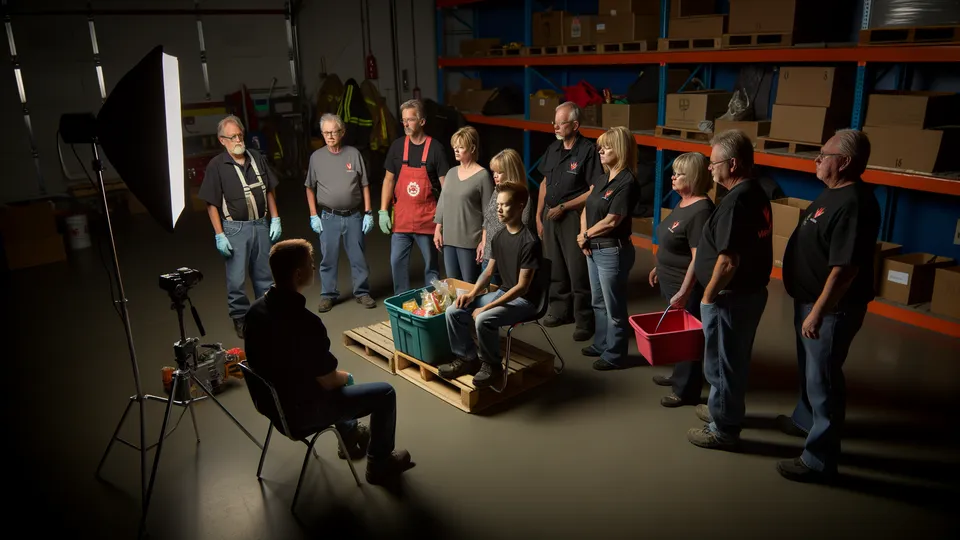
On a raw spring morning outside Brandon’s food bank, tables are laid out like a small assembly line. Margaret, 72, moves with the deliberate economy that comes from years of practice—sorting cans, folding bread bags, greeting newcomers by name. Beside her, Jamal, who arrived in Manitoba three years ago, explains to a young volunteer how to stack boxes to keep them balanced in a pickup. Their hands meet over the same task, the same urgency: community needs have surged, and the people who show up make the difference.
The image is familiar across Westman. From rural volunteer fire halls that double as community hubs to the hospital auxiliary selling pies in the lobby, unpaid civic service is the scaffolding of daily life. But that scaffolding is shifting. Local coordinators and longtime volunteers say the last half-decade has exposed fractures: an aging volunteer base, pandemic burnout, and an emerging preference for episodic and skills-based contributions rather than long-term commitments.
"We still have incredible generosity here," says a volunteer coordinator who has overseen placements in Brandon for more than a decade. "But the way people give their time has changed. We used to recruit people for weekly shifts; now people want to pick projects, or they can only commit for a few months." The observation mirrors conversations happening in nonprofits across Canada: traditional models of volunteerism are under strain, and institutions that rely on steady rosters are scrambling to adapt.
The consequences are not abstract. In small towns where volunteer fire departments are the first—and sometimes only—responders, recruiting and retaining volunteers is literally a matter of public safety. Ryan, a volunteer firefighter who grew up in a Westman community, explains that calls used to be covered by a dozen regulars. "Now sometimes we’re down to six, and that can mean long response times or missed training," he says. "It’s not because people don’t care. It’s because work schedules, child care needs, and distance make regular attendance harder."
Healthcare institutions feel the pressures in other ways. The Brandon General Hospital Auxiliary, like many hospital auxiliaries across the province, has long relied on retirees for fundraising and patient support. As those volunteers age out, coordinators report a gap in both manpower and institutional memory. "We keep losing volunteers to health reasons and fewer young people are stepping up for the traditional roles," one auxiliary member told me. "But we've also seen younger volunteers bring fresh skills—social media, event planning—that we desperately needed. It's a matter of matching needs to capacities."
Those matches are increasingly creative. Across Westman, organizations are experimenting with micro-volunteering—short, defined tasks that can be completed in a single session—and skills-based volunteering, where professionals lend expertise for specific projects. A local newcomer settlement program paired an IT contractor with a volunteer coordinator to automate client intake forms; the result was faster service and less front-desk pressure. A rural museum drew on a university student’s grant-funded research to digitize archives in a month rather than a year.
Newcomers themselves are reshaping service. For some, volunteering is a route to community belonging and employment references. For others, it’s a chance to transfer skills learned abroad into meaningful local work. Jamal, who now leads evening language circles at a neighborhood center, says volunteering gave him both a network and confidence to apply for paid work. "People treat you like you belong," he says. "That matters."
But adaptation requires resources. Smaller nonprofits cite administrative burdens as a barrier to : creating short-term positions, training volunteers for skill-heavy tasks, or offering modest stipends all cost time and money. Volunteer Manitoba and municipal programs provide frameworks and occasional grants, but many local coordinators say sustained municipal support—coordinated recruitment platforms, childcare subsidies for volunteers, and recognition that volunteer time is infrastructure—would lower the bar.
There are promising experiments. A coalition of Westman organizations launched a shared volunteer database last year, allowing prospective volunteers to search multiple opportunities in one place. High schools in Brandon have instituted community-service partnerships that recognize flexible volunteering alongside traditional placements. And small stipends or transit passes offered by some groups have noticeably improved retention among younger and working volunteers.
The human thread through all these changes is persistence. Margaret’s hands keep sorting. Ryan still answers the call when the alarm rings. Newcomers like Jamal turn early volunteer shifts into lasting civic ties. If the future of volunteerism in Westman is uncertain, it’s being forged in the practical, improvisational way the region has always made things work: neighbor helping neighbor, adapting when necessary.
The question for the next decade is whether that improvisation will be supported intentionally. Civic resilience depends not only on goodwill but on systems that respect changing lives—flexible roles, paid coordinators, accessible training, and public investment. Without them, volunteers become a scarcer commodity. With them, Westman’s long tradition of mutual aid can become more inclusive and sustainable, blending the loyalty of lifelong volunteers with the energy and skills of a new generation. In the end, the work will likely remain the same—putting food on a table, answering an alarm, holding a newcomer’s hand—but the way that work is organized will determine how reliably it gets done.