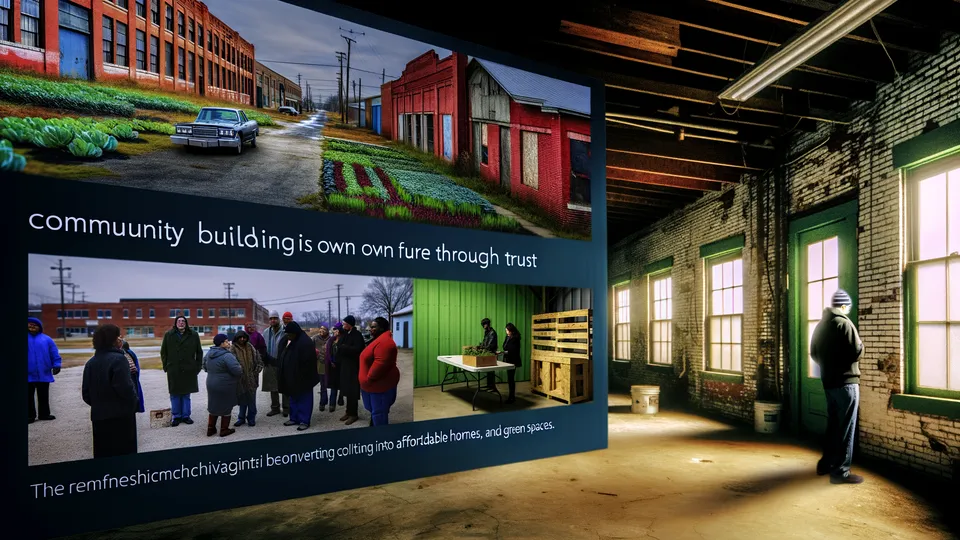
On a late spring morning a block off Brandon's main street, paint buckets glisten on a plywood counter while a toddler chases a paper airplane across newly refinished floorboards. The storefront they surround used to sit empty for nearly a decade, its windows clouded with dust and its doorway pasted with faded flyers. Today it is Prairie Commons — a hub where a bakery shares space with a childcare cooperative and a small business incubator. The change here is quiet and quotidian, but it also maps a larger experiment unfolding across Westman: a community-led effort to reclaim land, buildings and local agency.
The Westman Community Land Trust (WCLT), launched in 2019 by a coalition of neighbourhood organizers, small-business owners, and university researchers, has become the practical engine of that experiment. Its model is straightforward in theory and complex in practice: acquire underused properties, rehabilitate them for mixed use, and hold them in a trust so the community — not speculative markets — benefits from the long-term value. "We wanted tools that would let us plan for people, not for profit margins," says Sarah Kaur, WCLT's director of projects. "That meant thinking about housing and jobs as part of the same ecosystem."
WCLT's earliest projects were modest but deliberate. In Brandon, it converted a row of single-storey storefronts into six affordable rental units above ground-floor workshops. In Neepawa, a former printing press was refashioned into a culinary incubator where three food entrepreneurs share equipment and licensing. Across the region, the trust has brokered 48 affordable units, activated 12 previously vacant commercial spaces and financed a community garden network that ties pocket parks to local meal programs.
Numbers only tell part of the story. Consider Samantha Lopez, who moved to Brandon two years ago with her three-year-old daughter after losing stable employment in a larger city. "I couldn't find anything that didn't require a credit history or six months' rent up front," she remembers. A unit in Prairie Commons gave her a predictable rent, a neighbourly network, and a short walk to a licensed childcare spot operated by parents and trained early-childhood workers. "It feels like someone planned life with families like mine in mind," she says. "That makes a difference you can't always put on a balance sheet."
That human scale is baked into the trust's governance. Residents, local Indigenous leaders, small-business representatives and municipal officials hold seats on WCLT's board. Mary Sinclair, an Anishinaabe community organizer from the Treaty 2 territory, helped secure space within two projects for cultural programming and Indigenous-run social enterprises. "We were clear from the start that decolonizing land in Westman means making space for ceremony and traditional stewardship, not just new buildings," Sinclair says.
Vocational renewal has been a practical byproduct of redevelopment. Earl McKay, a retired carpenter, runs "Hands On Westman," a training program subcontracted to several WCLT renovations. Teenagers learn framing and weatherization while earning stipends; older tradespeople gain work refurbishing heritage facades. "People learn skills and we keep money circulating locally," McKay says. "It's not glam — but it's steady, and it's building capacity."
There are measurable wins. Green retrofits — improved insulation, LED lighting, heat pumps — have reduced energy consumption in several WCLT buildings by roughly 25 to 30 percent. The trust is financing a community-owned solar array that will supply electricity to a cluster of mixed-use sites, lowering operating costs and giving residents a stake in utility revenues.
Challenges remain. Financing complicated, smaller projects in tertiary markets requires patient capital; provincial policies around zoning and taxation can slow conversions; and maintaining a mixed-income mix without relying on ongoing subsidies is an ongoing negotiation. "We've learned that community land trusts can't be purely charitable projects," Kaur says. "They need disciplined business planning and sometimes municipal policy nudges to make the math work."
Still, the initiative's ripple effects have been felt beyond the buildings themselves. Local procurement clauses have steered renovation contracts to Westman suppliers; pop-up festivals in reclaimed lots have brought foot traffic back to dormant blocks; and a nascent network of municipalities — Brandon, Virden and Neepawa among them — have begun sharing policy templates for community ownership models.
Looking ahead, WCLT plans a regional housing co-op that would let renters buy into stewardship, and a pilot mobile workshop to bring training to smaller towns. The trust's leaders are also pushing for a provincial framework that recognizes community land trusts as an eligible instrument for affordable housing capital in Manitoba.
What distinguishes Westman’s experiment is not simply the reuse of brick and timber but the insistence that development be relational: between neighbours, between generations, and between urban cores and the prairie hinterland. "You can see it in small things — the way someone leaves a hand-me-down drill at the workshop, or in how kids have a place to run while adults are in a meeting," Sinclair says. "Those are the investments that last."
On a weekday afternoon, Samantha watches her daughter use a fingertip to trace a painted wheat sheaf on the community wall. The child giggles, then runs off to practice balancing on a low bench. Nearby, volunteers chalk a schedule for an evening storytelling circle. The scenes are ordinary in many ways, and extraordinary in how deliberately they have been made to fit the lives of people who live here. In a region often written about for its departures, Westman has been quietly rewriting the terms of return, proving that redevelopment can be neither top-down nor tokenistic — it can instead be a labour of collective place-making that binds an economy to the people who inhabit it.