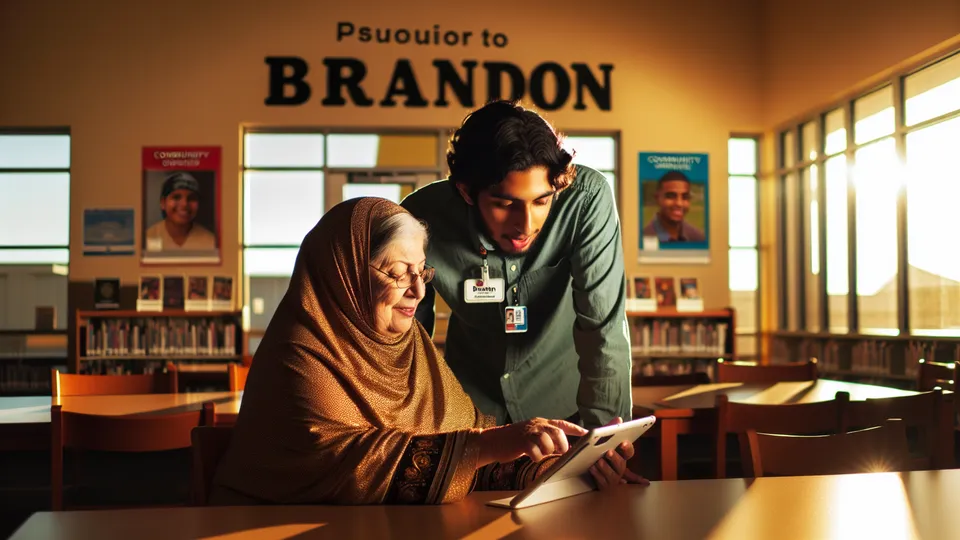
On a late-winter afternoon at the Brandon Public Library, a circle of folding chairs had the intimacy of a living-room conversation. Evelyn Martin, 72, sat beside a steaming mug of tea and a small tablet propped on a foam stand. Across from her, Aisha Khan—an instructor from Assiniboine College—guided Evelyn's finger across a calendar app, teaching the motions and the purpose behind them.
'It's not the I mind,' Evelyn said, folding her worn cardigan tighter. 'It's that I'm afraid of doing something wrong and losing it all.'
By the time the two-hour class ended, Evelyn had scheduled her first telehealth appointment, paid an overdue electric bill online, and sent a shaky first message to a grandson who lives in Calgary.
That quiet sequence—the patient unraveling of fear into competence—is the work of a new regional effort quietly reshaping life across Westman. Since its founding two years ago, a coalition of libraries, community college educators, municipal officials, and local businesses has run what they call Westman Connected: a series of workshops, pop-up digital clinics, and resource-sharing programs that aim to knit technology into the everyday routines of smaller towns without erasing the textures of rural life.
Westman Connected began as an ad hoc response to the pandemic, when telemedicine, online registration, and remote work suddenly demanded a baseline of digital fluency. Organizers say that early success in Brandon prompted invitations from nearby towns—Virden, Neepawa, and Minnedosa—to replicate the model. What started as a handful of classes has expanded into an ecosystem of services: loaner laptops housed at municipal offices, mobile hotspot routers that travel to community centers, evening drop-in help sessions in long-term care homes, and an e-commerce training series for Main Street merchants.
The initiative explicitly focuses on skills as much as infrastructure. 'Access without literacies is like a road without maps,' said Liam Carter, director of community programs at the library. 'We teach people what to do when a button appears, how to evaluate a message, how to reclaim a service that feels remote.'
That pedagogy plays out in discrete, meaningful ways. Miguel Lopez, who runs Lopez Hardware in Virden, once sold nearly all of his drills, plumbing supplies, and paint to walk-in customers. After taking a one-day e-commerce clinic with Westman Connected, he built a basic online inventory, learned to photograph products on a simple white sheet, and set up click-and-collect. 'My first online order was for a beaded curtain,' he laughed. 'It was the silliest thing, but the man who bought it had been driving from 45 minutes away just to pick up a bulb. Now he orders ahead. It's less time wasted for him, less guessing for me.'
In health care, the impacts are subtler and more structural. Nurses and administrators in Brandon's community health centers report that residents with digital skills are more likely to attend appointments, maintain medication schedules using reminder apps, and coordinate transportation when needed. The project has brokered partnerships with local clinics to set up private telehealth booths in community centers so people who lack home internet can still access virtual consultations.
Young people have become translators between worlds. High-school students and college interns staff drop-in cafés and teach grandparents to use social apps, but they also return home with a different sense of place. One former trainee, now employed remotely by a Winnipeg non-profit, credits the program with opening a pathway to work that allowed her to remain in Neepawa while contributing to a metropolitan organization.
The initiative is not without friction. Broadband gaps remain stubbornly territorial; a pop-up hotspot can't substitute for a household connection. Skepticism persists among residents who equate new platforms with scams and surveillance. And coordination across municipalities requires constant attention: scheduling instructors, securing shared devices, and maintaining trust with local health providers.
Organizers are candid about those limits but pragmatic about how to move forward. They are negotiating with regional internet providers to align municipal capital projects with digital-literacy programming so new infrastructure is matched by outreach. They are developing a 'train-the-trainer' curriculum to scale knowledge through local volunteer networks. And they are tracking outcomes—appointment attendance, business revenues, youth employment—so that the effort can speak plainly to funders and policy makers.
If there is a throughline here, it is not that technology transforms places automatically. The work is slower and quotidian: a librarian replacing trepidation with confidence, a hardware owner learning to photograph a widget, a teenager staying in town because her skills are portable. These are the seams where durable change happens.
Evelyn, who now checks in on family video calls every Tuesday, puts it simply: 'I don't want to be a stranger to my own life.'
For communities across Westman, that sentence reframes the stakes. The future of rural digital inclusion will turn on whether small towns can weave technology into civic life without losing what makes them distinct: neighborly care, mutual aid, and practical know-how. Westman Connected is less a technological silver bullet than a civic experiment—one that asks an old question anew: how do communities keep pace with wider social change while sustaining the relationships that bind them? Its answer, so far, has been to teach the hands, coach the minds, and trust the slow work of learning together.