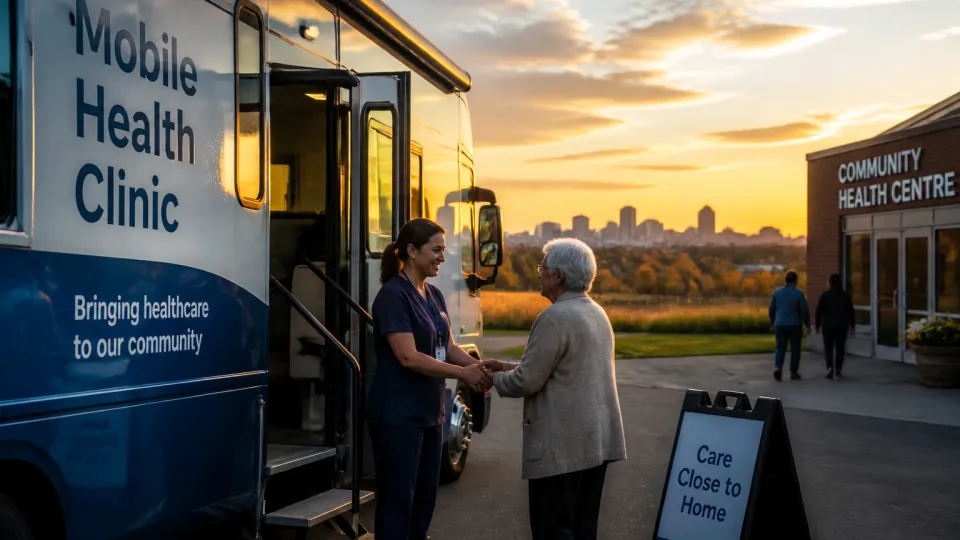
On a wind-bitten morning in late March, a converted school bus idles outside a volunteer-run food bank on the edge of Brandon. Solar panels line its roof; inside, a nurse checks the vitals of a woman who works night shifts at a poultry plant. The woman fumbles with a paper list of medications, relieved when the nurse takes the time to explain which pills should be taken together.
This rolling clinic is the most visible part of PrairieBridge Health, a community health initiative founded by Maya Sinclair, a 39-year-old entrepreneur who grew up on a grain farm west of Virden and studied social enterprise in Winnipeg. Sinclair is not a clinician but she has become, in the eyes of many residents and health-care professionals across Westman, an essential connector in a system stretched thin.
"I kept seeing the same patterns: long drives for routine care, missed follow-ups, people relying on emergency rooms for non-emergency needs," Sinclair says. "You don't have to be a doctor to see where the bottlenecks are. You need relationships, and you need to bring care to where people actually are."
PrairieBridge began in 2018 as a pilot program offering weekend diabetes and hypertension clinics at community centres in Brandon and Neepawa. It has since expanded into a suite of services: a mobile clinic that visits towns from Minnedosa to Swan River, telehealth kiosks placed in five public libraries and two Indigenous friendship centres, and a Community Health Corps that employs local residents as health navigators and peer support workers.
Sinclair's approach is deliberately pragmatic. Rather than replicate the offerings of the Brandon Regional Health Centre, PrairieBridge focuses on the interstices—medication reconciliation, chronic disease education, mental-health check-ins and warm handoffs to primary-care providers. The mobile clinic is staffed most weeks by a nurse practitioner and a community health worker; when a patient needs psychiatric care, a telepsychiatry session can be arranged the same day using a secure video line.
One afternoon last summer in Rivers, a 62-year-old man came to a PrairieBridge pop-up clinic complaining of dizziness. Instead of sending him straight to the emergency room, the team performed point-of-care blood tests, reviewed his medications and discovered an interaction between a new prescription and an over-the-counter supplement. A phone call to his family physician arranged a medication change and a follow-up telehealth visit. For the man, it was less than an hour in a familiar place. For the local system, it was an avoided ambulance call and an avoided overnight stay.
"They gave me time—and someone who listened," the man told me. "I didn't have to drive to Brandon and sit in a waiting room all day."
PrairieBridge's work depends on practical partnerships. Sinclair forged an early collaboration with the Brandon University nursing program, which now sends students to staff mobile clinics as part of clinical placements. Local paramedics participate in community paramedicine shifts that prioritize home visits for high-risk patients. Prairie Mountain Health provides data-sharing agreements that help the startup identify service gaps without duplicating efforts.
Beyond immediate clinical outcomes, Sinclair emphasizes workforce creation. The Community Health Corps has hired more than two dozen Westman residents, many of them women balancing caregiving responsibilities, training them in health navigation, chronic-disease coaching and digital-literacy support for older adults. "Employment changes how people see themselves," Sinclair notes. "It's not just about health metrics—it's about dignity and belonging."
Measurable impacts are emerging. In the communities where PrairieBridge operates regularly, clinic leaders report fewer non-urgent emergency-room visits and improved adherence to follow-up appointments. Patients with diabetes enrolled in PrairieBridge education sessions are more likely to attend scheduled endocrine consultations, local clinicians say. Those numbers are modest so far, but the real value, residents insist, is relational: a steady presence that builds trust over time.
Funding remains the challenge. Sinclair balances grants, fee-for-service contracts and philanthropic donations, and she is candid about the fragility of the model. "Scaling community care in rural places isn't a tech problem—it's a financing and policy problem," she says. PrairieBridge is advocating for sustainable payments for telehealth, community-based chronic-care coordination and training stipends for community health workers.
Looking ahead, Sinclair plans to pilot a social-prescribing program that connects patients to local resources—housing support, senior-friendly exercise groups, culturally appropriate programming for Indigenous clients—rather than only to medical specialists. She is also developing a data dashboard that would allow local clinics and Brandon Regional Health Centre to coordinate referrals and track outcomes without compromising privacy.
The story of PrairieBridge is, in part, a story about the adaptability of small-town people and institutions. It is also about the limits of improvisation when structural supports lag. Sinclair's work does not obviate the need for more clinicians in Westman, but it reframes care by redistributing tasks, cultivating local expertise and bringing services into community rhythms.
When I asked Sinclair what keeps her going on the days the bus breaks down or a grant falls through, she paused. "You see somebody who had nowhere else to turn, and they get what they need. That's not dramatic, but it's everything. We are building something that can endure because it's built on relationships, not headlines."
If PrairieBridge's modest experiments continue to stitch into the broader health system, Brandon and its neighbours may offer a lesson to other rural regions: that in health care begins not with disruption, but with patience, local knowledge and a willingness to meet people where they are.