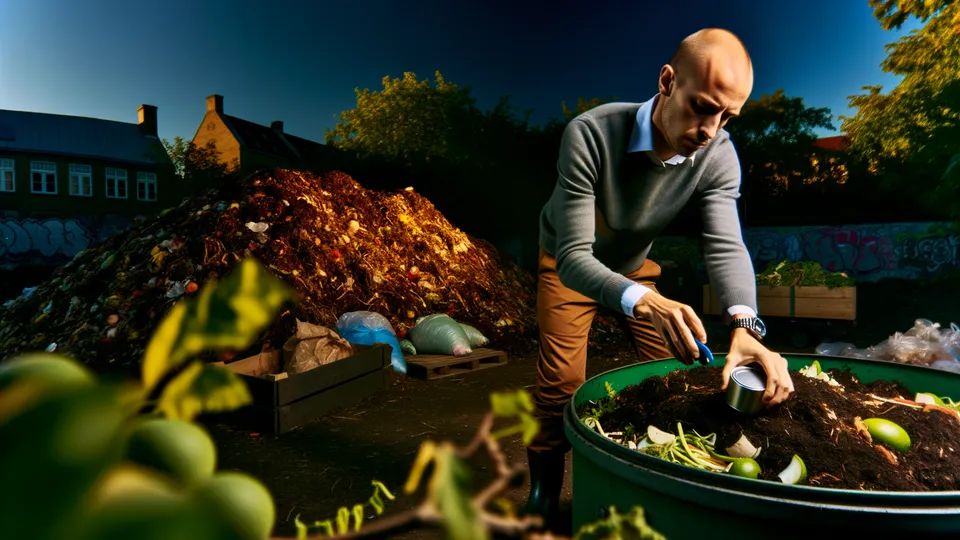
On a late April morning at the Brandon Farmers' Market, the smell is not of frying onions or sweet doughnuts but of earth—warm, slightly sweet, unmistakably alive. Under a blue tarp, a battered wheelbarrow carries dark, granular soil that draws people in the way bread draws a crowd. Rowan Sinclair, grease-stained gloves tucked into his back pocket, hands a small clump to a woman with gardening gloves. "Smells like the river in spring," she says. Rowan smiles as if she has just confirmed something he has worked toward for years.
Sinclair is not a conventional farmer. In his mid-thirties, with a calm cadence and a conviction that feels practiced rather than rehearsed, he runs Prairie Root Collective, a Brandon-based social enterprise that collects food waste from restaurants and institutions across Westman, composts it at a modular facility, and returns the finished soil to gardens, local farmers, and public spaces. What began as a backyard compost pile and a nagging sense of wasted potential has expanded into a network that diverts roughly 120 tonnes of organic waste per year from landfills, partners with fifteen restaurants and three municipal institutions, and supports six community garden projects across the region.
"It wasn't always this tidy," Rowan told me in a conversation while he loaded a pallet of finished compost into a flatbed. "There were a lot of mistakes—contamination, vermin, cold snaps that stalled decomposition. But each failure taught us how to design for prairie realities: the long winters, the fluctuating volumes from harvest to holidays, the patchwork of municipal regulations. We learned to adapt and to keep asking who benefits."
The Collective's work is as much about relationship-building as it is about biochemistry. In Brandon, where agriculture dominates both landscape and imagination, the idea of returning food to the soil resonates, but the logistical and cultural hurdles are substantial. Rowan's strategy has been to start small and local. He convinced a handful of restaurants—an artisanal bakery downtown, a diner near the university, an Indigenous-owned café on Princess Avenue—to separate their organic waste, then invested his modest savings to build a mobile composter: an insulated trailer equipped with turning drums, heaters, and a biochar unit to stabilize nutrients through winter.
"We used to throw everything into a bin, no thought," said Maria Lopez, owner of the bakery. "Rowan came by, explained the science without making me feel ignorant, and picked our scraps up twice a week. It's cleaner now, and seeing the soil back at the market—it's a full circle."
Prairie Root's soil is not just a symbol; it changes measurable things. In demonstration plots on city allotments, organic matter climbed from about 2 percent to 4 percent in two growing seasons, improving water retention and reducing fertilizer needs. Schoolyards that planted with the Collective's compost recorded healthier seedlings and lower irrigation calls during hot stretches. For local gardeners, the value was practical and immediate: better yields from pea rows, fewer pests, and a sense of stewardship where once there was disposal anxiety.
Training has been integral to Rowan's approach. The Collective runs an apprenticeship that has taken on twenty young people from Brandon and surrounding towns, many of them new Canadians and Indigenous youth. The program combines hands-on compost management, small- skills, and a component on traditional land stewardship led by an Indigenous elder. "It's about reclaiming a relationship with the land—not a romantic notion but a set of practices that sustain life," Rowan says. Several apprentices have gone on to start their own micro-enterprises: a nursery selling native plugs, a landscaping crew specializing in low-input gardens.
The impact is not only ecological or vocational; it is civic. City councillors have visited the mobile composting site and begun conversations about municipal organics programs. The Collective's pilot has highlighted how much of what the city pays to bury could instead feed soil—turning an expense into an investment. Yet scaling up is difficult. Challenges include winter energy costs for the composting system, contamination from non-compostables, and the limited availability of landing sites zoned for processing. Funding remains project-based, which complicates long-term plans.
Rowan is candid about that friction. "If we want systemic change, we need policy that recognizes circular flows—food to soil, soil to food. That means municipal leadership and flexible infrastructure funding that works across seasons. Otherwise, we stay a nice story with a limited footprint."
Looking ahead, Prairie Root Collective is piloting a regional hub model: centralized processing during summer, satellite warming units in winter, and a pay-what-you-can subscription for households. Rowan also envisions partnerships with nearby rural municipalities where crop residues could be blended with urban organics to make large-batch soil amendments for degraded fields.
What keeps him going, he says, is the small confirmations—the gardener who brings a jar of pickles to say thank you, the youth who texts a photo of a backyard greenhouse thriving on the Collective's soil. "You start to see soil as a ledger of care," Rowan told me, watching a volunteer turn a steaming pile. "Every handful has the story of people who cooked, who hauled, who learned. It's messy, human, and exactly what should be: a practice of repair."
Prairie Root's story is not a prescription for solving global climate change, nor does Rowan pretend it is. It is a localized experiment in remaking waste into resource, in rebuilding ties between city and field, and in training the next generation to do work that is equal parts technical and humane. In Brandon, where the prairie reaches out in all directions and winters press the pause button on growth, those small acts of repair add up—ton by ton, garden by garden—to a different kind of resilience.