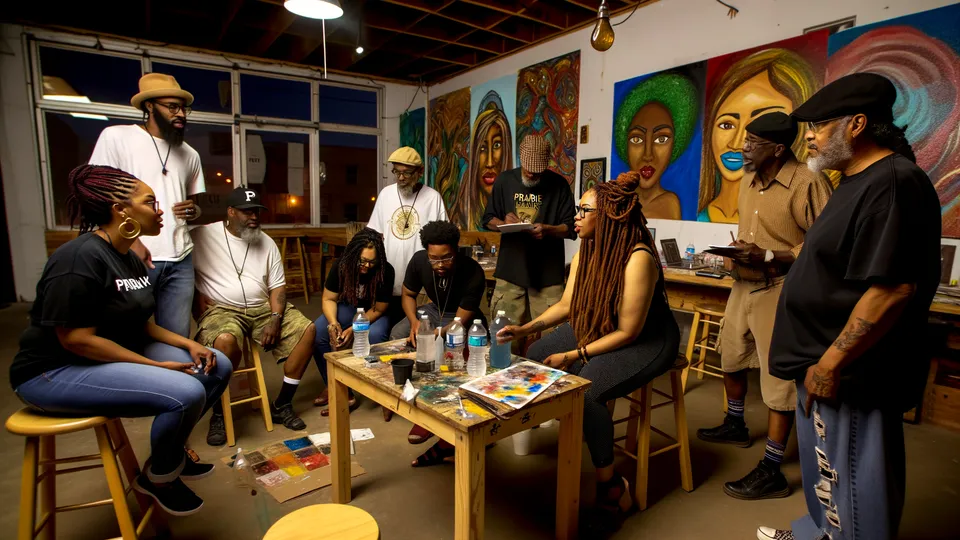
At 7:30 on a November morning, the heaters in the studio kick on with a soft clank and a smell of coffee and linseed oil fills the air. Maya Thompson moves through the space with the calm certainty of someone who has spent years learning how things reopen — what needs patching, which conversations require extra time, and which canvases should be left unwatched for a day so paint can breathe. The storefront is modest: high windows with a view of Main Street, a narrow gallery, a back room for classes. But the building is not what defines her work. It is the steady accumulation of people who have been given room to try, to fail, and to recommit to making things together.
Thompson founded Prairie Light Studio in 2016 after returning to Brandon from a period living and studying in the Prairies and the West Coast. She had watched small cities and rural towns build cultural infrastructure not through headline projects but through patient networks: pop-up exhibitions in cafés, collaborative murals across neighborhoods, a roster of weekly classes that met the rhythms of local life. She saw an opportunity in downtown Brandon — a place where a vacant storefront was less a failure than a blank page — and she set about turning it into a place that could hold practice, commerce, and conversation.
The work is practical and municipal as much as it is aesthetic. Prairie Light offers low-cost studio rentals, a sliding-scale workshop calendar, and an apprenticeship program for local youth. For many participants, the space is an incubator: a place to learn how to prepare a portfolio, price a commission, or navigate the logistics of grant applications. For others, it is a site of return — adults who stepped away from art during parenthood or after layoffs find a re-entry point where judgment is subdued and curiosity encouraged.
One of the studio's flagship initiatives has been a series of neighborhood mural projects. Instead of hiring a single artist to paint a wall in isolation, Thompson's team brings together residents, high school students, Indigenous knowledge-keepers, and local businesses. The resulting murals are not decorative afterthoughts; they are stitched into local narratives. In one project on the south side of town, youth apprentices worked side-by-side with an elder to depict the seasonal cycle of the Assiniboine valley. 'It changed how I see my neighborhood,' said Eli, a sixteen-year-old apprentice who used to skip art class and now teaches sign-making techniques to younger volunteers. 'People stop when they walk by. They ask why the river is blue here or what the animals are doing. That starts conversations.'
Thompson has been deliberate about the studio's relationship to Indigenous artistic practice. She partners with local Indigenous artists and storytellers to co-design residencies, ensuring cultural protocols are respected and that compensation is fair. These partnerships have shifted the character of public work across Brandon, encouraging municipal planners and owners to think differently about placemaking and cultural consultation.
Economically, Prairie Light is modest but consequential. Studio rentals and workshop fees cover part of the overhead; local grants, small business loans, and event revenue fill the rest. More importantly, the studio acts as a multiplier: cafés and shops nearby report steadier midday traffic when exhibitions are on; artists who trained at Prairie Light have contracted for school projects and public commissions across Westman. Thompson estimates the studio has directly supported more than 120 artists and engaged over 2,500 participants in programs since opening — numbers that matter in a city where cultural infrastructure has historically been lean.
The work has not been without strain. Securing long-term, affordable space is an ongoing challenge, as is the ever-present balancing act between community programming and financial . Thompson is candid about the compromises: 'There are months when I spend more time writing grants than I do painting,' she says. 'That's not glamorous, but it's necessary if this place is to keep serving people.' She is also relentless about maintaining standards — insisting on paid opportunities for artists and on projects that prioritize community voice over quick visual fixes.
Looking forward, Thompson imagines Prairie Light as a node in a wider Westman constellation of cultural spaces: a mobile art van to bring workshops to smaller towns, satellite pop-ups in neighboring communities, and a formalized apprenticeship pathway in partnership with Brandon University and local high schools. Her ambition is not expansion for its own sake but a decentralization of cultural access — a belief that creative practice should be as distributed as grocery stores or libraries.
The measure of Prairie Light's success is not an Instagram following or a glossy brochure. It is the way people use the studio: a retired mechanic learning printmaking, a recent immigrant leading a textile workshop, teenagers who once leaned on the edges of downtown now installing a mural with a neighbor they waved to every day without knowing. In a region where economic and social shifts can feel abrupt, Thompson's work has introduced a different tempo: patient, iterative, and relational. That tempo has given Brandon more than colorful facades; it has given the community a framework for seeing art as a practice of care and a tool for civic imagination.
On an afternoon in late winter, as students pack up their brushes and neighbors linger with hot drinks, Thompson stands by the window and watches people move in and out of the light. It is a small scene, ordinary in its parts, but it feels like the beginning of a long chapter — one where culture is not an add-on but a scaffold for how a place learns to keep itself whole.