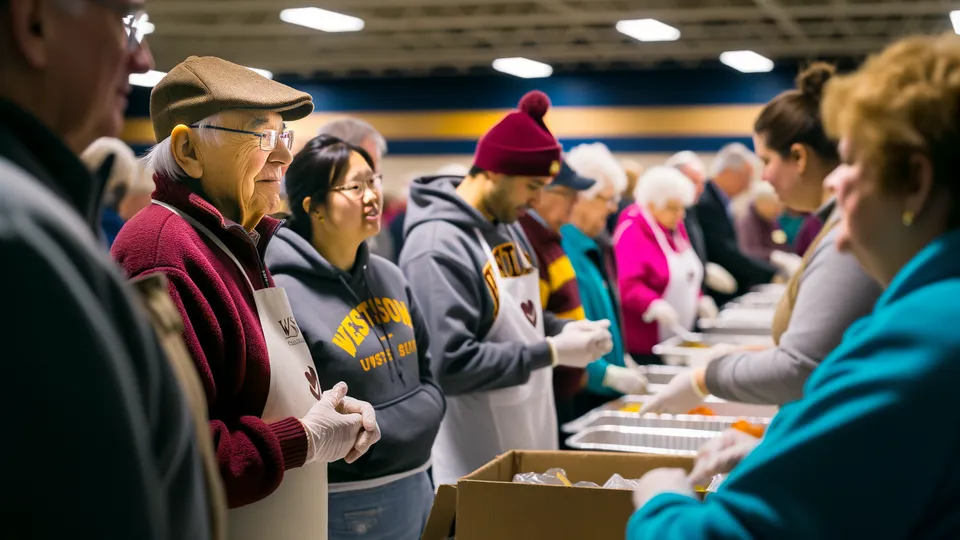
At 7 a.m. on a January morning, the fluorescent lights of a Brandon warehouse hum awake and a line of volunteers files in, coffee mugs warming their palms. Margaret, 71, a retired schoolteacher with a careful braid, moves between pallets of canned goods and winter coats, slipping a marked envelope of hygiene items into every box. Across the room, a group of Brandon University students hefts crates, their breath fogging in the cold as they laugh about exams and where the next shift's sandwiches will come from.
This is the choreography of community service in Westman: ordinary people assembling, hour by hour, to make small seams in an otherwise brittle safety net. Their labor is practical and immediate—sheltering a family after a house fire, delivering a hot meal to a man who lives alone, staffing a pop-up vaccine clinic—but it is also quietly transformative. In places where formal services can be stretched thin by distance, funding cycles, or capacity, volunteers become the connective tissue that holds civic life together.
The programs are as varied as the people who run them. In Brandon, food distribution efforts operate out of modest storefronts and church basements. A rural volunteer circuit delivers groceries to seniors living on gravel roads hours from the city. Local high schools organize clothing drives and mentorship programs, pairing students with younger children for reading and homework help. At the Brandon Friendship Centre, Indigenous elders meet with youth for cultural teachings and crafts, blending practical support with reclamation of tradition.
'People often think we're just passing out food,' says one volunteer coordinator, who has worked with assorted Westman organizations for more than a decade. 'What we do is create a place where someone is seen. They can get food, sure, but they also get a conversation, a contact, a reminder that someone cared enough to show up.'
That human element matters in measurable ways. When Meals on Wheels or similar programs make a regular stop, they do more than satisfy hunger; they provide health checks, spot changes in mobility or mood, and alert professional services when a situation requires intervention. Volunteers often act as early warning systems for neighbours who have slipped between bureaucratic cracks.
Yet volunteerism in Westman has changed in recent years. The demands have grown more complex as economic pressures and climate-related emergencies—spring flood responses in low-lying communities, sudden weather-driven power outages—create spikes in need. At the same time, recruitment is harder, with competing obligations and a smaller pool of retirees who once formed the backbone of many programs.
Community organizations are responding by rethinking how they mobilize people. Student groups from Brandon University and Assiniboine Community College increasingly collaborate with local nonprofits for service-learning projects, bringing younger volunteers into established systems and providing structure that helps sustain longer commitments. Digital coordination tools make scheduling and tasking more efficient, while training programs emphasize boundaries and emotional resilience to prevent burnout.
'We try to meet volunteers where they're at,' says a student organizer coordinating a winter drive. 'Some people can only offer a few hours on weekends; others commit to weekly shifts. The point is building relationships, so when crises hit, we already know how to work together.'
The projects themselves are becoming more holistic. Food programs now include nutrition education and links to employment services. Emergency responses coordinate with municipal planners to anticipate vulnerable neighbourhoods during extreme weather. Indigenous-led initiatives center cultural continuity alongside material aid, ensuring that service is not only about survival but also about dignity and belonging.
There are small, telling scenes that capture this ethos. A teenage volunteer teaching a senior woman how to video-call her grandchildren. A retired paramedic who uses his expertise to streamline intake processes at a warming centre. A farmer who diverts hay and manpower to a neighbour when a barn collapses after a spring storm. These are not heroic acts in the cinematic sense; they are steady, ordinary commitments that accumulate into community resilience.
Looking ahead, Westman's volunteer networks face persistent challenges: funding uncertainties, volunteer retention, and the structural issues—affordable housing, accessible healthcare, transportation—that create the very needs volunteers are trying to meet. The answer, many organizers argue, is not to romanticize volunteer labor as a replacement for public investment, but to integrate it more deliberately with formal services.
That means supporting volunteers with training, flexible schedules, modest stipends where possible, and clear pathways for youth to transition into long-term civic engagement. It also means policymakers listening to the lived experience volunteers accumulate on the ground; their insights about gaps in service are a valuable resource for planning.
On a below-freezing afternoon, as another shift wraps up at the warehouse, Margaret ties her scarf and looks out at the street. 'People ask me why I keep doing this,' she says. 'I tell them: it's how we stay human. It's how we make this place liveable.' Her words are both an answer and an invitation: a practice of service that sustains not only those in need but the fabric of community itself.
In Westman, the work of volunteers remains messy and imperfect, but it is also incarnate and hopeful. The future will demand more of these networks, not less. If the region wants resilience, it will have to invest in the people who already show up—supporting them, learning from them, and ensuring that their gifts are met with the resources needed to translate compassion into durable social change.