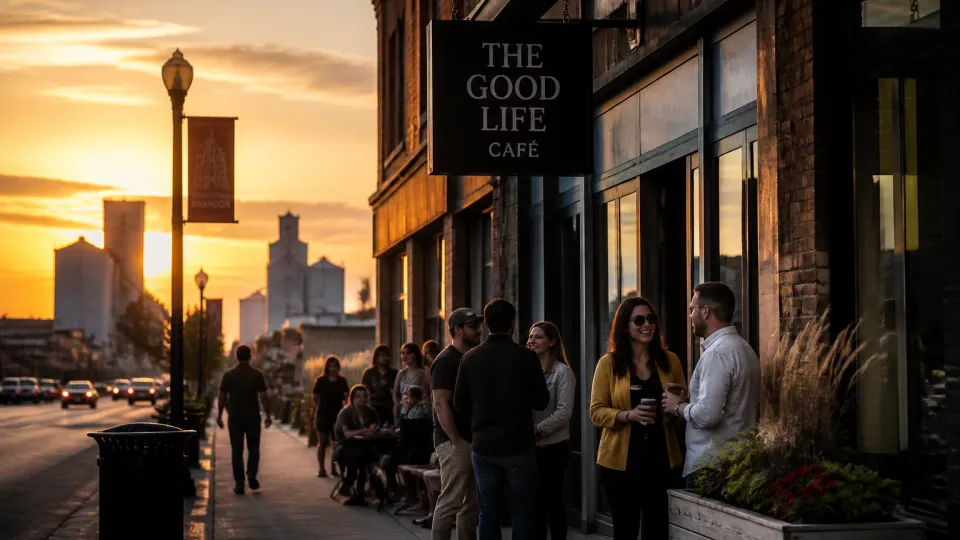
On a Tuesday evening in downtown Brandon, light pours through the tall windows of a converted furniture shop. People sip coffee, tap keyboards and argue about marketing funnels in voices that rise and fall like a choir tuning up. It is not a Silicon Valley incubator; it is a downtown common room, where long-time residents, recent immigrants and young people returning after university are staking out a shared future.
That scene—humble, improvisational, fiercely practical—captures an unfolding truth across Westman: is no longer an urban luxury. It is a local necessity, and the entrepreneurs who stay or come back are experimenting with a new rural economy that is at once digital and deeply place-based.
To understand how that economy is forming, you have to look both at the visible—coffee shops, artisan bakeries, boutique manufacturers—and the less visible: precision-ag startups operating out of farm garages, social enterprises employing newcomers, and service businesses that help older residents age in place. The entrepreneurs I spoke with described a common starting point: a problem in their they wanted to solve.
Take the bakery on Ninth Street, run by a second-career baker who moved from Winnipeg after her children started school. She started baking to fill a gap—a downtown without a morning bakery—and ended up redefining what commercial revitalization looks like in a mid-size prairie city. "People come for the bread, but they stay because there is a place to meet," she said, watching a retired farmer and a software developer compare notes on grain markets and web design. Her is modest, but its ripple effects are tangible: foot traffic, collaborations with farmers for grain, and a new lease on an aging storefront.
Then there are the less picturesque but no less consequential projects. On the outskirts of Virden, a small team is retrofitting farm machinery with sensors to give livestock producers real-time data on water usage and feed. They work out of a quonset and a spare bedroom, and their customers are often skeptical at first—until the sensors save a season. "We sell peace of mind," one founder told me. "That grows into trust, and trust grows into contracts." Their story shows how rural knowledge—intimate, generational—when combined with simple tech, produces solutions that urban startups seldom imagine.
But opportunity is not evenly distributed. A recurring theme in interviews, council reports and focus groups is access to capital and infrastructure. Local entrepreneurs lament small pools of seed funding and lending criteria unsuited to the seasonality of farming businesses. Broadband remains an uneven patchwork: where it is fast and reliable, businesses scale; where it is not, they choke on administrative delays and limited market reach.
Municipal leaders and community lenders are trying to respond. Brandon University, for example, has expanded programming to connect students with local ventures, while community development corporations in smaller towns have repurposed underused buildings into low-cost commercial spaces. These efforts are pragmatic: they accept that growth will be incremental, measured in a new hire here, a refurbished facade there. But they are also systemic, addressing zoning bottlenecks, mentorship gaps and the thorny question of housing.
Housing proves a stubborn constraint. Young entrepreneurs and essential service workers struggle to find rental options in towns with aging housing stock and rising prices. A local real-estate agent described "a squeeze" that forces talent into longer commutes or out of the region entirely. Several founders said their biggest obstacle was not a plan or customer demand, but where to put employees.
Yet the most striking trend is cultural. Entrepreneurship in Westman is less about disruption for disruption’s sake and more about remaking social infrastructure. Immigrant-led businesses are among the most resilient—introducing new cuisines, services and employment pathways while knitting newcomers into civic life. Multi-generational partnerships—parents offering financial backing, adult children offering digital skills—have pushed many ventures past the fragile first year.
There is also a new language for risk. Younger founders speak in terms of sustainable livelihoods, community benefit and circular practices rather than rapid scale and exit. They remain acutely practical—balancing grant cycles, cash-flow forecasts and school runs—but their framing is different: entrepreneurship as stewardship of place.
What does this mean for the future of Westman? The answer is neither inevitable decline nor fast urban-style growth. It is a hybrid: slow accretion, where modest businesses anchor neighborhoods, where tech augments rather than replaces local expertise, and where civic institutions slowly adapt to a more diverse economic base. That adaptation will require targeted investments—broadband corridors, flexible financing, and creative housing solutions—and a willingness to calibrate expectations.
Policy alone won't remake the prairie. The entrepreneurs I met emphasized relationships: a bank manager who loosened a loan after watching three seasons of consistent sales; an older farmer who let a startup test sensors in exchange for in-kind labor; neighbors who posted job openings on community Facebook groups. These micro-acts of trust compound.
In the quiet geometry of Westman towns—a storefront here, a grain elevator silhouette there—new economic patterns are being stitched together. They are imperfect and local, sometimes precarious, but increasingly inventive. The real question now is whether regional institutions, funders and civic leaders will step beyond cursory support and build systems that recognize the particularities of rural enterprise. If they do, the prairie will not mimic a city; it will offer a different model: inventive, place-tethered, quietly durable.