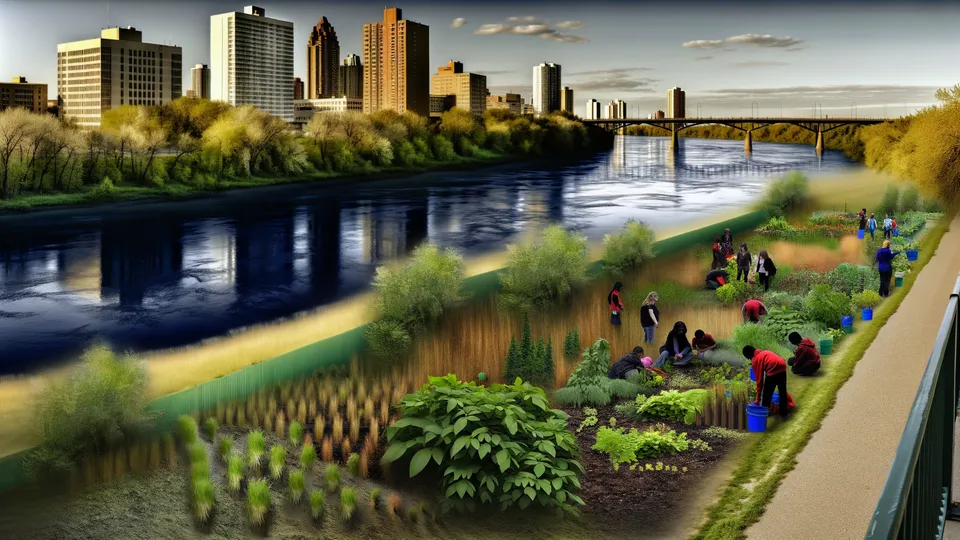
At first light, the Assiniboine looks like a mirror someone forgot to clean: pale, patient, edged in mist. By seven, the riverbank is no longer an unclaimed margin. A group of volunteers—retirees with soil under their fingernails, high school students lugging compost, an Indigenous elder carrying a thermos and stories—are already kneeling in the beds, whispering to seedlings as if coaxing memory into the ground.
This patch of reclaimed riverfront, modest in scale but deliberate in intent, is the heart of the Assiniboine Riverfront Gardens, a neighbourhood-led initiative that stitches together food security, flood mitigation and cultural revival. What began as a handful of raised beds on a flood-prone slope has grown into a network of rain gardens, bioswales, compost hubs and public programming that draws the city and its surrounding communities into a shared, tangible response to a changing climate.
"People come with different reasons," said Marta Sinclair, the project’s coordinator and a former urban planner. "Some want fresh vegetables, some want a place to be outside, some are here because their grandparents tended this land. What ties it all together is that we stopped thinking of the riverbank as something to armor against—and started thinking of it as something to work with."
That philosophical shift is visible in the project's design choices. Where concrete once separated sidewalk from slope, volunteers built a sequence of terraces planted with native sedges, wild rye and chokecherry. Between them, stormwater is slowed and filtered through modest swales and layers of gravel and native soil; during heavy rains the terraces hold and absorb water that would otherwise rush into city drains. A small demonstration site near the pedestrian bridge shows how permeable pavers and a planted bioswale can reduce runoff within a single block.
Local engineering students helped model how these interventions alter peak flows. "It's not magic," said Claire Dubois, a municipal engineer who consults with the gardens. "It's design that respects prairie hydrology. Slowing water down at the edge of urban land reduces pressure on drains and creates renewed space for life." The city has begun to treat the gardens as pilot infrastructure rather than an aesthetic afterthought.
Food production is intentionally modest and communal rather than commercial. Dozens of households participate in shared beds, with surplus distributed through a weekly market stand and a box program for seniors. For many participants, the harvest represents more than calories; it is a place of exchange. "I brought the beans my grandmother showed me how to grow," said Elias Redfern, an elder from a nearby . "We also learned from the kids about new techniques. That mix is making the place stronger."
Youth engagement—through summer internships, school partnerships and apprenticeships in native plant restoration—has become one of the most visible outcomes. Jalen Peters, an eighteen-year-old who started as a volunteer, now runs workshops on composting and soil health. "I used to mow lawns for summer cash," he said. "Now I know how to read soil. It’s work that matters and people notice."
The gardens’ social impact runs parallel to the environmental. Neighbours who once passed each other on morning walks now exchange recipes and shifts at the compost hub. A winter program offers cross-country-ski days and local history talks beneath the riverbank's aged elms; an elder-led medicine-plant walk this spring drew more attendees than any single public lecture the city has hosted all year. "This place makes people stakeholders instead of spectators," Sinclair said.
There are limits and tensions. The volunteer model can strain when heavy maintenance is needed, and securing long-term municipal funding remains a recurring negotiation. Some residents worry about equity—who benefits when prime riverfront space is repurposed? The coalition has tried to answer by reserving beds for elders, newcomers and low-income households, and by documenting maintenance schedules and governance so responsibility doesn't fall just on a few committed volunteers.
Looking forward, the coalition is shifting from ad hoc projects to a networked strategy. Rather than isolated pockets of green infrastructure, the goal is a braided approach across neighbourhoods—linking pocket parks, schoolyards and municipal corridors so stormwater has more places to linger and percolate across the city. Partners hope to formalize apprenticeship pathways for Indigenous land stewardship practices and to measure social returns alongside hydrological gains.
On a late afternoon in June, as the garden's shadows lengthen and the river slumps gold, a tiny boy hands his mother a handful of muddy lettuce. They laugh, negotiate the first bite, and move on toward a bench where several people swap stories about a lost dog and an upcoming harvest dinner. The technical reports and grant applications matter, but so do these ordinary exchanges: small acts of repair that accumulate into something more durable.
The Assiniboine Riverfront Gardens are not a panacea, nor are they meant to be. They are a local experiment—humble, imperfect, human—that offers a different way to live with water and one another: not through hard defenses and distant plans, but through tending, learning and shared work. In a region where weather can feel like a decree, the garden insists on conversation instead.