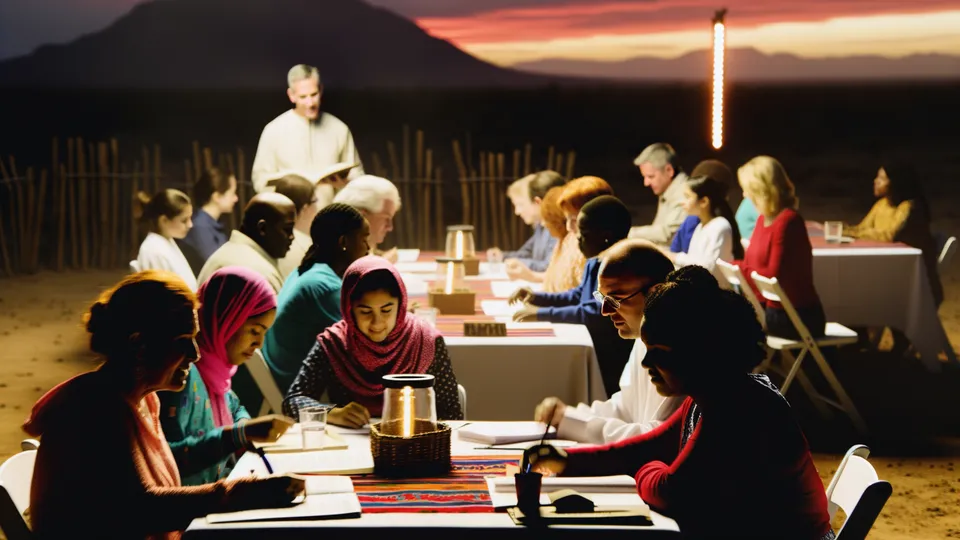
On a raw November evening, the lights in the old gym at King George School stay on long after the last bell. Rows of folding tables are covered with pencil boxes, soldering irons, poetry drafts, and a humming 3D printer. Outside, a bus idles, waiting to take teenagers back to surrounding communities. Inside, a circle of elders leans in as a ten-year-old reads aloud in Cree, pausing to explain a word and then to ask a question about the story's ending. This is not a typical after-school program; it's the pulse of a quietly ambitious experiment in Brandon and the broader Westman region — where learning has been pulled out of its ordinary hours and redesigned to heal, connect, and prepare.
The initiative, called the Westman Learning Collective, began three years ago when a small group of teachers, municipal workers, and elders responded to a string of reports: falling engagement in classrooms, limited access to tutoring across town, and a sense that children were growing up disconnected from local culture and livelihoods. What began as a handful of pilot evenings — literacy circles, homework help, and a weekend 'maker lab' at the library — now meets in school gyms, community centres, and on the lands of Treaty 2 territory. The Collective's programming intentionally links academic coaching with cultural mentorship and practical skills training.
'Most after-school programs patch one hole,' says Maya Sinclair, the Collective's coordinator and a former middle-school teacher. 'We wanted to stitch the whole garment — academic supports, cultural continuity, and real-world skills — into a single fabric that reflects how our families actually live.'
The structure is deliberately porous. A child might begin with math tutoring, drift to a small robotics project, and end the evening in a story circle with Elders. Parents come in for morning adult literacy classes and stay for employment-readiness workshops offered in partnership with Brandon University. Local farmers, tradespeople, and business owners run weekend apprenticeships that let students try carpentry, horticulture, and basic electrical work — tying schooling to local economic life.
Specific successes are easiest to see in moments. Liam, a shy Grade 7 student, struggled with reading and rarely spoke up in class. Over a year of paired reading sessions and storytelling with Elder Evelyn Crowfoot, teachers noticed steadier comprehension and a willingness to present in class. 'He started bringing me his book to the bus,' an after-school volunteer remembers. 'That was the change.' Parents like Sara Ortiz, who immigrated from the Philippines and works two shifts, say the Collective's evening programs made it possible to support homework and to enroll in an ESL-plus-literacy course that led toward credentialing for work as an educational assistant.
There are quieter, systemic shifts as well. Teachers report higher homework completion and improved classroom participation among students who attend the Collective. Attendance at school has a different rhythm now: the gym lights coming on after class has become part of the neighborhood's social calendar, not merely an add-on. Importantly, the initiative reframes deficit conversations: rather than isolating students who need help, it embeds help into communal time that includes parents, Elders, and professionals.
The Collective's partnerships have been essential. A small municipal grant covered startup costs; private foundations provided seed funding for a mobile maker kit; Brandon University contributes evaluation support and student volunteers; Indigenous organizations hold language circles. But is still an open question. 'We don't want to be a project that flickers and goes away,' Sinclair says. 'We're designing for permanence, but permanence requires stable funding and policy that recognizes learning beyond the school day.'
Measurement is evolving alongside programming. Rather than relying only on standardized test scores, the Collective tracks a mix of indicators: reading fluency gains, adult learners' credential progression, apprenticeship placements, and qualitative measures of belonging collected through interviews and storytelling sessions. Early results suggest that children in the program are more likely to take advanced courses, and adult learners are better positioned to pursue stable work. Those are promising signals, though Sinclair cautions that long-term evaluation will require multi-year commitment.
The initiative's most durable asset may be intangible: relationships. In an era where community bonds have been strained by economic shifts and uneven services, the Collective stitches together generations and systems. An elder explained the local river's seasonal cycles to a group of kids, who later built a scale model for a science fair. A former carpenter mentored a teen who now apprentices at a shop downtown. These moments ripple outward, altering expectations about who belongs in a classroom, and what counts as preparation for life.
Looking ahead, the Collective aims to deepen partnerships with rural schools across Westman, offer more paid positions to community educators, and advocate for provincial recognition of community learning hours as part of students' records. The ambition is not to replace the classroom but to broaden its perimeter — to allow learning to happen in kitchens, farms, shops, and around firesides.
What began as an afterthought to the school day has, in quiet and persistent ways, reframed how a region thinks about education. For the families in Brandon and its neighboring towns, the change is practical and human: more confidence at the homework table, more voices in the classroom, and a sense that the knowledge carried by Elders and tradespeople belongs beside algebra and essay writing. In doing so, the Westman Learning Collective offers a modest blueprint: education that is academically rigorous, culturally anchored, and woven into the rhythms of everyday life.