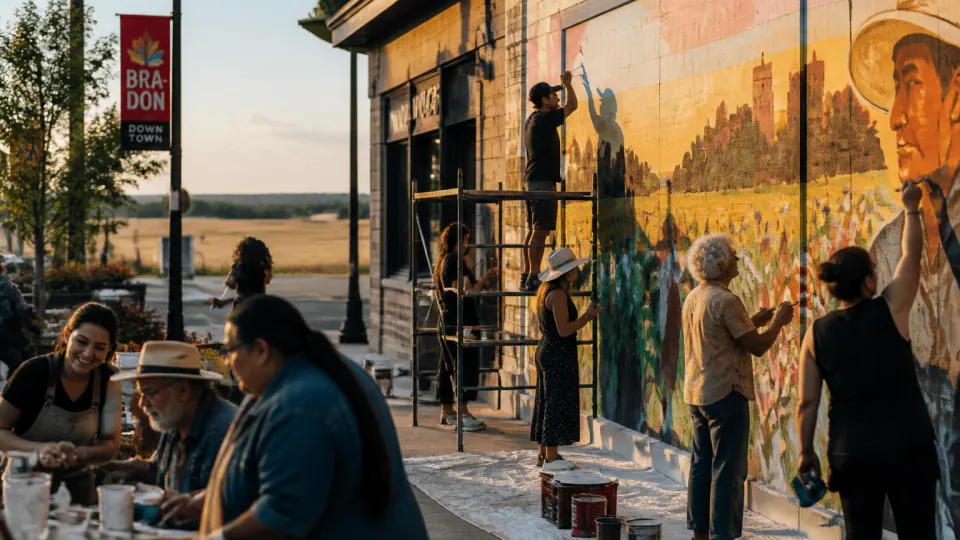
On a damp Tuesday morning in downtown Brandon, a half-dozen people stood on folding stools and ladders, their voices rising above the metallic clatter of scaffolding and the distant hum of delivery trucks. They were painting a mural across two boarded-up windows that, until six weeks earlier, had been an empty storefront left to the weather. Beneath broad strokes of cobalt and ochre, they had painted the curve of the Assiniboine River and a row of hands—each pair different: a child's small, a fisherman's knotted and scarred, a university student's long and neat.
The mural belongs to the Prairie Thread Collective, a volunteer-run initiative that has spent the last three years turning forgotten commercial facades into sites of art, learning and commerce. What began as weekend pop-ups and a few cheaply stretched canvases has become a coordinated program of workshops, artist residencies and storefront takeovers that animate Brandon's downtown on otherwise quiet afternoons.
'We didn't start with a master plan,' says Thomas Delorme, the project's coordinator, as he rinses brushes in a plastic tub. 'We started with a belief that people wanted to make things in public again. The rest followed—the relationships, the programming, the sense that this city could breathe a little differently.'
Prairie Thread's interventions are intentionally low-tech and high-relationship. One of its most popular offerings is the Window Gallery: an artist moves into a once-empty window for a week, curates small-priced works, and opens the space for conversations with passersby. Another program, 'Stitching Stories,' pairs university art students with residents from nearby elder-care homes to share embroidery techniques and recorded narratives. The resulting quilts, stitched in public sessions on market days, have hung in storefronts as living exhibitions.
The human element is where the project's impact is most visible. Evelyn Cartwright, 78, a retired school secretary, describes the quilting workshops as an unexpected remedy for loneliness. 'I used to sit and watch the clock,' she says, holding a square of fabric she embroidered with a small cornflower. 'Now people stop on the sidewalk, ask me about the pattern, tell me about their mother. It's ordinary, but it matters.'
For local artists, Prairie Thread offers more than a place to show work; it offers audience and context. Maya Singh, who teaches printmaking at Brandon University and recently completed a monthlong residency, recalls why she accepted an invitation to work in a storefront rather than a studio. 'When you make work in public, it becomes a conversation. I printed posters of local recipes and invited people to paste them onto a communal wall. A cook I'd never met ended up teaching me how to shape bannock. Those exchanges informed the pieces I made.'
The relationship with Brandon University has been crucial to the initiative's sustainability. Faculty and students contribute material, host critique nights in cafes that double as temporary galleries, and provide research help; in turn, the city gains a pipeline of emerging designers and technicians. Local merchants have been more ambivalent. Some have welcomed the increased foot traffic; others worry about the longevity of an arts economy built on short-term activations. Prairie Thread has tried to address those concerns by helping small businesses curate window exhibitions that align with their commercial calendars—bakers host cake-decorating demos, barbers display portrait work, hardware stores run tool-themed sculpture shows.
Economic uplift was never the sole aim, but it has been a measurable byproduct. Restaurants report busier afternoons on installation days, and one once-empty boutique rented its space after months of negotiation following a three-week artist residency that drew regular visitors. The result is neither boom nor miracle; it is a steady accretion of attention and purpose—a small change in how people move through downtown.
Prairie Thread's work has not been without friction. Municipal regulations about signage and temporary structures required patient negotiation. Some residents have criticized the aesthetic choices of certain murals. Funding remains patchwork: small municipal microgrants, donations from local businesses, and a recurring crowdfunding drive that buys paint and pays modest stipends to older artists. Delorme is candid about the fragility of the model. 'We have momentum now, but it's not institutionalized. A few key grants, a permanent workshop, and we'd be able to plan beyond the season.'
The collective's next step is deliberately structural. Working with a coalition of downtown merchants and university researchers, Prairie Thread is applying for provincial arts funding to convert a former warehouse into a mixed-use creative hub. The space would host a residency program, a materials library, and a shared studio for craftspeople whose work today is fragmented across basements and kitchen tables. Importantly, the proposal centers accessibility: sliding scale studio fees, free hours for seniors, and pop-up childcare during evening programming. 'If we can build a kind of civic workshop,' Delorme says, 'we're not just decorating the city. We're investing in its capacity to make.'
What makes the initiative quietly radical is not its murals or markets, but its insistence that art be ordinary and useful—an everyday language for people who rarely see themselves in a gallery. In a region where winters are long and economic life is often uncertain, those ordinary encounters accumulate trust.
As the sun broke through the cloud that morning, a child reached up and traced a painted hand, giggling. Across the street, a coffee shop owner counted new faces among his regulars. The mural remains a work in progress; some paint would flake, a seam might not quite line up. But the scene felt more durable than perfection: a group of neighbors making something together, and in the process, making a little more of the place they all called home.
In the end, Prairie Thread's story is ordinary in the best sense—incremental, human, and forward-looking. Its ambition is not to remake Brandon at once but to make space for the kinds of experiments that, given time and modest support, change how a city remembers and imagines itself. That, perhaps, is the truest measure of cultural work on the prairie: not the attention it draws, but the new kinds of civic life it quietly helps to grow.