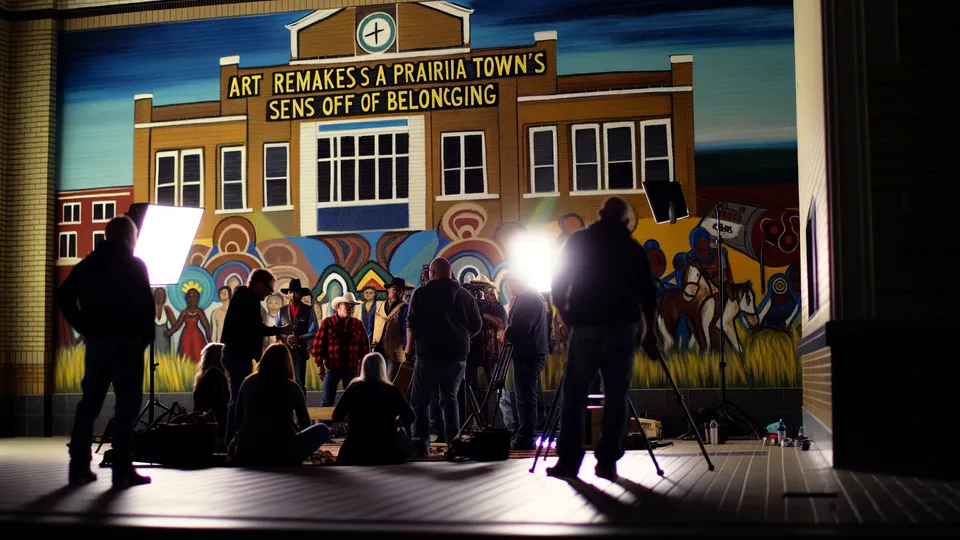
On an October morning, under a sky the colour of pewter, a crew of painters takes over a block of Rosser Avenue. Ladders lean against a century-old brick façade, rollers and brushes pass between weathered hands and new ones still callused from first-year studio work. People stop to ask questions, to offer coffee, to point out a childhood memory of the building now being transformed into a mural. The scene could be any small-city arts project—except that here it is also a conversation across generations, a negotiation with history, and an investment in how a prairie city imagines its future.
Brandon, Manitoba, sits at an inflection point. Once understood primarily as an agricultural service centre, the city and its Westman hinterland are quietly redefining themselves through cultural work. At its centre are collaborations: between Brandon University students and professors, artists who have returned from larger centres, Indigenous knowledge-keepers, and community organizations like the Art Gallery of Southwestern Manitoba. The result is not merely prettier facades; it is a changing rhythm of public life.
The mural project on Rosser is emblematic. Conceived as a public-art initiative to animate downtown and create opportunities for young artists, the mural began with a series of listening sessions. Organizers invited neighbours, shopkeepers, elders and students to describe images, stories and tensions they wanted acknowledged. "We didn't want art dropped on the street," says the gallery's outreach coordinator. "We wanted the wall to say something that feels true to people who live here."
Those listening sessions yielded a composite: prairie horizons interlaced with river imagery, agricultural motifs reimagined alongside Métis beadwork patterns. One panel, painted in consultation with an Indigenous elder, incorporates a wampum-like sequence to acknowledge treaty histories—subtle, not didactic, visible if you know how to look. For many residents the mural has become a site of memory and civic pride; for others it is an invitation to ask why certain stories are visible while others remain hidden.
Partnerships with Brandon University alter the dynamic further. Students in visual and performing arts classes are no longer training in isolation—faculty now build curricular projects that place students in community contexts. A theatre production last spring staged in a repurposed warehouse featured a cast of local non-professionals alongside university actors, drawing attention not only to local talent but to the city’s capacity for creative reuse. In the aftermath, several participants reported renewed interest in community engagement and a stronger desire to stay in Brandon after graduation.
Music remains central to the region’s cultural life. The Brandon Folk Music Festival and a constellation of smaller concerts and open-mic nights provide economic lift—hotels, restaurants and artists benefit when visitors come for performances. For local musicians, these events are also a proving ground: one young songwriter described how a set at a downtown café led to a small regional tour and a steady stream of commissions for murals and album artwork. In the slow churn of prairie life, these moments create momentum.
The social impact is palpable. Arts programming centered on youth has become a refuge and a launchpad. Workshops that teach mural painting, songwriting, or zine-making offer teenagers a way to reframe the narrative about what it means to grow up in Westman. Community members describe a drop in vandalism where murals have appeared and a new kind of foot traffic—students staying late in the library, families lingering after a gallery opening—that changes how retail and public spaces feel.
Challenges remain. Funding for arts organizations is often competitive and precarious; public infrastructure like the ageing auditorium requires capital that small municipalities struggle to raise. Affordable studio space is scarce, pushing artists to juggle multiple jobs or to relocate. The question locally is not whether culture matters—residents and civic leaders agree that it does—but how to make cultural investment sustainable and inclusive.
Looking forward, the most compelling prospect is the slow institutionalization of what was once ad hoc. Conversations are underway about a cultural hub that would combine exhibition space, rehearsal rooms, and affordable studios—an ecosystem that might keep emerging artists in Brandon and attract touring artists to the region. Equally important is the deepening of Indigenous partnerships that position First Nations and Métis narratives not as adjuncts but as central to the city's cultural life.
At the mural site, a child traces a painted river with a sticky finger and laughs when an elder pretends to scold him. The mural will fade and be repainted; the buildings will change hands, and the businesses that sponsor initiatives will come and go. But the pattern of collaboration—artists working with schools, elders sitting at planning tables, students gaining practical experience—creates a durable architecture of civic belonging. In a place whose landscapes are often described in broad strokes, these small, patient interventions are remaking stories at the human scale: who belongs, who gets to tell what happened here, and what a prairie town might become next.
For Brandon and the Westman region, the contestable terrain is now less about whether culture can matter and more about how to sustain it. If the recent projects are any indication, the answer will be found in a mix of grassroots ingenuity, institutional backing, and a willingness to let art be messy—and profoundly public—work.