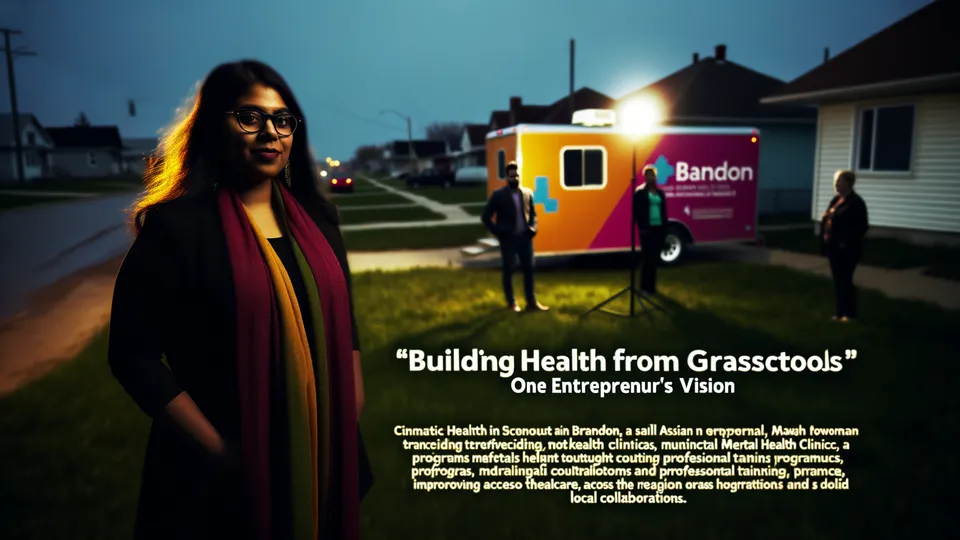
On a January morning when the prairie sky split open in a single, hard blue, a white van idled beside a curling two-lane highway outside Minnedosa. Steam rose from the radiator; inside, a small sign on the dashboard read PRAIRIE HEALTH COLLECTIVE. Maya Sinclair tightened her scarf, flipped the van’s heater to high, and checked the day’s schedule: three school-based sessions on anxiety management, a pop-up reproductive health clinic in the community hall, and a late visit with an elderly farmer who had been unable to travel to Brandon for months.
Sinclair’s route looks like much of the Westman region: long distances, sparse public transit, and a patchwork of clinics that struggle to meet demand. It’s a landscape of practical needs, but also of relationships—neighbors, community boards, school principals—where trust is earned slowly. That is the terrain she has learned to map.
Prairie Health Collective, the social enterprise Sinclair founded in 2017, began as a modest experiment in outreach. Trained earlier as a community nurse and then working in program development, Sinclair watched patients fall through logistical cracks: missed appointments, long waits for mental health care, and preventive services that never reached small towns. She wanted a model that could move with the people it served.
"Our goal was never to replace the health system," Sinclair told me over coffee in a cluttered office above a bakery in downtown Brandon. "It was to stitch ourselves into it—where the seams were coming undone."
The Collective’s flagship effort is a mobile clinic retrofitted into a van that functions as a primary care and counseling room. It visits towns on a predictable rotation so residents know when it will be nearby. The van’s visits are coordinated with local schools and community centres to provide low-barrier services: sexual-health education for teenagers, chronic disease check-ins for older adults, and immediate counselling for residents who might otherwise wait months for an appointment.
Beyond the van, Sinclair’s team has pioneered a network of telehealth booths hosted in municipal halls and libraries. These booths—soundproof, connected rooms with nurse facilitators—allow a resident to consult a distant psychiatrist or a specialist in Brandon without the hours-long drive. "It felt like someone finally gave us a room where we could talk and be heard," said Evelyn Martin, 68, who lives on a mixed grain farm near Carberry. She used the booth to follow up with a mental-health therapist after losing her husband; the convenience, she says, kept her engaged in care.
The Collective has also trained local community health workers—often the people who already hold neighbors together: a school secretary, a retired paramedic, a church elder—to perform basic screening, navigate referrals, and reduce stigma around seeking help. Training includes practical modules: identifying depression in older men, supporting parents of anxious children, and administering basic wound care until a clinic appointment is available.
Specific choices reveal Sinclair’s pragmatic ethic. Rather than hire exclusively clinical staff, the Collective hires for community knowledge and curiosity, then pairs those hires with clinicians from Brandon Regional Health Centre and volunteer specialists. Partnerships are formal where necessary, informal where trust matters more. The result is a constellation of services that, according to local practitioners, has reduced unnecessary emergency-room visits and kept more patients engaged in scheduled care.
"It's about lowering friction," said Dr. Alan Reeves, a family physician in Brandon who has collaborated with the Collective on pediatric outreach. "When people can get a follow-up in their community, they actually show up. It saves system costs and, more importantly, it keeps families healthier."
The human impact is easiest to see in small moments: a teenage girl who used the van’s confidential services to access contraception, a dairy worker who received diabetes education without missing a day’s pay, a Métis outreach worker who helped reconcile care plans with cultural supports. For many residents, the Collective has been less a program than an extension of neighbors' goodwill—practical, discreet, and reliable.
Yet Sinclair knows the limits. Funding remains a chronic challenge. The Collective blends grants, fee-for-service partnerships, and a small social-enterprise café whose profits subsidize outreach days. Policy barriers—data-sharing restrictions, licensure rules for cross-community practice, and the brittle nature of short-term funding—make scaling difficult. Sinclair is candid about the trade-offs. "We've learned to hold two things at once: be ambitious about access, but realistic about what can be sustained without steady funding," she says.
Looking forward, Sinclair imagines a more integrated model: interoperable data systems that protect privacy while allowing smoother referrals; provincial support for mobile and community-based roles; and a cohort-based training program that could seed similar initiatives across rural Manitoba. Her ambition is not to build an empire but to demonstrate practices that can be adopted by public systems and community groups alike.
The van pulled away from Minnedosa that afternoon and climbed back onto the highway, its heated seats carrying the recycled air of expertise and small-town stories. For Westman’s dispersed population, Sinclair’s work is less about novelty than about consistency—returning to the same halls, offering the same kindness, and proving that healthcare can move toward people who have long been left behind. In a region where distance often defines possibility, that steady return can be transformative.
If the test of an entrepreneur is whether an idea survives its second winter, then Sinclair’s work is passing, in small, practical increments. Her challenge now is to convert those increments into policy and partnerships that outlast any one person’s energy. For residents who have received a blood pressure check at a kitchen table or accessed grief counselling without an overnight trip, the difference is already clear: care that arrives on time, in the right place, and with someone who knows your name.