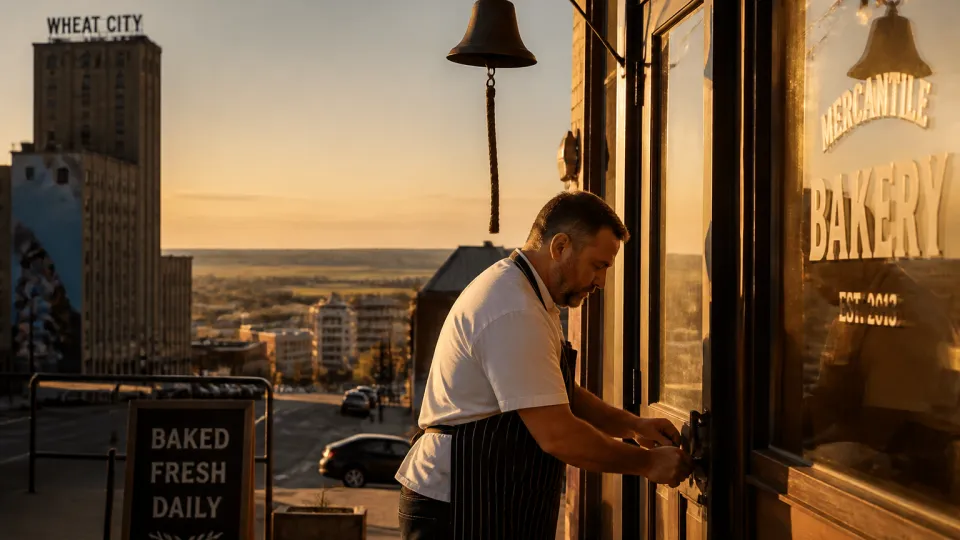
In the early light of a prairie morning, a man unlocks the heavy glass door of a small hardware store on Rosser Avenue. The bell over the door has been the same for decades; the list of things people ask for has not. What has changed is how the owner responds: online ordering, curbside pickup, a neighborhood repair clinic on Saturday afternoons. These modest shifts—part instinct, part necessity—are how Brandon and the wider Westman region have rewritten the playbook for local business.
This is not a story of sudden disruptors arriving from Silicon Valley. It is the layered history of adaptation: credit cooperatives extending risk-tolerant loans to first-time farmers; a downtown brewery learning to can and ship when festivals vanished; a municipal economic-development office that stopped writing reports and started matching makers with makers. Taken together, these moves amount to a quiet revolution in how commerce supports life.
One of the region’s clearest institutional stories is that of the local credit union. Long before online banking, the co-operative model in Westman was an engine for locally informed lending. In recent decades, that institutional ethos became a platform for experimentation. Within a conservative regulatory context, the credit-union system in Brandon added digital services that preserved the relationship-building work of the teller while reaching younger, mobile members. "We were learning to serve multiple generations at once," a long-serving staff member recalled. "You still help someone balance a cheque book, but you also help a small business list inventory online."
The agricultural economy—always the backbone of Westman—has been central to this . Local grain elevators and farm suppliers, once purely transactional, began offering bundled services: equipment rentals, co-op marketing for small-acreage producers, and shared storage for value-added processing. These adaptations mattered most when commodity prices dipped. By organizing along cooperative lines or by building service margins instead of simply relying on bulk sales, businesses reduced vulnerability across a wide rural hinterland.
Downtown Brandon has been both beneficiary and laboratory for change. Wheat City Brewing, a small craft brewery that started as a neighborhood taproom, exemplifies a nimble local enterprise. When large gatherings disappeared in 2020, the brewery accelerated a plan to can its beer and sell through broader retail channels. That shift required new supply-chain thinking, new branding work and, crucially, new partnerships with independent grocers and delivery services across Manitoba. The immediate payoff was financial survival; the broader effect was a stronger link between the downtown physical place and the region it serves.
Equally important are the countless family shops whose names never make provincial headlines but whose decisions shape everyday life. One third-generation grocer on Princess Avenue began hosting weekly "meet-the-producer" nights, connecting local produce growers with city shoppers. A downtown seamstress reinvested her modest savings in a small CNC machine to prototype masks and then community theatre costumes, a move that kept her doors open and forged new clientele in neighbouring towns. These are not dramatic tales of scale; they are iterative, human acts of reimagining what a shop can offer.
Public actors have mattered, too. Economic Development Brandon and similar organizations in the region moved from providing grants and promotional materials to convening practical coalitions: incubator space for digital entrepreneurs, cross-training programs for retail employees learning e-commerce fulfillment, and low-interest loan pools for storefront revitalizations. Those interventions are less glamorous than venture capital, but they have been effective because they align with how people here value reciprocity and long-term place attachment.
A recurring theme is the role of relationships. In interviews and community conversations, entrepreneurs emphasize that innovation in Westman is less often about inventing a product than about inventing a relationship—between banker and borrower, farmer and processor, brewer and grocer. "You can’t just drop a tech platform into this economy and call it innovation," one local economic planner observed. "The needs to be embedded in existing trust networks. That’s where it scales."
Looking forward, the region faces familiar challenges—population retention, labour shortages, and climate variability—but also clear assets. The same cooperative instincts that smoothed past transitions position Brandon to be a hub for distributed processing, small-batch manufacturing, and service models that stitch urban and rural needs together. The next phase of innovation is likely to be hybrid: digital tools layered over deeply local knowledge, shared infrastructure financed by local institutions, and a new generation of entrepreneurs who grew up in Westman but learned to speak the language of remote markets.
If there is a lesson in this history, it is not that small towns must imitate big-city models but that they must be deliberate about the forms of change they choose. The quiet revolution in Brandon and across Westman has been quiet precisely because it is pragmatic—an accumulation of small choices that preserved capacity and dignity. Those choices, repeated, reinvented not only businesses but the social scaffolding that supports them. And in that, there is something stubbornly hopeful: the future of local enterprise here will be built less on novelty and more on the learned art of adaptation.