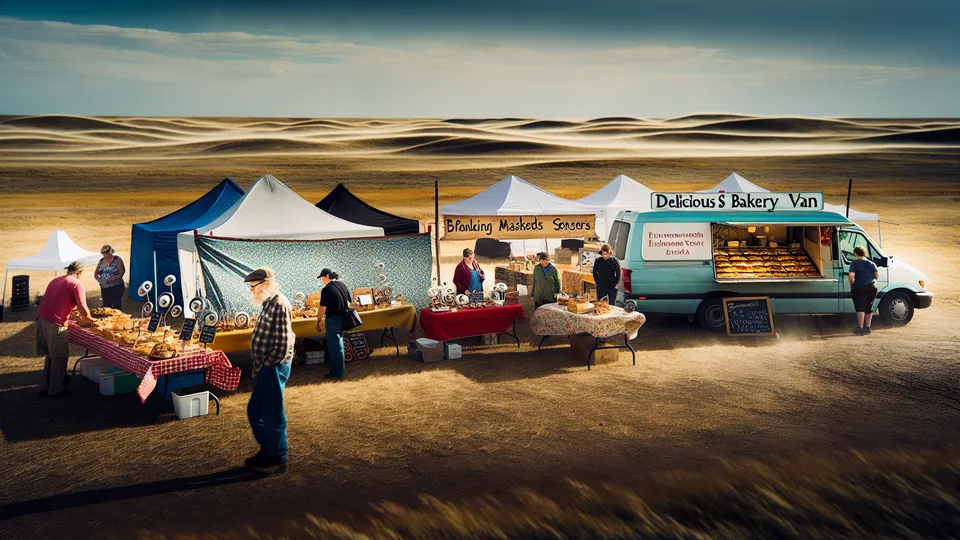
On a wind-scoured Saturday in early June, the covered stalls at the Brandon Farmers' Market smell of coffee and fresh rhubarb. Among the familiar faces—retirees swapping gardening tips, young parents balancing infants and baskets—are a different breed of vendors: a software developer selling sensors for soil moisture, a former grain elevator operator with a line of artisanal pickles, and an Indigenous co-op offering bannock baked with locally milled flour.
They are not outliers. They are, in many ways, the visible end of a quieter restructuring that has been under way across Westman: that does not simply imitate urban models but reshapes itself around local assets, obligations and the particular constraints of rural life.
"Growing up here, you learn to build things because you have to," says Maya Singh, 33, who runs WildRoot AgTech from a converted office behind her parents' home in Brandon. "But it's not just about for its own sake—it's about keeping value here. If my sensors keep a third-generation farm from going under, that's success in a way that wouldn't translate the same way in Toronto."
Singh's company started as a capstone project at Brandon University and has since sold a modest number of sensors to farms in the region. The devices are low-cost and rugged; the software is intentionally simple so it can be operated by someone who learned computer skills on a laptop in the library. WildRoot's growth has been incremental, but it has multiplied other impacts: Singh partners with a local machine shop for casings, hires seasonal students, and offers workshops at the farmers' market to demystify data for older operators.
Across town in a former feed store, Riverbend Foods demonstrates another trajectory. Founded by siblings who returned after careers in Winnipeg and Calgary, the company processes specialty grains and legumes into shelf-stable products for regional grocery stores and online customers. "We knew we couldn't beat commodity prices," says co-founder Elias Carter, "so we leaned into craft, traceability and relationships. That meant sourcing locally, paying farmers a bit more, and building our brand around that trust."
Riverbend has created a handful of year-round jobs and a dozen seasonal positions. More importantly, their contracts have provided predictable income for local growers, allowing some to diversify seed rotations and experiment with new crops. Their model shows how value-added processing, coupled with transparent supply chains, can rework the economic geometry of a rural region.
Indigenous entrepreneurship is quietly reshaping community economies as well. In the nearby town of Swan Lake, the Yellow Willow Cooperative formed in response to decades of underemployment. The co-op runs a garden-to-table program that hires young people for land stewardship and culinary training, sells produce to local schools, and operates a small mobile kitchen that serves events and elders. "It's been a way to connect land, language and livelihoods," says co-op coordinator Leona Whitebear. "People here talk about resilience differently. For us, business is a way to restore relationships."
None of these ventures are silver bullets. Common challenges—thin local capital markets, difficulties accessing scale, a chronic shortage of skilled labour in specialized roles—remain. Entrepreneurs in Westman routinely juggle three jobs: running the business, networking for contracts, and doing the day-to-day work of production. Broadband gaps, although narrowing, still make remote hiring and cloud-dependent services more complicated than they are in cities.
But what stands out is the way entrepreneurs and institutions are responding through place-based strategies. Brandon University has expanded mentorship programs and practicum partnerships that keep talent in the region. Municipalities are experimenting with small-grant loan pools and expedited permitting for adaptive reuse of buildings. Local credit unions and community investors are creating hybrid financing instruments that accept slower returns in exchange for more visible social benefits.
These strategies amplify something less tangible: social capital. "In a small town, your customers are also your cousins and your school board members," says Carter. "That creates accountability. It also means your reputational capital is a resource." Entrepreneurs in the region talk less about disruption and more about durability—businesses that can survive seasonal swings, weather events, and the ebb of farm incomes.
Looking forward, the shape of rural entrepreneurship in Westman will depend on networks rather than lone founders. Shared processing facilities, cooperative marketing, and distributed manufacturing—small-scale, locally governed infrastructure—offer a way to capture more value within the region. Climate pressures will force faster innovation in crop choices and water management, and those who can translate local knowledge into practical, scalable solutions will find demand.
If there is a common thread, it is this: entrepreneurship here is embedded. It emerges from conversations at the farmers' market and late-night jamborees at the curling club. It is animated by a determination not simply to survive, but to remake economies so that young people can choose to stay, return, or arrive anew.
"We don't pretend it's easy," says Maya Singh, watching the market thin as clouds gather. "But when a farmer texts you at midnight because your sensor saved a field, that's not just revenue. That's why we keep building here. It's for the folks who will look after this place after we're gone."