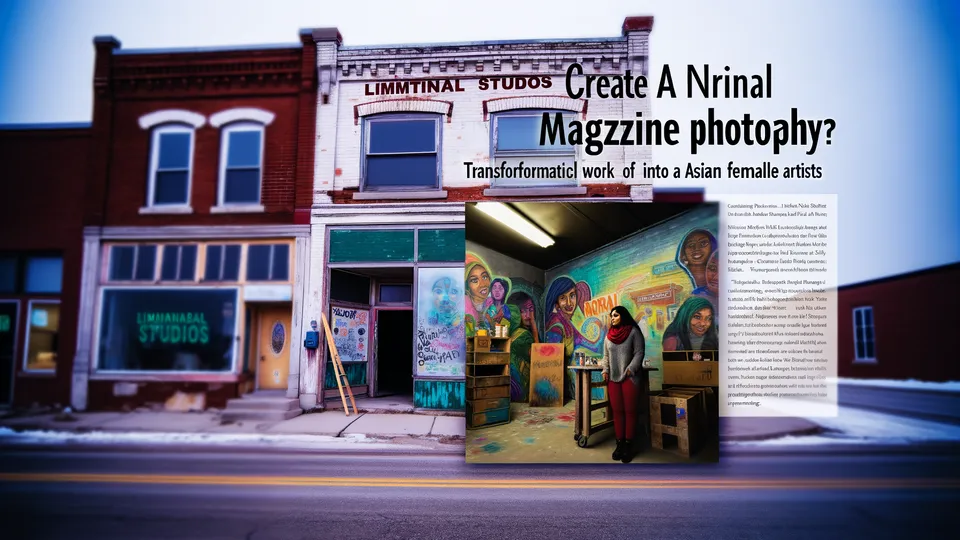
At 6:30 a.m., long before the businesses along Princess Avenue flip their signs, a ladder rests against a brick wall and a radio hums low. Nora Patel stands with a roller in one hand and a sketchbook tucked under her elbow, tracing the outline of prairie grasses the size of a child's memory. Her gloves are spattered with the same ochres and blues that tracked into the studio hours earlier when teenagers from the nearby high school arrived for a Saturday mural workshop.
“It’s not about the paint,” she said, stepping down to hand a brush to a young participant. “It’s about making a place where people can feel they belong to the work.” That sentence — matter-of-fact and unornamented — is the throughline of Patel’s nine-year project in Brandon: Liminal Studios, a reclaimed storefront that now functions as gallery, workspace, classroom and civic forum.
The transformation was incremental and stubborn. Patel came to Brandon a decade ago with a studio practice and a handful of small grants, trained in printmaking and community arts facilitation. Where other young artists looked to larger cities, she saw a network of possibilities in the Westman region: empty retail space, a patchwork of community halls, and a public appetite for projects that felt local rather than imported. She negotiated rent that allowed for evening classes, persuaded a neighbouring café to host artist talks, and used modest community donations to fund visiting residencies.
Liminal’s programming reads like a neighborhood choreography. There are weekly life-drawing nights that subsidize studio rental for emerging artists, a “First Brush” apprenticeship pairing high-school students with working painters during summer, and a Mobile Story Booth — a converted bookstore cart that visits community fairs and records oral histories. Last year, Patel and her collaborators brought more than 200 participants through hands-on workshops and public events, with a third of those attendees under twenty-five.
Concrete examples reveal how the studio reshaped ordinary civic life. When the city council debated the fate of a faded municipal wall, it was Liminal that proposed a mural-focused public consultation, inviting elders, farmers and students to pin sketches on a community board. The mural that emerged—an interwoven field of grasses and railway ties—was painted in days and became a backdrop for weddings, graduation photos and class trips. A local diner reported unprompted increases in weekend foot traffic; a new florist chose a storefront next door. Those are small economic ripples, but they reflect a different relationship to downtown: people returning, staying, participating.
Patel is careful not to conflate cultural vitality with easy metrics. “You can’t just count brushes and show receipts,” she told me, wiping a streak of cobalt from her thumb. “You have to look at conversations that start in a line at the studio door, or the kid who opens up about the first thing she’s made that isn’t judged.” Still, she recognizes that requires structure. Liminal’s revenues come from a mix of class fees, modest sales commissions, and project grants; the studio also runs a co-op model for studio renters, which has allowed a dozen artists to afford steady work and benefits through shared resources.
Crucially, Patel prioritized partnerships. She developed curricula with local teachers, organized residencies with visiting Indigenous artists to ensure programming welcomed and amplified diverse voices, and created an internship pipeline with Brandon University that helped graduates test the leap between campus and community. That collaborative ethos has, in practical terms, expanded the resource base for culture across the region — not simply by delivering programming, but by teaching organizations how to host and sustain art themselves.
But there have been setbacks. Funding cycles are volatile, and the studio has weathered seasons when classes dwindled and grants lagged. There is also the ongoing conversation about who benefits when neighborhoods renew: Patel defers to the community on matters of scale and aims to avoid displacing the very people who animate the streets.
Looking forward, Patel designs with humility. She is sketching plans for a satellite program that would bring workshops to smaller towns in Westman, a travelling studio that can fit into a community hall or a school gym. She is advocating for municipal policies that give artists access to affordable long-term leases and to small performance fees when public spaces are used for cultural events. Her goals are pragmatic: not to remake Brandon in an artsy image, but to embed practices that make cultural work less precarious and more visible.
In the mid-morning light, as children chase a loose dog and an elderly man offers a thumbs-up to a freshly painted section, the mural becomes less an artwork and more a ledger of encounters. Liminal Clinics, community art nights, and public consultations have not generated overnight prosperity. But they have re-aligned time and place — converting slow afternoons into rehearsal spaces, marginal storefronts into rehearsal stages, and private practice into a shared craft. For a town that has often been described in seasonal terms, that shift feels like an invitation to a year-round conversation.
Patel does not romanticize the work. She knows it is iterative, sometimes flawed, and always contingent on many small acts of faith. Yet when the studio door opens and someone unfamiliar steps inside, she smiles in a way that suggests the work has already started to take root. “What I hope for,” she says, “is that when someone imagines what’s possible here, they see themselves in it.” It is an unassuming ambition, and perhaps for that reason, quietly catalytic: the slow, careful remaking of cultural life in Westman, one mural, one workshop, one month at a time.